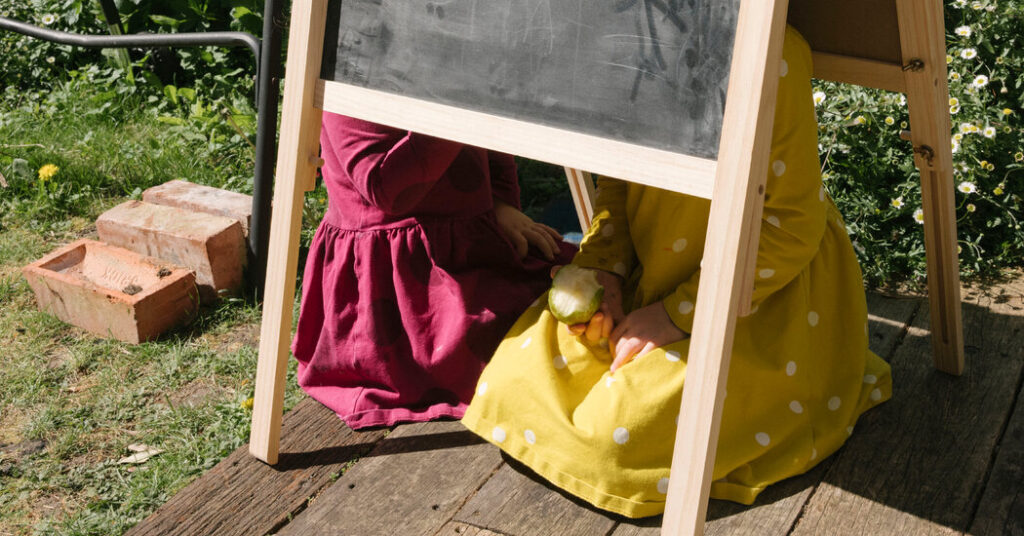
By my third year of home-schooling — in 1994, when I was 12 — Mom’s project of turning me back into an infant was nearly complete.
Ever since she’d pulled me out of school, she had been applying lighteners and hydrogen peroxide to restore my brownish hair to the bright blonde of its baby color. After reading that a crawling phase might help an infant develop fine motor control, she determined that, even at age 12, it might not be too late for me to crawl my way to better handwriting.
She had me crawl whenever I was at home, which was most of the time. Mom home schooled me between fourth and eighth grades, and even today, as a parent who has come to see plainly how damaging those years were, I know that she believed that her choice was in my best interest.
It was the lack of state oversight or standards that allowed our situation. It was the laws that failed me. Today, as home-schooling numbers continue to surge, similar laws fail to protect millions of kids.
Mom called what we did “unschooling,” a concept championed by the home-schooling pioneer John Holt. She agreed with his assertion that “schools are bad places for kids,” or at least for a certain kind of kid; my brother Aaron, she decided, was better suited for public school and was sent off on the bus each morning.
I, on the other hand, was a “creative global learner,” and Mom said that she was going to give me a “free-form education” in order to “pursue passions.” Other than math, which I began to do by correspondence course, I mostly spent my days with her visiting shops, libraries and restaurants of our rapidly-growing suburb, or else having “project time” — drawing superheroes, rereading my David Macaulay and Roald Dahl books, or writing short stories by the pool as Mom reapplied my hair bleach.
Mom had been going through a hard time — ever since we’d moved to Plano, Texas, her social life was dim, her career as a children’s magazine editor had been put on hiatus, and her own mother had begun a long decline into dementia — but my presence by her side seemed to lift her spirits. “You are better than any grown-up, Stef. You are more than all I need,” she told me.
I felt proud to help her, but silently I worried. The longer I spent at home with her (Dad was at work five days a week), the more impossible it seemed that I might ever go back into the world. I knew how badly my return to school would hurt her, and increasingly school seemed to me a terrifying place. I’d mostly lost my friendships from my old school, and my few attempts to re-enter the land of other kids had been failures; after just a day or two at a Boy Scout camp, I’d actively tried to contract conjunctivitis so that I could be sent home early.
Sometimes, flipping through one of my brother’s old textbooks, I’d see how far behind I’d already fallen. But who could I speak with about any of that?
As the years passed, my isolation deepened. My mom needed to take on part-time work, so now I largely spent my afternoons alone in my room, where there was no one to witness the long AOL Instant Messenger romance I carried on with a supposed teenage girl, who in fact turned out to be an older sexual predator. No one noticed the track of scars I’d been making on my hip with the tip of a compass. No one saw how I’d spend countless hours alone in my room with a portable TV inches from my face, wanting to disappear into the worlds onscreen.
Not once, in the four and a half years I spent at home, did anyone from the state come to assess what sort of education I was receiving, or even just to check on me.
I didn’t know it at the time, but our home-school had fallen into a newly legislated invisible space, where a child could easily vanish from public view. For much of the 20th century, the law was essentially silent with regard to home-schooling. The 1972 Supreme Court case of Wisconsin v. Yoder granted Amish parents the right to withdraw their children from school after eighth grade due to unique religious beliefs and practices, but the U.S. Supreme Court has never specifically addressed a constitutional right to home-schooling in general.
In the absence of any federal law or Supreme Court decision, home-schooling regulation was left to the states. In large part driven by fundamentalist Christian lobby groups like the Home School Legal Defense Association (H.S.L.D.A.), home-schooling had become formally legalized in nearly every state by the time Mom pulled me out of school in the 1990s. Over the following three decades, H.S.L.D.A. and an associated network of smaller organizations have been staggeringly successful in furthering their anti-regulation agenda and quashing dissent. Current home-school laws still differ by state, but in nearly all states the lack of oversight beggars belief.
In 48 states, registered sex offenders and adults with a conviction of crimes against minors can still home-school a child, effectively removing the child from the observation of other adults and peers, even if that child’s safety is under active investigation by child protective services. In 12 states (including Texas), parents aren’t required to submit any documentation to home-school. They can simply remove a child from school, and then they will no longer be subject to any mandatory state assessments or contact with officials. In another 17 states, families are required only to provide notice to the state of their intention to home-school, but they too face no state-mandated assessments.
In 19 of the 21 remaining states that do have laws requiring assessments of home-schooled children, the laws are not enforced in all home-schooling situations. In 49 states, home-schooling parents are not required to have their children screened for medical issues or ensure that they receive care. In 40 states, home-schooling parents are not required to have a high school diploma.
As the number of home-schoolers has surged — around half a million when I was a kid, driven to around 3.5 million since the pandemic — the country has passively endorsed a nationwide system of blind spots, where the fate of home-schooled children has been left almost entirely to their parents. States continue to allow parents to operate with little or no oversight, resigning the fates of millions of kids to the assumption that parents know best, even if evidence abounds that this is not always the case.
An online project called “Homeschooling’s Invisible Children” has documented hundreds of heinous cases of children whose neglect and physical and sexual abuse ultimately resulted in their death. But home-schooling abuse also takes subtler and more pernicious forms.
Legal definitions of abuse vary, but the choice to isolate a child from peers and outsiders seems to me plainly abusive. I would also characterize as abuse a parent’s decision to limit a child’s access to learning materials, or to indoctrinate a child into one mind-set or ideology without the possibility of other perspectives, or to willingly limit a child’s ability to function in a larger society.
Each home-school is different, and of course most home-schooling parents do not abuse or neglect their children. Indeed, for many parents, the choice to home-school is about prioritizing a child’s safety and better meeting a child’s special learning needs.
But what home-schooling experiences — good or bad — have in common is that they remove what schools provide: a place where children learn and are with one another, a place where adults outside the home interact with children and can intervene on a child’s behalf, and also a transparent, public minimum standard of education.
In a few states, laws offer some protections against home-schooled children losing ground academically — in New York and Hawaii, for example, home-schooled children are required periodically to take standardized testing and face the possibility of intervention should their test scores be insufficient — but to truly protect home-schooled children, we must put in place common-sense laws nationwide.
A good starting point would be protections like those included in a new bill that is currently working its way through British Parliament, the Children’s Wellbeing and Schools Bill, which requires parents to register their home-schooled child with the state, and to require special permission from local councils to home-school any child who is deemed at risk.
In 2013, a group of former home-schoolers formed the Coalition for Responsible Home Education (C.R.H.E.), a nonprofit organization that advocates reforms like these. Led until very recently by an all-volunteer staff, C.R.H.E. has worked on a state-by-state level to try to influence legislators to legally enshrine basic protections and assessments for home-schooled kids; they have assembled online resources for teenage home-schoolers to help them find their way beyond the cloistered world of home once they are 18, and they work often to guide concerned adults who suspect that a child is suffering home-school abuse. The children themselves, under the near-absolute power of their parents, remain largely unreachable.
Jonah Stewart, C.R.H.E.’s director of programs, says that “C.R.H.E.’s greatest achievement is that we exist.” As modern home-schooling is still relatively young, the story of the home-school movement has been told almost exclusively by the adults at its helm, while the only potentially powerful dissenting group — home-schooled children — have been largely unable to speak out for themselves. Over recent years, however, C.R.H.E. and other online outlets have emerged as vital spaces for former home-schoolers to share their own stories and to organize.
It was through C.R.H.E. that I began to connect with other former home-schoolers and learned how many share with me childhoods characterized by social isolation and educational neglect. In many cases, they experienced far worse.
In my research, I met a 45-year-old woman who was home-schooled in Mississippi in the late 1980s and 1990s, and her experience resembles a woefully familiar pattern. When she was in second grade, she says, her parents found a simple way of avoiding the questions that her teachers might ask if they saw the bruises on her body: They simply removed her and her siblings from that school and so from the gaze of concerned adults. She says that once she and her siblings were behind the legal veil of home-schooling, their parents continued to beat them, locked away any educational materials in the house, and forced the children to spend their days doing chores on the property.
Those who oppose regulation claim that such cases are rare, and they rightfully argue that educational neglect and abuse happen at school as well. But we’ve created a system in which it’s impossible to know how common home-schooling abuse might actually be. Because home-schoolers in many states are not even required to officially register, proper data collection can be nearly impossible, and children who exist under the sovereign power of a home-schooling parent face enormous risks by speaking out.
Those in favor of home-schooling also point to a multitude of home-school successes under current laws, and certainly there are a great many. I agree with the pro-home-school lobby that the close attention of parent-educators and the student-interest-led learning model can teach children how to learn in creative and uncommon ways.
All of which makes me wonder why it is that this same lobby fights so fiercely to keep these children from even minimal oversight. Indeed, it would seem that these parents would invite outside assessments to demonstrate the success of their approach. At the very least, it’s hard to understand why home-schooling parents would not warmly welcome routine checks of health and wellness, in order to protect those children whose parents misuse home-schooling to abuse and isolate their children.
Even for us former home-schoolers, risks remain. To confront your parent and home-school teacher or to hurt them in ways they might never forgive is to risk losing your connection not only with a parent, but also with your entire childhood social sphere. It’s potentially an act of self-exile from a home nation.
For a long while, I would never have risked it. Even into my early adulthood, when speaking or writing about my home-schooling years, I’d omit critical elements, sharing only the version that I knew would please Mom. It took me four and a half years at home to finally insist I go back to school, but it took a great many more years to separate myself from the psychological enmeshment that characterized that time. It took years of therapy, and becoming a parent myself, to see those years for what they were and to question the anti-school indoctrination of my childhood. Ultimately it took her death to write honestly about what happened to me.
My father and brother, reading my account of those years, tell me that they recognize the episodes I describe, but that even they — the closest observers of that time — did not know how alone and often lost I felt while they were at work and school, or how desperately I wished someone would put an end to the situation. “I just assumed your mom knew what was best,” Dad says. I see now that it would have taken an authority from outside the home — a teacher, counselor, or social worker charged with enforcing minimum standards — to have connected me with the resources and social outlets I so needed.
Lobby groups like H.S.L.D.A. still maintain an outsize political power. Like the National Rifle Association, but with much smaller membership numbers, H.S.L.D.A. represents only a portion of Americans. But it has been remarkably effective in shaping laws and striking down basic protections for all American children, even amid growing calls for reform. But as more and more of us former home-schoolers reach adulthood, it falls to us to raise our own voices and tell our stories, to show what can happen to home-schooled children whose own stories are still going unwitnessed.
Why, after all, would anyone want to deny an abused or neglected home-schooled child the comfort of knowing that at last, at some point, someone will come to check on them?
Stefan Merrill Block is the author of three novels.
The Times is committed to publishing a diversity of letters to the editor. We’d like to hear what you think about this or any of our articles. Here are some tips. And here’s our email: [email protected].
Follow the New York Times Opinion section on Facebook, Instagram, TikTok, Bluesky, WhatsApp and Threads.
The post Home-Schooled Kids Are Not All Right appeared first on New York Times.