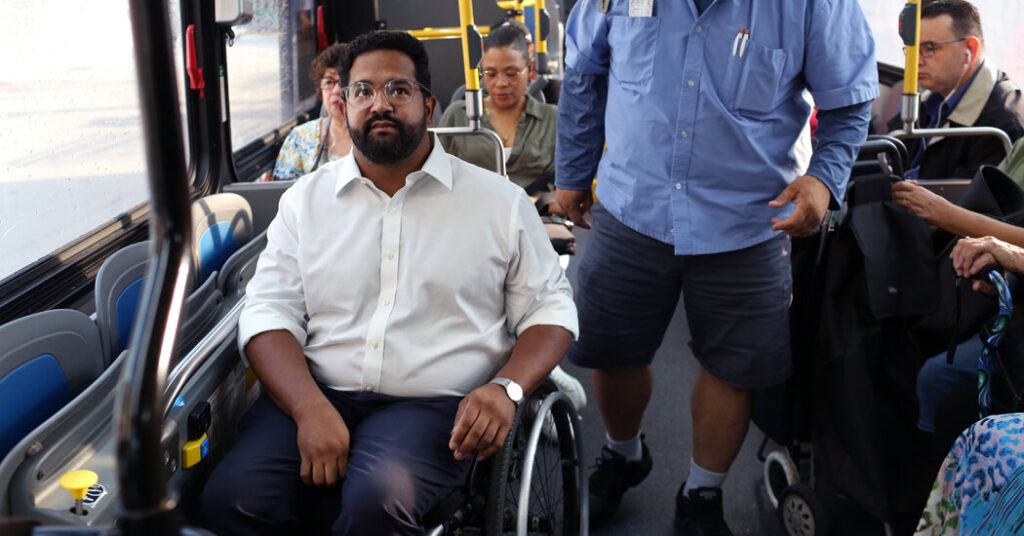
There is a subway stop two blocks from Quemuel Arroyo’s apartment in Harlem, but it does not have an elevator.
So he begins his workday by rolling his wheelchair onto an M4 bus. He switches to an M104 bus after less than a mile, getting off at 96th Street for the closest accessible subway stop on the No. 1 line, 40 blocks from home.
He arrives at his office near Wall Street about an hour later, a reminder of the importance of his job: making the transit system more accessible for New Yorkers like him.
As the Metropolitan Transportation Authority’s first chief accessibility officer, Mr. Arroyo lobbies for billions of dollars to build new subway elevators, knowing that nearly two-thirds of stations do not have them. He pushes officials to repair the system’s roughly 350 elevators more quickly, knowing the feeling of helplessness that comes with getting stranded.
It is a monumental and often thankless task that, despite his efforts, has at times cast him as an adversary to elected officials and disability advocates who want him to do more, faster.
But to spend time with Mr. Arroyo is to realize just how much his firsthand experience and dedication has not only fueled his mission, but also given inspiration to Janno Lieber, the chairman of the M.T.A., whose office is down the hall from Mr. Arroyo’s and who has become be an evangelist for accessibility.
“I tell Janno, ‘I need you to ride the system one day only using elevators, and you’ll understand why this is so impactful,’” Mr. Arroyo said.
He had just waited in a long line of strollers and shopping carts for a subway elevator.
“Five trains go by while I’m still waiting — that’s upsetting,” he said. “That’s the lived experience for so many people.”
Mr. Arroyo, 36, who goes by the nickname Q, has used a wheelchair for half of his life. As a teenager, he fell while mountain biking in Vermont and injured his spinal cord.
He spent 10 months at the Rusk Institute of Rehabilitation Medicine, where he underwent extensive physical therapy and learned how to navigate the world in a wheelchair. His time there also served as a window into how he would be perceived in the outside world.
“What I learned there was awful,” he said. “I learned how people are made to feel invisible and how little regard society has for people with disabilities.”
After studying urban design at New York University, he worked in human resources at Morgan Stanley before joining the city’s Department of Transportation to work on accessibility projects. He spent five years there working on issues like pedestrian ramps and raised crosswalks.
Nearly one million people with disabilities live in New York City. Efforts to make the subway accessible have been painfully slow, and public officials have been surprisingly callous. In the 1980s, Mayor Ed Koch blocked a deal to add elevators. A transit official said it would amount to “tossing money down the drain.”
Instead, officials moved to create a separate paratransit system called Access-A-Ride. Wheelchair users regularly appear at M.T.A. meetings to complain about poor service and having to book trips in advance.
Mr. Arroyo joined the M.T.A. in 2021 and has had some wins lately. The city’s congestion pricing program is pouring money into subway upgrades. State lawmakers approved a $68 billion capital plan in April that will bring elevators to 60 stations.
The M.T.A. has also received criticism over its exorbitant building costs. Adding elevators at a single station typically costs $100 million. Now the agency is trying a new approach to lower costs by installing elevators directly from the street to the platform, requiring fewer elevators at each station.
But for disability advocates, it is not enough. It has been 35 years since the Americans with Disabilities Act guaranteed equal access in public spaces. The goal of making most stations accessible by 2055 feels too far away.
Sasha Blair-Goldensohn, a Google engineer who has used a wheelchair since he was injured by a falling tree branch in Central Park in 2009, said he wished Mr. Arroyo did not toe the company line over a lawsuit demanding that the M.T.A. make subway elevators more reliable by improving maintenance.
“Public transit has to work for everyone,” he said. “We have day jobs. We have other stuff we’d rather be doing. The only reason we’re doing this is because things are so dysfunctional and so unfair. We can’t go to work. We can’t take our kids to soccer practice.”
But Mr. Blair-Goldensohn acknowledged that Mr. Arroyo had a difficult job.
“It’s so critical to have representation and visibility,” he said. “I’m so glad he’s there. I can only imagine it’s an incredibly heavy burden.”
Mr. Arroyo understands and shares the frustration. When three new elevators were added at the Hunter College stop on the No. 6 subway line, he appeared at the opening with a beaming smile. In private, he felt exasperated that it took 15 years, in large part because of complaints from Upper East Side residents.
“It has been the most grotesque exhibit of NIMBYism that I’ve experienced in my career,” he said.
Still, the nation’s largest subway appears to be at a turning point. The station closest to Mr. Arroyo’s apartment is slated to get new elevators soon, as are five nearby stops on the No. 1 line.
Even so, Mr. Arroyo often faces obstacles navigating the city’s transportation network. He checks the website that lists which subway elevators are broken before he goes anywhere. On a recent day, 36 were listed as out of service.
He does not try to hail a taxi. A decade ago, when he was working at Morgan Stanley, he struggled to hail one to take him to the emergency room for a heart problem.
“Drivers will not stop for you by and large,” he said. “They don’t know that my chair is 12 pounds. I can transfer it to the back seat. They’re afraid of me.”
He recently ordered a wheelchair-accessible Uber so he could get to an M.T.A. event to announce new fines for drivers who block bus stops. The Uber pulled over next to a construction site, forcing Mr. Arroyo to hurtle into the intersection, dodging traffic and potholes to enter the vehicle from a ramp in the back.
The event was held in Midtown Manhattan across the street from the Rusk Institute, bringing back memories of his time there and the mostly child-age patients he spent time with.
“I left promising to live a life of joy,” he said. “So they could see someone who they could relate with.”
He goes sailing on the Hudson River and rock climbing at gyms. He joined a guerrilla dance troop. He scuba dives in the Dominican Republic, where he was born.
And Mr. Arroyo has begun to increase his political profile. He counts among his friends Henry Garrido, the leader of the city’s largest municipal union, who called Mr. Arroyo a “force of nature.” He considered running for a City Council seat in Harlem where he grew up and his mother worked as a home health aide.
Mr. Lieber has described Mr. Arroyo as a “strategic operator” who had frequented hookah bars with Mayor Eric Adams and spoke at a campaign rally for Zohran Mamdani, surprising his boss. A month later, Mr. Arroyo was spotted huddling with Mr. Mamdani in Puerto Rico, prompting speculation of a potential role in the new administration.
When he rolled onstage at Mr. Mamdani’s rally at the United Palace Theater in October, Mr. Arroyo said he was inspired by the soon-to-be mayor. He made the case for why accessibility should be part of Mr. Mamdani’s vision for a fairer city and left the crowd with a parting lesson.
“Never mistake a disability for inability,” he said.
The theater erupted into cheers.
Emma G. Fitzsimmons is the City Hall bureau chief for The Times, covering Mayor Eric Adams and his administration.
The post His Job Is to Make the Subway Accessible. His Own Life Fuels His Work. appeared first on New York Times.