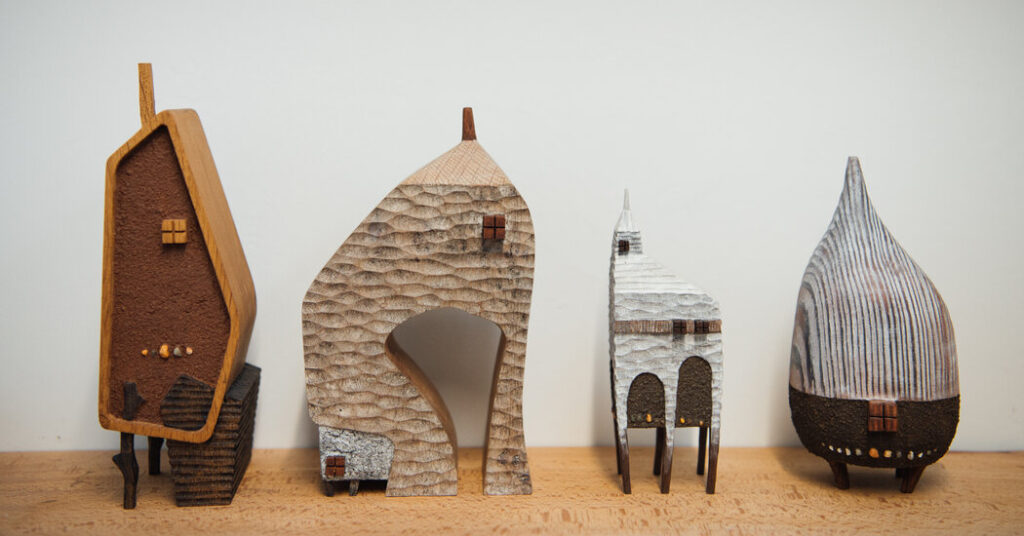
In 2013 Yukihiro Akama found some small blocks of oak behind the house in northern England where his family was living at the time. Trained as an architect in his native Japan, he began carving miniature houses, a subject that has since become his signature.
“I have only designed buildings in the past, so that’s why I’m making these houses,” Mr. Akama, 50, said during a video interview from the Daniel Baker furniture and cabinetry company in Shelley, a village in West Yorkshire. He works there four days a week and on the fifth and sixth — Fridays and Saturdays — he cuts up the scraps of wood that are left when he and his two colleagues finish building wardrobes and other items. Then, using tools he brought from Japan, he carves his whimsical art objects.
Mr. Akama also has his own studio in Huddersfield, a 30-minute drive from the Daniel Baker workshop. There, he covers the carvings’ walls with clay and other materials, accents them with pebbles and sends them to customers who have made purchases through his website. He drops 10 to 15 new pieces every 40 days and, judging from the website’s “sold” labels, sells out quickly. (He also occasionally sells through galleries or gallery shops.)
Each house is one of a kind, ranging in height from the three-centimeter (almost 1.2- inch) Tiny Little Grain Store in oak (85 pounds, or $110) to the 60-centimeter Birch Forest Tree House in silver birch (£1,430).
Most of the houses stand on stilts, Mr. Akama said, and have pointed roofs because “they are pretty.” Both of those features were incorporated in the Ancient Seaside House, a 22-centimeter-high piece also made in oak (£265).
Imperfect Is Authentic
The natural irregularity of wood ensures “there are some cracks or tiny holes with some houses,” Mr. Akama wrote on his website, warning customers to “please refrain from purchasing if you would not prefer those natural textures.”
But those distortions actually are attractions, according to Alfred Zollinger, an associate professor of architecture and interior design at Parsons School for Design in New York City and the co-founder of Matter Practice, an architectural and exhibition design firm. “We’re all swiping through images and social media all day long,” he said, “so to have something in your hand that is imperfect speaks of authenticity, somebody not being obsessed with appearance and being more human.”
The scale of Mr. Akama’s buildings is playful and primitive, said Steven Ceraso, an adjunct lecturer in woodworking for the Center for Continuing and Professional Studies at the Fashion Institute of Technology in New York City who also has other part-time academic roles. “The carvings aren’t highly detailed or accurate, so they are like sketches too,” Mr. Ceraso said, comparing them to the cartoonlike, animated work of the Canadian American artist Philip Guston or Tim Burton’s otherworldly movie set designs.
Mr. Akama said he initially was inspired by the work of Terunobu Fujimori, a Japanese architect whose designs also feature natural materials, stilts and pointed roofs. But he has added reflections of his own experiences, like the tiny windows that echo what he described as the small dots “sticking out from the mud wall” at the Baltit Fort in northern Pakistan, where he backpacked in 2003.
Each house has a poetic name, such as the 32-centimeter-tall piece in oak (£456) that he called Blush House “because, for me, this looks like a shy boy” or the 24-centimeter-tall piece in Douglas fir (£252) that he called Floating Fortune Teller’s House because he “imagined a fortune teller living there.”
Thierry Nataf, the president and chief executive of the Luxury Consulting Company in Paris, said the miniatures are “the ultimate expression of luxury” because each one is “something that’s unique that nobody else has.” He acknowledged that Mr. Akama’s prices are not at luxury level, but, “Luxury is sometimes not defined only by pricing.”
Architecture and Forestry
Born in Kawasaki, a town north of Fukushima on Japan’s main island, Honshu, Mr. Akama graduated in 1998 from Tohoku University of Art and Design in Yamagata, Japan. After doing some traveling and working as an architectural technician, he changed careers in 2006, planting, maintaining and felling trees for a town forestry cooperative just south of his hometown. He married the following year.
In 2011 he was about to start building a family home in the Fukushima region when the Tohoku earthquake hit, generating a tsunami that flooded the entire prefecture and led to the core meltdowns at the Fukushima Daiichi nuclear plant. The family fled “because where we live is only 50 kilometers [30 miles] away, so there was a lot of radiation which is not good for babies or young children. And because we had a 3-year-old daughter and 6-month-old son,” Mr. Akama said.
The family came to England — “until the accident settled down, but we are still here,” he said. To improve his English, Mr. Akama worked as a bar man, waiter and sushi chef in Japanese restaurants in Huddersfield and nearby Leeds from 2012 to 2020, then started to work with Daniel Baker.
A Risky Process
At the Daniel Baker workshop, Mr. Akama begins creating a house by studying a piece of wood, drawing a design directly onto it and then cutting out the shape with a bandsaw. He uses a vise to hold the shape steady while he cuts windows with a small saw, then chisels away any excess wood, flattens the surface and carves textured patterns into it.
He uses a blowtorch to burn the surface, then cleans it “with a toothbrush to get the little black crumbs off,” he said.
At his own workshop, he mixes his clays with glue and wood dust, spreading white color clay on first with a palette knife, then wiping it down and allowing it to dry. Then he wipes the surface with a cloth dipped into some brown or black color clay, “so only the high spots get brown or black, and you get a mixture of color,” he said.
Before the wet clay dries, he accents the surface with tiny pebbles, using tweezers to place each one, as “once the clay gets dry the stones stay there,” he said. “Once the clay gets dry, I paint on the clay again with wood stain. Then I coat them with oil finishing and then put a maker’s mark with a hot branding iron” on the base.
The work is difficult “because the wood’s easily snapped,” he said. And when something breaks, he changes the design: “For example, if it was four legs and I snap one, I might change it to two legs. Sometimes I fix it, but very occasionally,” he said.
Looking ahead, Mr. Akama hopes to move to a new studio in the next few years so he can design to distribute under one roof, and plans to add other material like steel, iron or ceramic to his houses “as when I use different materials, the design can get more of a variety,” he said.
The post From Blocks of Wood Come Miniature Houses appeared first on New York Times.