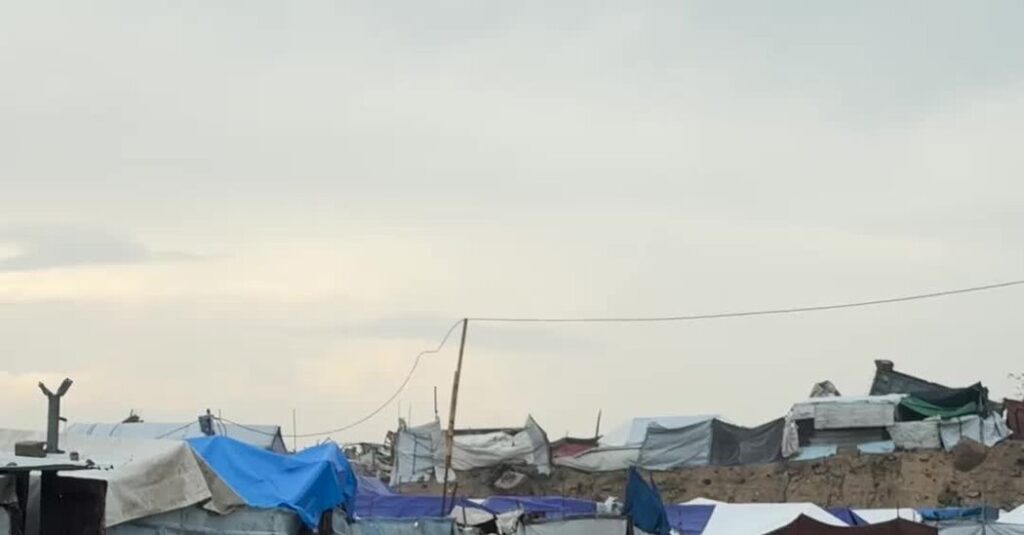
Tents flooded as rain poured down outside. Children huddled around campfires in buildings half-smashed by fighting. Roads torn up by two years of war turned to muddy tracks.
For Gazans, the storm that battered the enclave this week was a reminder that while the bombs may have stopped falling for now, life is still far from normal.
Palestinians had hoped the cease-fire between Israel and Hamas would permit the devastated enclave to begin rebuilding as soon as possible. But they are likely to be kept waiting as Israel, the United States and Hamas wrangle over Gaza’s future.
More than two months into the cease-fire, many of Gaza’s two million Palestinians still have no permanent homes. Instead, they are often forced to choose between living under rubber tarps between mounds of rubble or in partly destroyed buildings.
Both options can be dangerous: Gaza’s civil defense emergency workers said that at least 11 people were killed this week when damaged buildings collapsed on those taking shelter there during the storm.
Staying warm, for many, is a constant battle. Cooking gas can be prohibitively expensive, and firewood damp and difficult to light. Gazans lucky enough to be living in stable buildings rarely have access to electricity or central heating.
The United Nations’s Office for the Coordination of Humanitarian Affairs in Jerusalem has reported that about 1.3 million Palestinians in Gaza lack proper shelter. More than 100,000 Palestinians were estimated to have been affected by the storm, which flooded more than 200 displacement sites, according to the agency.
The flooding brought sewage into the streets as well — overwhelming sanitation systems badly damaged in the war — according to the U.N.’s humanitarian office, raising the risk of turning clean water supplies into dangerous sources of disease.
Israel’s military campaign against Hamas killed tens of thousands in Gaza. It also flattened much of its cities through a relentless drumbeat of airstrikes and the systematic razing of entire residential neighborhoods.
According to the United Nations, more than 120,000 buildings in Gaza were destroyed and tens of thousands more were either moderately or severely damaged — in all, about 81 percent of the structures in the enclave.
Rebuilding them is likely to cost around $70 billion, according to U.N. agencies, and it is far from clear which nations might be willing to provide the funds. With Hamas and Israel still at loggerheads, potential donors say they fear pouring money into buildings that could be brought crashing down if the conflict reignites.
United States officials have said they would not allow large-scale reconstruction to take place in the half of Gaza still controlled by Hamas, which began the war by attacking Israel on Oct. 7, 2023. But a vast majority of the two million Gazans live in that area.
Israel says it is allowing international relief organizations to bring large amounts of winter supplies — like tents and tarps — into Gaza, but United Nations officials say that, so far, it is not nearly enough.
Aaron Boxerman is a Times reporter covering Israel and Gaza. He is based in Jerusalem.
The post Floods, Mud and Cold Add to Gazans’ Misery appeared first on New York Times.