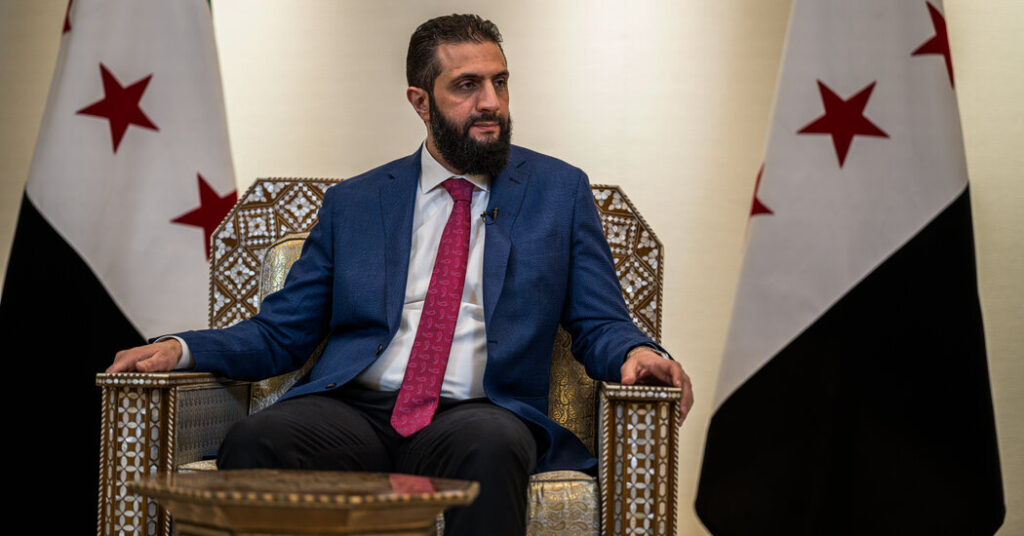
When a lone gunman that President Trump said was linked to the Islamic State killed three Americans in central Syria on Saturday, it laid bare the mounting security challenges and precarious state of affairs confronting the country’s new leader, Ahmed al-Sharaa.
Since ousting Syria’s dictator, Bashar al-Assad, a year ago, Mr. al-Sharaa has had to deal with the daunting task of restoring control over a deeply fractured nation. His government has sought to rebuild a unified military force. Yet sectarian violence, involving government forces, has killed hundreds, hindering meaningful progress toward national reconciliation. And rising tensions with Kurdish militias, who hold significant sway over the country’s northeast, have complicated government efforts to integrate them into Syria’s new political and military structure.
Mr. al-Sharaa has also had to delicately navigate his relationship with Mr. Trump — who has openly embraced him — amid questions about the future of U.S. forces in Syria. American troops have been there for years, to fight the Islamic State, or ISIS, counteract Iranian influence and guard strategically important areas, including oil fields.
The persistent danger of terrorism has loomed large as Mr. al-Sharaa has tried to deal with these challenges.
Over the past year, ISIS has exploited security gaps to target civilians and Mr. al-Sharaa’s forces. Then, on Saturday, the shooting attack left two U.S. soldiers and a civilian interpreter involved in counterterrorism efforts dead. Three U.S. military personnel and two Syrian security forces were also wounded in the attack in Palmyra, a city in central Syria, according to American officials and Syrian state media.
Government forces detained five people in raids in Palmyra, Syria’s interior ministry said in a statement carried by the state-run news agency, SANA. The operation was carried out in coordination with the U.S.-led coalition, SANA reported.
The Islamic State has not claimed responsibility for the attack on Saturday, the first killing of Americans in Syria since Mr. al-Assad was overthrown. Syria’s Interior Ministry said in a statement on Sunday evening that an individual affiliated with the group was behind the killings. It also said on Saturday that it had warned American counterparts about potential ISIS attacks on U.S. forces.
The Interior Ministry said the ISIS member infiltrated a meeting on Saturday between Syrian forces in the region and a delegation from the international coalition forces, who were discussing ways of combating the extremist group.
A senior U.S. military official, speaking on the condition of anonymity to discuss operational matters, did not dispute the Syrian warning and said that’s why the U.S. soldiers were providing security for the meeting.
“This was a lone gunman who was ISIS,” the official said. “He got lucky.”
U.S. officials on Sunday declined to specify the nature of the meeting, whether American officials had been attending and why the National Guard soldiers were needed to provide security for the gathering.
The attack was a setback for Mr. al-Sharaa’s government, analysts say, and complicates his efforts to forge a lasting peace in a country still reeling from decades of authoritarian rule and a devastating civil war.
“This is a remarkably difficult moment for the president,” said Bassam Barabandi, a political analyst in the Syrian capital, Damascus.
Mr. al-Sharaa “doesn’t have the luxury of options,” he added. “He has no choice except to stabilize Syria, rebuild Syria and make Syria into a place that no terrorist organization has any presence.”
Mr. al-Sharaa came to power last December after his forces swiftly advanced across Syria, toppling the al-Assad family’s five-decade rule. A former leader of the Syrian branch of Al Qaeda, he was once imprisoned by U.S. forces in Iraq and had a $10 million bounty on his head. He cut ties with Al Qaeda in 2016 and rebranded his group as more moderate, and the U.S. dropped the bounty on him last December.
Since becoming president, Mr. al-Sharaa has sought to build international ties, including with the United States.He has met with Mr. Trump at the White House, delivered a speech at the United Nations and received strong support from several neighboring Arab states. Last month, his government also joined the U.S.-led global coalition to fight ISIS, reinforcing its commitment to combating the group.
The assault in Palmyra came as ISIS has conducted attacks in Syria in recent weeks, and as the authorities have ratcheted up their operations targeting the group.
The attack on Saturday brings American involvement in Syria into sharp focus, analysts say, and will test Mr. al-Sharaa’s relationship with Mr. Trump and the broader coalition.
Colin P. Clarke, a counterterrorism analyst at the Soufan Group, a global intelligence and security firm based in New York, said the attack could provide an impetus for Mr. Trump to accelerate the withdrawal of U.S. troops from Syria.
The United States has about 1,000 troops at outposts in Syria’s northeast and at al-Tanf base in the southeast, roughly half the total that were in the country when Mr. Trump took office in January.
“That’s also exactly what ISIS hopes to achieve,” Mr. Clarke said. “A hasty U.S. withdrawal that would offer the group more room to maneuver.”
The Palmyra assault also highlights the growing urgency for Mr. al-Sharaa’s government’s to address its relationship with the Kurdish-led Syrian Democratic Forces, or the S.D.F., a militia group that controls much of northeastern Syria.
For years, the S.D.F. has been the United States’ primary ally in its battle against ISIS, capturing territory in the civil war. The group also oversees detention camps and prisons that hold thousands of ISIS fighters and their families.
In March, the S.D.F. signed an agreement with the Syrian government committing to integrate into the new state by the end of the year. But that has yet to be realized, analysts and Syrian officials say, and the two sides have clashed in recent months.
Following Saturday’s attack, the Kurdish group emphasized that its forces were not part of the joint patrol with American troops in the Palmyra area, while also signaling its willingness to the United States to continue fighting ISIS.
“We reaffirm our readiness to pursue ISIS in those areas and defeat it, should an agreement be reached with the International Coalition,” Farhad Shami, the spokesman for the Kurdish forces, said on social media.
Just before the attack on Saturday, a spokesman for Syria’s Interior Ministry accused the group of refusing to adhere to the agreement with the government and using the fight against ISIS as a way to preserve its power. Taking on the terror group allows the S.D.F. to legitimize its authority over the areas it controls, maintain power over valuable oil and gas fields, and position itself as an essential American ally.
“Eradicating terrorism and ISIS would mean the end of the S.D.F. politically and financially,” the Interior Ministry spokesman, Noureddine al-Baba, said in an interview with The New York Times.
Mr. al-Sharaa will have to confront all these challenges in the coming days, analysts say, while contending with a range of security, economic and political pressures. He will also need to manage any fallout from the United States, as the Pentagon investigates the shooting and Mr. Trump vows to retaliate.
The senior U.S. official downplayed the likelihood of a major bombing campaign or commando raids against ISIS in Syria, emphasizing the need for a cautious approach to avoid destabilizing al-Sharaa’s fragile political situation.
Mr. Barabandi, the political analyst in Damascus, said Mr. al-Sharaa’s government will most likely emphasize that it is doing its utmost, despite limited resources, expertise and capacity on the ground.
“Their message will be to show how they are doing their best and are still a reliable partner even though they face many elements that don’t want Syria to be stable,” he said.
Reporting was contributed by Muhammad Haj Kadour from Damascus; and Euan Ward and Hwaida Saad from Beirut, Lebanon.
Abdi Latif Dahir is the East Africa correspondent for The Times, based in Nairobi, Kenya. He covers a broad range of issues including geopolitics, business, society and arts.
The post Deadly Attack on U.S. Troops Poses Growing Challenge for Syria’s Leader appeared first on New York Times.