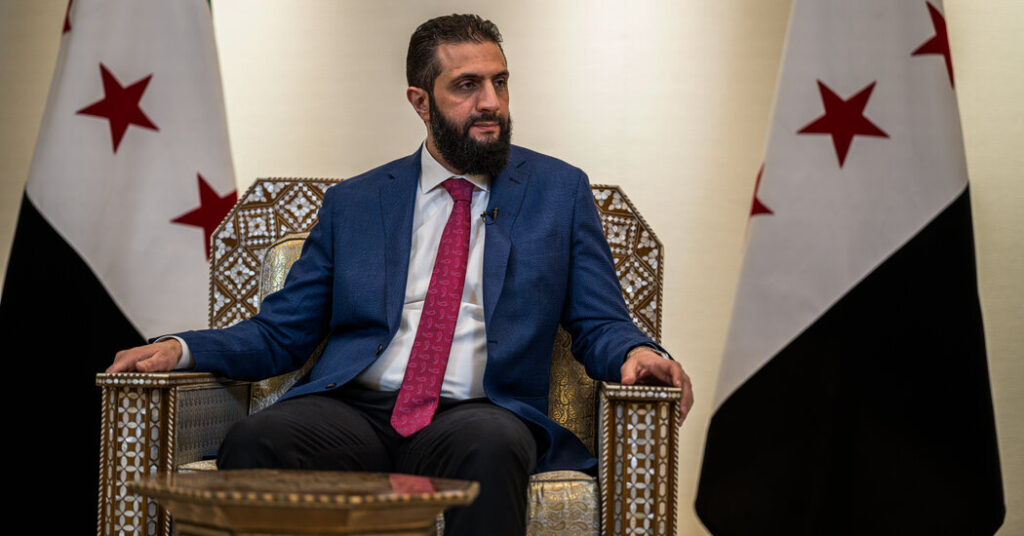
When a lone gunman that President Trump said was linked to the Islamic State killed three Americans in central Syria on Saturday, it laid bare the mounting security challenges and precarious state of affairs confronting the country’s new leader, Ahmed al-Sharaa.
Since ousting Syria’s dictator, Bashar al-Assad, a year ago, Mr. al-Sharaa has had to deal with the daunting task of restoring control over a deeply fractured nation. His government has sought to rebuild a unified military force. Yet sectarian violence, involving government forces, has killed hundreds, hindering meaningful progress toward national reconciliation. And rising tensions with Kurdish militias, who hold significant sway over the country’s northeast, have complicated government efforts to integrate them into Syria’s new political and military structure.
Mr. al-Sharaa has also had to delicately navigate his relationship with Mr. Trump — who has openly embraced him — amid questions about the future of U.S. forces in Syria. American troops have been there for years, to fight the Islamic State, or ISIS, counteract Iranian influence and guard strategically important areas, including oil fields.
The persistent danger of terrorism has loomed large as Mr. al-Sharaa has tried to deal with these challenges.
Over the past year, ISIS has exploited security gaps to target civilians and Mr. al-Sharaa’s forces. Then, on Saturday, the shooting attack left two U.S. soldiers and a civilian interpreter involved in counterterrorism efforts dead. Three U.S. military personnel and two Syrian security forces were also wounded in the attack in Palmyra, a city in central Syria, according to American officials and Syrian state media.
ISIS has not claimed responsibility for the attack on Saturday, the first killing of Americans in Syria since Mr. al-Assad was overthrown. The Syrian government has also not said who was behind the killings, even after Mr. Trump’s statement blaming ISIS, and said it had warned American counterparts about potential ISIS attacks on U.S. forces.
The attack was a major blow for Mr. al-Sharaa’s government, analysts say, and complicates his efforts to forge a lasting peace in a country still reeling from decades of authoritarian rule and a devastating civil war.
“This is a remarkably difficult moment for the president,” said Bassam Barabandi, a political analyst in the Syrian capital, Damascus.
Mr. al-Sharaa “doesn’t have the luxury of options,” he added. “He has no choice except to stabilize Syria, rebuild Syria and make Syria into a place that no terrorist organization has any presence.”
Mr. al-Sharaa came to power last December after his forces swiftly advanced across Syria, toppling the al-Assad family’s five-decade rule. A former leader of the Syrian branch of Al Qaeda, he was once imprisoned by U.S. forces in Iraq and had a $10 million bounty on his head. He cut ties with Al Qaeda in 2016 and rebranded his group as more moderate, and the US dropped a bounty on him last December.
But since becoming president, he has garnered significant international attention, meeting with Mr. Trump at the White House, delivering a speech at the United Nations and receiving strong support from several neighboring Arab states. Last month, his government also joined the U.S.-led global coalition to defeat ISIS, reinforcing its commitment to combating the group.
The attack brings American involvement in Syria into sharp focus, analysts say, and will test Mr. al-Sharaa’s relationship with Mr. Trump and the broader coalition.
Colin P. Clarke, a counterterrorism analyst at the Soufan Group, a global intelligence and security firm based in New York, said the attack could provide an impetus for Mr. Trump to accelerate the withdrawal of U.S. troops from Syria.
The United States has about 1,000 troops at outposts in Syria’s northeast and at al-Tanf base in the southeast, roughly half the total that were in the country when Mr. Trump took office in January.
“That’s also exactly what ISIS hopes to achieve,” Mr. Clarke said. “A hasty U.S. withdrawal that would offer the group more room to maneuver.”
Eric Schmitt contributed reporting from Washington.
Abdi Latif Dahir is the East Africa correspondent for The Times, based in Nairobi, Kenya. He covers a broad range of issues including geopolitics, business, society and arts.
The post Deadly Attack in Syria on U.S. Troops Exposes Growing Challenges for Country’s Leader appeared first on New York Times.