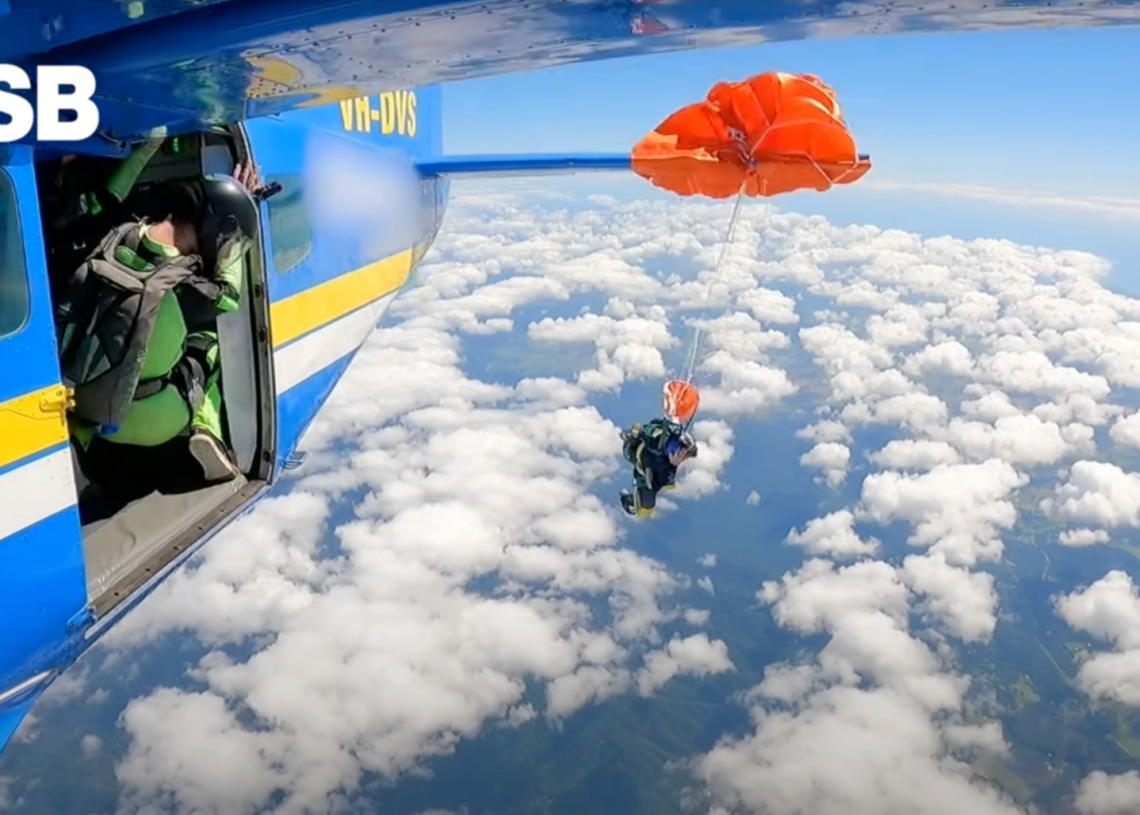
A skydive over northern Queensland, Australia, turned into a nightmare scenario when a parachutist ended up dangling beneath the very plane he’d just jumped from, suspended at roughly 15,000 feet while the aircraft struggled to stay in the air.
The incident happened on September 20 during a jump run out of Tully Airport. A Cessna Caravan was carrying a pilot and 17 parachutists, planning a 16-way formation jump with one skydiver filming from the door. As the first jumper, Adrian Ferguson, moved to exit, the handle of his reserve parachute snagged on the aircraft’s wing flap, according to a final report released by the Australian Transport Safety Bureau.
The reserve chute deployed instantly and violently. Ferguson was yanked backward, his legs striking the aircraft’s horizontal stabilizer before the parachute wrapped around it. The result was a skydiver hanging below the tailplane and a plane that no longer wanted to behave like a plane.
“The pilot recalled feeling the aircraft suddenly pitch up, and observed the airspeed rapidly decreasing,” ATSB Chief Commissioner Angus Mitchell said in a statement. At first, the pilot thought the aircraft had stalled and responded accordingly. That assessment changed once it became clear a person was attached to the tail.
As the aircraft vibrated and resisted control inputs, most of the remaining parachutists jumped. Two stayed onboard with the pilot, watching as Ferguson reached for a hook knife. He cut through 11 lines of his reserve parachute, tearing enough fabric to free himself from the aircraft.
Once clear, Ferguson entered free-fall and deployed his main parachute. Despite tangling with remnants of the reserve chute, it inflated. He landed safely, suffering minor leg injuries.
The pilot declared a mayday and prepared to bail out if control deteriorated further. With part of the parachute still wrapped around the damaged tailplane, the aircraft had limited pitch control. “With forward pressure, they found they could achieve a gradual descent,” Mitchell said. Air traffic control determined the plane could attempt a landing, and it returned safely to Tully.
The ATSB released video of the incident alongside its report, pointing out one practical takeaway. “Carrying a hook knife, although it is not a regulatory requirement, could be lifesaving in the event of a premature reserve parachute deployment,” Mitchell said.
Investigators also noted unrelated weight and balance issues, adding context to how thin the margin was that day. What happened could have gone very differently without quick action and a hook knife used at exactly the right moment.
The post Australian Skydiver Filmed Dangling at 15,000 Feet After Parachute Snags on Plane appeared first on VICE.