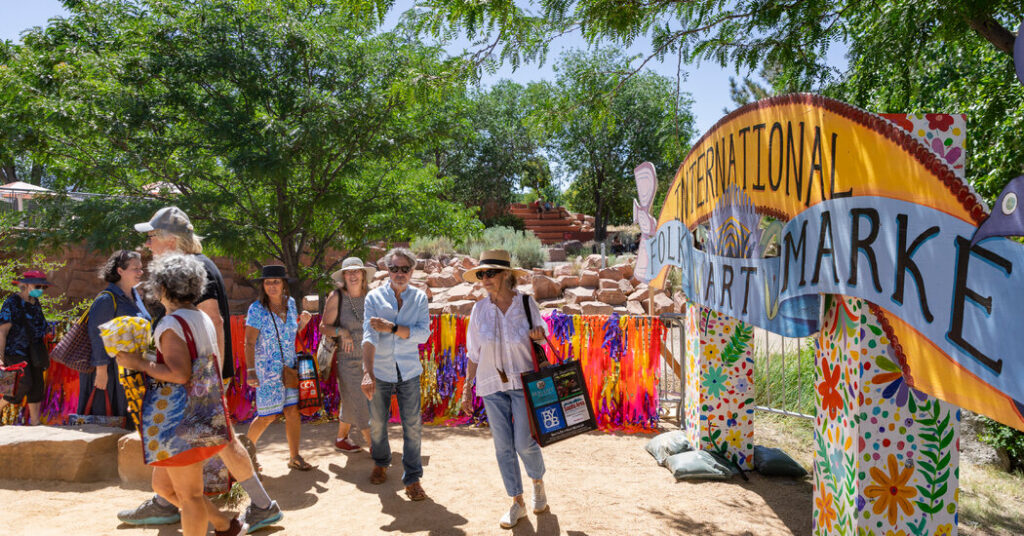
Every year in mid-July, basket makers, weavers, silversmiths, potters, wood carvers, glassblowers and other artists from more than 50 countries converge in Santa Fe for the International Folk Art Market.
The 2025 event drew more than 20,000 visitors, tallied nearly $3.9 million in sales, benefited artisan communities around the world and enabled a rich cultural exchange, according to Stacey Edgar, the chief executive of the nonprofit organization that puts on the market. (Organizers tend to use the acronym IFAM, pronouncing it EYE-fam.)
“To me, it’s just person-to-person diplomacy that is unparalleled — with beautiful products,” Ms. Edgar said in a recent interview.
But some artisans decided not to apply for the 2026 market, she said, citing concerns about U.S. tariffs or anxiety about traveling to the United States. A total of 599 artists, she said, applied for the 148 booths available next year, a 15 percent decrease from the 2025 application numbers.
“This has always been a country that people wanted to visit,” she said. “And hearing some people be nervous to do so is really disheartening.”
Other organizations that work with international artisans have encountered similar situations.
Cultural Survival, a nonprofit that advocates for Indigenous peoples’ rights, hosts four artisan bazaars a year in locations around the Northeastern United States. It saw a decline of about 15 percent in the numbers of international vendors participating in its two bazaars in July, according to Mark Camp, the organization’s deputy executive director.
In some cases, he said, people were unable to get U.S. visas or had their visa interviews canceled; in others, people were afraid of being targeted by U.S. law enforcement after their arrival.
“Those images that have been broadcast around the world have scared people,” he said.
Another factor hurting artisans and other small-scale producers around the world, he noted, was the elimination of the “de minimis” exemption, which had allowed packages valued at $800 or less into the United States tariff-free.
He said he suspected that some people would adapt by marketing their goods elsewhere: “They’ll just go sell them in Italy and Switzerland and Germany instead.”
Economic Barriers
Several participants in the Santa Fe market said they have felt the effects of U.S. tariffs.
That was the case for Ami Avellan, a Finnish silversmith who lives in a village north of the Arctic Circle. A first-time participant this year, she displayed jewelry with textured surfaces that created what she called a “frosty, sparkling, winter-morning effect.”
Ms. Avellan said her experience had been lovely and the community celebration — which included a procession in which participants from each country had their moment on center stage — made her feel “like some sports star.” Still, she decided not to apply for the 2026 event.
“The problem is, of course, the tariffs,” she said, adding that the “yo-yo effect” of U.S. tariff rates in the months before the market had been stressful and left her mistrustful about the future. She said she had made a profit this year but the tariffs she paid on the unsold items she took home were not refunded.
“We should have a more open world,” she said, “and not make barriers.”
Josef Koó also decided not to reapply. Speaking from Austria, where he runs a more than century-old family business making apparel from indigo-dyed fabrics, he said the uncertainty over both tariffs and the euro-to-dollar exchange rate made it too difficult to calculate costs months in advance, which is required in the market’s application paperwork, and too hard to keep prices accessible for U.S. customers.
But Nisha Subramaniam said she did apply to return, representing a social enterprise that she helped found in northern India, called Kullvi Whims. It works with more than 300 artisans who spin, knit and weave sheep’s wool bought from shepherds in the Himalayas.
She said visitors had loved the jackets and coats she brought this year, the first time she had participated in the market. “In that 90-degree heat, people were trying on our wool and buying it,” she said with a smile.
But customs duties and tariffs took a sizable bite of her profits, and tariffs on products from India now are 50 percent. An enterprise such as Kullvi Whims can’t absorb such costs, she said, and yet passing along the entire increase to customers might make prices too high.
“I don’t know how we’re going to do, but I’m still hopeful,” she said.
Gunjan Jain, another participant from India, said her experience at the market — first as a volunteer at the World Crafts Council booth, then for the past two years at her own booth — had given her the courage to diversify her product line.
Now Vriksh, her social enterprise and design studio in eastern India, produces not only saris, stoles and shawls but also stitched items such as long silk jackets.
“I’ve learned so much from the interactions I’ve had with other artists and organizers and experts in IFAM, I find it like a university,” she said.
Ms. Jain said she would absorb most of the increased cost of tariffs next year, if necessary, but she hoped the Trump administration would reassess the rates to take into consideration small-scale industries and artisans. (Both Ms. Subramaniam and Ms. Jain learned this month that the market had accepted their 2026 applications.)
One study that Ms. Edgar worked on several years ago estimated — very conservatively, she said — that 300 million people around the world made their living in the artisan sector.
It is important to value these “culture keepers,” she said, and to recognize that the work of their hands is not the same as materials like digital chips, aluminum or steel.
“Tariffs are meant to even the playing field on competition,” said Ms. Edgar, who was an entrepreneur, consultant and business professor before joining the International Folk Art Market two years ago. “There’s not a competitive alternative to a woman’s weaving in Guatemala. That is hers, that is her culture. We shouldn’t be putting tariffs on cultural exchange, in my opinion.”
Exhibitors and Storytellers
A juried market that got its start in 2004, the Santa Fe event has a no-cash, no-bargaining policy. Participating artists have consigned their goods to the market; they do not handle sales. Anyone who wants to buy an item has to go to a market pay station.
The artists interact with customers, demonstrate craft techniques and talk about their traditions — often with the help of volunteer interpreters. Once they return home, the market wires them the proceeds from their booth sales, minus expenses.
This arrangement complies with the rules governing the types of nonimmigrant visas typically granted to participants, Ms. Edgar said: “We are the importer of record and then we are the sellers of those goods. The artists are really the exhibitors and storytellers.”
Artists set their own prices when they apply to participate, factoring in expenses such as airfare, lodging, shipping and customs duties. While some financial assistance is available to new participants, returning artists cover their costs out of their booth sales.
All artists pay booth rental fees (typically $700), as well as a handling fee (10 percent of sales in the first year, 20 percent in following years) to defray some of the market’s costs.
But because the market covers many expenses up front and deducts them from sales revenue, the artists do not have to come up with a lot of cash ahead of time, Ms. Edgar said.
“It’s one of the biggest reasons that we’re able to attract global artists from many different countries,” she added, “because they do not have to take some of that financial risk.”
Visa Issues
In early December, the market issued acceptances for the 2026 edition. This year, for the first time, it created a 10-person waiting list, so if anyone who has been accepted is unable to get a visa, a substitute is waiting for the spot.
Depending on a person’s country of origin, age and other factors, getting a U.S. visa can be a steep climb, according to Rebecca Kitson, an immigration lawyer in Albuquerque who provides pro bono assistance to the International Folk Art Market.
All visa applicants, including people wanting to visit for tourism or business, have been subject to increased scrutiny by the current administration, she said.
The visa process can be unpredictable, as Yovanna Champi and Edgar Romaní of Lima, Peru, discovered. They create silver, copper and brass jewelry — including nose adornments and bold pectoral necklaces inspired by pre-Columbian designs — under the brand name T’ampa Uma Itinerante.
In December 2024, after being accepted to participate in the 2025 market, the couple applied for U.S. visas and were given an interview date in March 2026. Eventually, they were able to snag someone’s canceled appointment on July 1.
They got their visas, valid for 10 years, but by then, the market was already underway. (They have been invited to the 2026 market.)
Despite all the news reports about U.S. immigration policies, they said, they were eager to represent Peru and believed that if they approached the experience with positive energy, everything would work out.
Mr. Romaní put it this way: “They say that if you know your roots, if you understand where you come from, then when you grow up you can be in any space, anywhere in this world, and always know that you have your identity, you have your legacy to give you support.”
The post Artisans Weigh Whether U.S. Fairs Are Worth the Trouble appeared first on New York Times.