This is an edition of The Atlantic Daily, a newsletter that guides you through the biggest stories of the day, helps you discover new ideas, and recommends the best in culture. Sign up for it here.
Welcome back to The Daily’s Sunday culture edition, in which one Atlantic writer or editor reveals what’s keeping them entertained. Today’s special guest is Álex Maroño Porto, an associate editor who has written about becoming a different person after learning English.
Álex recommends watching Problemista, a surrealist film featuring an aspiring toy designer and an art critic with a cryogenically frozen husband. He also enjoys listening to folktronica music, reading Joan Didion, and spending time with Sandra Blow’s photography.
— Stephanie Bai, associate editor
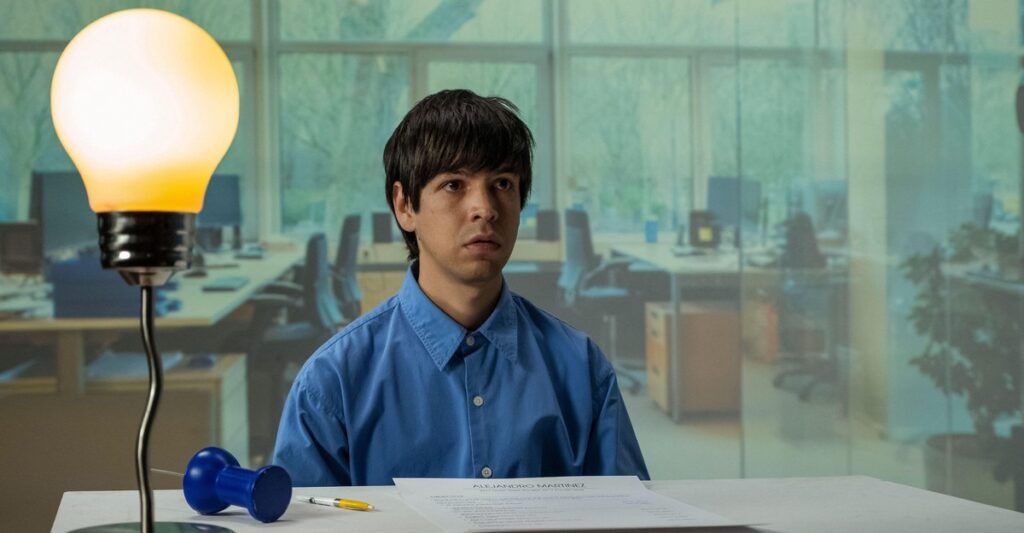
Something I recently rewatched: A few months ago, a friend of mine got sucked into the endless vortex of looking at streaming options. After he’d spent a while fumbling with the remote, I tried to rescue him—and the evening—by proposing Problemista. Julio Torres’s 2024 directorial feature-film debut is an absurdist take on the seemingly infinite steps needed for Alejandro, a young Salvadorian man in Brooklyn, to fulfil his American dream: getting a job at Hasbro. Early in the film, Tilda Swinton enters as Elizabeth, an unhinged art critic who could possibly solve all of Alejandro’s problems by sponsoring his visa. Craigslist makes a cameo embodied as a glitchy siren of sorts, and Isabella Rossellini’s soothing voice threads together the narrative, which stretches like the Penrose stairs as Alejandro navigates the fractured immigration system.
Best novel I’ve recently read, and the best work of nonfiction: Bad Habit, a coming-of-age debut by Alana S. Portero, is the type of book you wish you’d discovered as a teenager. Beginning in 1980s Spain, it chronicles the story of a young girl who navigates her trans identity while living in a working-class neighborhood in Madrid. The novel is an ode to the mundane actions that trigger change in the outskirts of society: bringing a plate of garlic mushrooms to a person in need, talking to an old neighbor who is derided because of her appearance. “Women who live the way they want, who age on their own terms and wear their lives etched into their faces, are treated with pathos and mockery because they are feared,” Portero writes.
I first read Slouching Towards Bethlehem in 2020 while confined in my grandmother’s house in Irixoa, a village in rural Galicia. Didion’s essays about a country in apparent collapse may not have been the ideal respite during the pandemic, but she proved to be an invaluable companion on my writing journey. Her style hovers between detachment and self-involvement; in Slouching, every word falls in the right place as she observes the forces shaping the culture of the ’60s. It’s not an easy task to maintain such balance—for some writers, that center doesn’t seem to be holding. [Related: Joan Didion’s magic trick]
A musical artist who means a lot to me: Alejandro Guillén’s musical project, Baiuca, feels as if a group of cantareiras—Galician female folk singers—stormed a rave with tassel-covered bagpipes and tambourines, ready to fill the air with their high-pitched clamor. Guillén experiments with “folktronica,” a genre that blends traditional folk sounds with electronica beats; I recommend “Morriña,” a song that conveys the longing for one’s home, and “Veleno”—featuring the folktronica artist Rodrigo Cuevas—which has an infectious dose of magical realism. (Other folktronica singers include Omar Souleyman and Chancha Vía Circuito.) When I first heard Baiuca play during Madrid’s San Isidro festivities in 2019, I connected with a part of my culture that I hadn’t known existed: Baiuca’s songs taught me about the traditional Galician folk music passed down by generations of women who sang by the hearth.
A quiet song that I love, and a loud song that I love: “White Ferrari,” by Frank Ocean, a song for an overcast morning when time appears to stand still. By the time I hear the glitch before he sings, “I’m sure we’re taller in another dimension,” I want to replay it right away—or queue “Lost” next.
When I need immediate energy, I play “escucha,” by friedplatano. It never fails to drag me out of bed.
The last culture thing that made me cry: If I held back tears watching I’m Still Here, it’s because I didn’t deserve to cry as much as Eunice did. Played by Fernanda Torres, Eunice is a mother trying to shield her family from the ugly realities of fighting against an authoritarian state that kidnapped her husband. Torres commands the film, showing the gradual breakdown of normalcy, and how the arrival of a car in broad daylight can suddenly shatter everything. [Related: A horrifying true story, told through mundane details]
The last museum show that I loved: Two weeks ago, I discovered the transgressive beauty of Sandra Blow’s vision in “Lines of Belonging,” the latest exhibition in the Museum of Modern Art’s New Photography series. Her art chronicles the underground queer communities of Mexico City while redefining Catholic symbolism, imbuing her subjects with a delicate light that elevates them to the status of religious idols. The sheer intimacy of her pictures and the warm colors reminded me of Clifford Prince King, another queer photographer with a distinctive gaze.
A favorite story I’ve read in The Atlantic: In 2020, trapped at home and jobless, I started a document with articles that I wanted to revisit. Something I’ve always admired about The Atlantic is how its writers can identify a particular social phenomenon and explain the forces behind its rise, as well as its cultural effects. Spencer Kornhaber’s “The Lady Gaga Anthem That Previewed a Decade of Culture Wars” was one of those stories: He places Gaga’s art within the political debates of the 2010s, exposing the flaws in her attempt at broad intersectionality and analyzing the limits of celebrity’s political aims. At least she fared better than Katy Perry.
Here are three Sunday reads from The Atlantic:
- Something ominous is happening in the AI economy.
- Can Jollibee beat American fast food at its own game?
- How private equity is changing housing
The Week Ahead
- Avatar: Fire and Ash, a movie directed by James Cameron about the war on Pandora (in theaters Friday)
- Season 2 of Fallout, a postapocalyptic series about life on Earth after nuclear destruction (premieres Wednesday on Prime Video)
- Season 5 of Emily in Paris, a series about an American woman who moves to Europe for a dream job (premieres Thursday on Netflix)
Essay

The New Allowance
By Michael Waters
Around the 1920s, a certain class of parents—those with enough money to indulge their kids from time to time—started to panic. Toy companies and trinket manufacturers were buffeting kids with ads, and children were pestering their parents for gifts. Many parents wanted their kids to have these new luxuries, but they also wanted them to understand that money had limits.
Parenting magazines suggested an intervention: small weekly payments, called allowances, that kids could squirrel away and use to buy toys or other treats on their own. The hope was that these payments would teach children to save rather than spend. But not everyone was a fan of the idea.
More in Culture
- The 10 best movies of 2025
- The apocalyptic potential of the Netflix–Warner Bros. deal
- Tamar Adler’s food writing doubles as a philosophy of kitchen scraps.
- When did the job market get so rude?
- The most impractical tool in my kitchen
Catch Up on The Atlantic
- The state that handed Trump his biggest defeat yet
- OpenAI is in trouble.
- The return of MAGA’s favorite forbidden book
Photo Album

Take a look at the year in photos, including Gen Z protests in Nepal, Hurricane Melissa in the Caribbean, and more.
Stephanie Bai contributed to this newsletter.
Explore all of our newsletters.
When you buy a book using a link in this newsletter, we receive a commission. Thank you for supporting The Atlantic.
The post An Absurdist Film About the American Dream appeared first on The Atlantic.