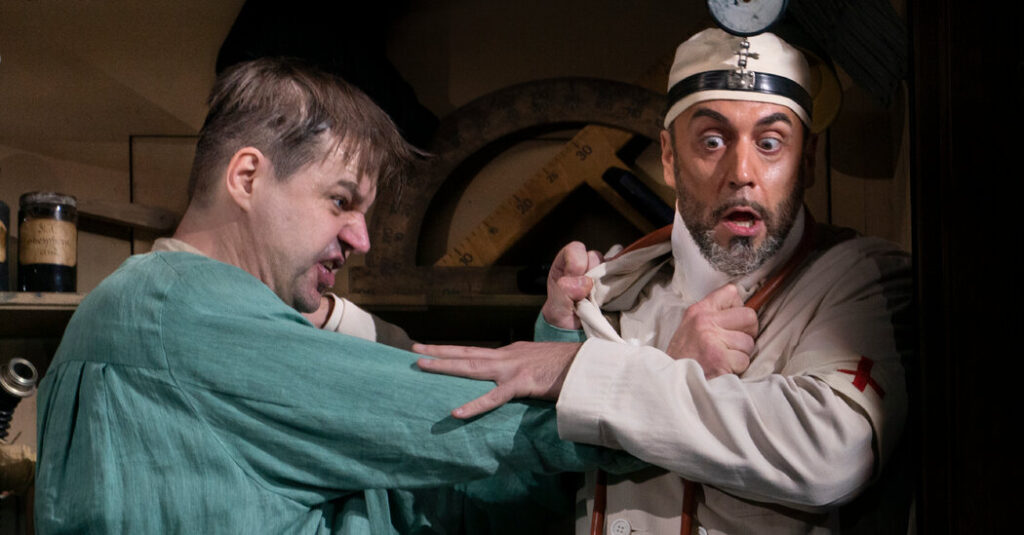
When Alban Berg’s opera “Wozzeck” was first seen in Berlin 100 years ago, it jolted its audience with a musical twist.
Opera fans were used to modern works that abandoned traditional ideas of form and sound. And for the most part they got that with “Wozzeck,” an unsparing and tragic thriller about a soldier driven to murder by indignity and madness, written in a style that would make Berg one of the great avant-garde composers of his time.
But at the climax of “Wozzeck,” Berg took a bayonet to his opera’s worldview and let the orchestra wail in grief.
This is a moment of pure feeling, and it comes out of nowhere. Up to this point, the orchestra, standing in for Berg, plays the role of passive, even cold observer. But then he steps out from behind the curtain to deliver a eulogy through music, which inspired apocalyptic animations by the artist William Kentridge in his production for the Metropolitan Opera:
The passage is in D minor, a naturally somber key, and is written in an emotionally immediate style, something the premiere’s audience probably would have known from the late-Romantic symphonies of Gustav Mahler earlier in the 20th century. For an atonal, modernist composer like Berg, this is almost a step back for music history.
Really, though, it’s a meeting point of tradition and innovation. An acknowledgment that, even in an age of radical artistic change, feeling is feeling.
Berg’s humanism here is just one reason “Wozzeck” is still so powerfully moving. Another is how the music is so thoroughly and smoothly integrated with the plot, representing opera in its purest ideal of form.
“Wozzeck” hints at a setting but doesn’t strictly take place in any time or era. For audiences with World War I fresh in their minds, though, it was shockingly resonant in its depiction of a nobody soldier stuck in a system much larger than himself and driven insane. And this opera still has the power to shock: A marvel of head meeting heart, it will be a gut punch as long as there is conflict and inequality in the world.
Astonishingly, this was also Berg’s first opera. He had a lot of experience composing art songs, but he wasn’t inspired to fully commit to writing a dramatic work until he saw a version of Georg Büchner’s haunting play “Woyzeck,” which had been left unfinished and in fragments in the 19th century, then was assembled and finally performed in 1913.
The timing was bad. Berg saw the play in spring 1914 and immediately shaped it into three acts of five scenes each. But that summer, war erupted in Europe, and a year later, he was called up for Austro-Hungarian military service. While in the army, he began to feel closer and closer to Wozzeck, telling his wife: “There’s a bit of me in him, since I have been spending these war years just as dependent on people I hate. I have been in chains, sick, captive, resigned, humiliated.”
Berg didn’t finish composing “Wozzeck” until 1922, and it didn’t land onstage until three years later. When it did, it was a hit. For the American premiere, in Philadelphia, the Pennsylvania Railroad offered a special train just to bring audiences down from New York. Today, it is firmly in the standard repertoire.
It is beloved in part because it works well on the foundational level of drama. The opera packs a wallop in just 90 minutes of episodic, often disorienting scenes with no space for the audience to reflect or rest. On closer inspection, you can see how tightly crafted it all is, starting with the opening notes: Wozzeck’s murder of Marie, his common-law wife, is foretold in a downward phrase that echoes much later as she screams “Help!” while dying.
Each act has a distinct form. The first is a set of five character pieces, the second is a five-movement symphony, and the third is a series of inventions, or brief compositions based on a single idea. So even though Berg was creating something truly new with “Wozzeck,” a full-length atonal opera, he was also writing in the lineage of classical music.
That emotional climax at the end isn’t the only time Berg seems to recall Mahler. A scene in the second act is like a Mahler scherzo, a traditionally lighthearted movement that is made to be darkly humorous, filtering popular styles through a prism of irony. In Berg’s case, it’s a waltz:
Berg was also writing, like all his opera peers, in the shadow of Richard Wagner, who drastically altered the language of music and evolved the usage of leitmotifs, musical phrases that repeat to signify something specific, like cues in “Star Wars.” The most common one in “Wozzeck” is first heard in the opening scene as Wozzeck sings, “wir arme Leut,” or “we poor folk.”
That’s the heart of “Wozzeck” in three words. It comes back throughout the opera: in orchestral interludes; while Wozzeck is talking with Marie at home; even disguised as a grotesque waltz.
All this meticulous detail may seem strange for a story of madness, but scholars have theorized that the opera’s obsessive form isn’t so different from Wozzeck’s insanity. Studying the score can induce a kind of paranoia. You look for patterns everywhere. You turn to numerology to make sense of things.
The rabbit hole of interpreting “Wozzeck” turns into something more like an abyss in the third act, with its parade of inventions. It starts with seven variations on a theme that lasts seven measures:
Eventually, the variations land on a fugue. Next up is an invention on a single note: B. It’s subtle, but Berg peppers the note everywhere in the second scene, from a pedal tone, low and sustained, to eerie high notes on a solo violin. Just as understated is the third scene’s invention on a rhythm, a short-short-long gesture that emerges from a polka played on a honky-tonk-style piano:
In the fourth scene, Berg composes based on a six-note chord that, for example, he inverts and breaks up, creating a phrase from the notes called an arpeggio. The chord is used to chilling effect as Wozzeck drowns. You can practically feel him sink into the water, then you can trace a final air bubble rising from his corpse and the landscape returning to stillness.
The orchestral interlude that follows is an invention on the key of D minor. This is the emotional outburst, what Berg once called “an appeal to humanity.” Then we’re at the final scene, an invention on perpetual motion, constant eighth notes from beginning to end. It’s a treadmill of music, tiring and too much in light of what’s happening onstage: Wozzeck’s son plays where his mother was murdered, and as the other children flippantly point out her body, the boy joins the run of eighth notes with a shatteringly innocent “hopp, hopp!”
Perpetual motion keeps the music from reaching a restful conclusion. Your ear wants some kind of final chord, perhaps even resolution, but instead the wind instruments keep alternating between two eighth notes; in Kentridge’s production, the audience is left with an unsettled look at Wozzeck’s son, portrayed by a puppet. The opera ends as if in the middle of a sentence:
Or maybe it seems to keep going. Berg once said that the final bar of “Wozzeck” links up with the first. The tragedy could repeat itself, again and again. Music and story are one and the same here. In his first try, Berg cracked the code of opera.
And yet he didn’t inspire a new school of opera; Berg, perhaps evasively, said he was never seeking reform to begin with. Later, Benjamin Britten borrowed his device of orchestral interludes for his first opera, “Peter Grimes.” And the unflinching severity of “Wozzeck” gave way to Dmitri Shostakovich’s feral “Lady Macbeth of Mtsensk.” But Berg was no Wagner, nor had he unleashed modernism in opera as Richard Strauss did 20 years earlier with the slithering notes that open his adaptation of Oscar Wilde’s “Salome.”
Instead, “Wozzeck” seems to follow the tradition of opera while standing outside it. That’s fitting for a work that sounds as if it could have been written at any moment in modern history. Composed in the gloom of World War I, it rings just as true in Vietnam and Iraq, in Ukraine and Gaza. Berg may always have a message for us, harrowing, poignant and communicated entirely through music.
Video and audio credits: Metropolitan Opera, “Wozzeck” (Met Opera on Demand); Jessye Norman and the London Symphony Orchestra, conducted by Pierre Boulez, “Altenberg Lieder” (Sony); Orchestra and Chorus of the Paris Opera et al., conducted by Pierre Boulez, “Wozzeck” (Sony); BBC Philharmonic, conducted by Edward Gardner, “Peter Grimes: Four Sea Interludes” (Chandos); Boston Symphony Orchestra et al., conducted by Andris Nelsons, “Lady Macbeth of Mtsensk” (Deutsche Grammophon); Vienna Philharmonic, conducted by Georg Solti, “Salome” (Decca)
Joshua Barone is an editor for The Times covering classical music and dance. He also writes criticism about classical music and opera.
The post After 100 Years, an Operatic Masterpiece Keeps Shocking Us appeared first on New York Times.