I am lying face down in a brightly lit sixth-story room beside a motorway on the outskirts of Istanbul. As I breathe through a hole in the examination bench, a team of two (polite, friendly) medics are making the first of 9,400 incisions in my head. And yet really, I am not on the bench at all. Really, I am not even in the same room. I am someplace else, somewhere not too far from here, it will turn out, flying over the heads of villagers all dancing in rows, swooping across the vista before me like the boy from Raymond Briggs’ The Snowman.
I am tripping. Perhaps that much is obvious already. The general anaesthetic administered by the medics (with skill, tenderness) has taken spectacular effect and briefly, I am sucked through the webbed edges of consciousness into the Foreverrealm. The villagers engaged in their ritual dance down below look like they’re made out of the crystallized, blown-out graphics used in the early MIA albums. Somehow, I know instinctively that they are Ancient Mesopotamians, despite never having thought about Ancient Mesopotamia before in my life. And here’s the thing: when the staff (attentive, dexterous) hand back my phone at the halfway stage of the operation, the first thing I do is google “ancient mesopotamia”—and there it is, laid out across the southeastern reaches of the land that today they call “Türkiye.”
“What’s that up there?” I imagine one of the villagers asking another, gesturing toward me in the sky. “Just another bald cunt from England,” I imagine his friend replying.
I am here for a hair transplant. Perhaps that much is obvious already. Because despite my experiences with astral travel, I remain convinced that we get just one life and I refuse to live mine bald. Mentally, once you’re there, there isn’t a counterargument that really matters.
The team of fixers and consultants I’d spoken to before the four-hour flight (peaceful, serene) from London had talked me through each stage of the process, and I knew exactly where my pickup would be waiting at SAW airport. On the drive to the clinic—the largest of its kind in the world—the hard shoulder of the eight-lane motorway turned suddenly into a watercolor view of the Bosphorus at dusk, salt and fresh water shimmering together in the last of the Friday sun, boats returning to their moorings. I began to understand why I’d heard that Istanbul is one of Earth’s greatest cities.
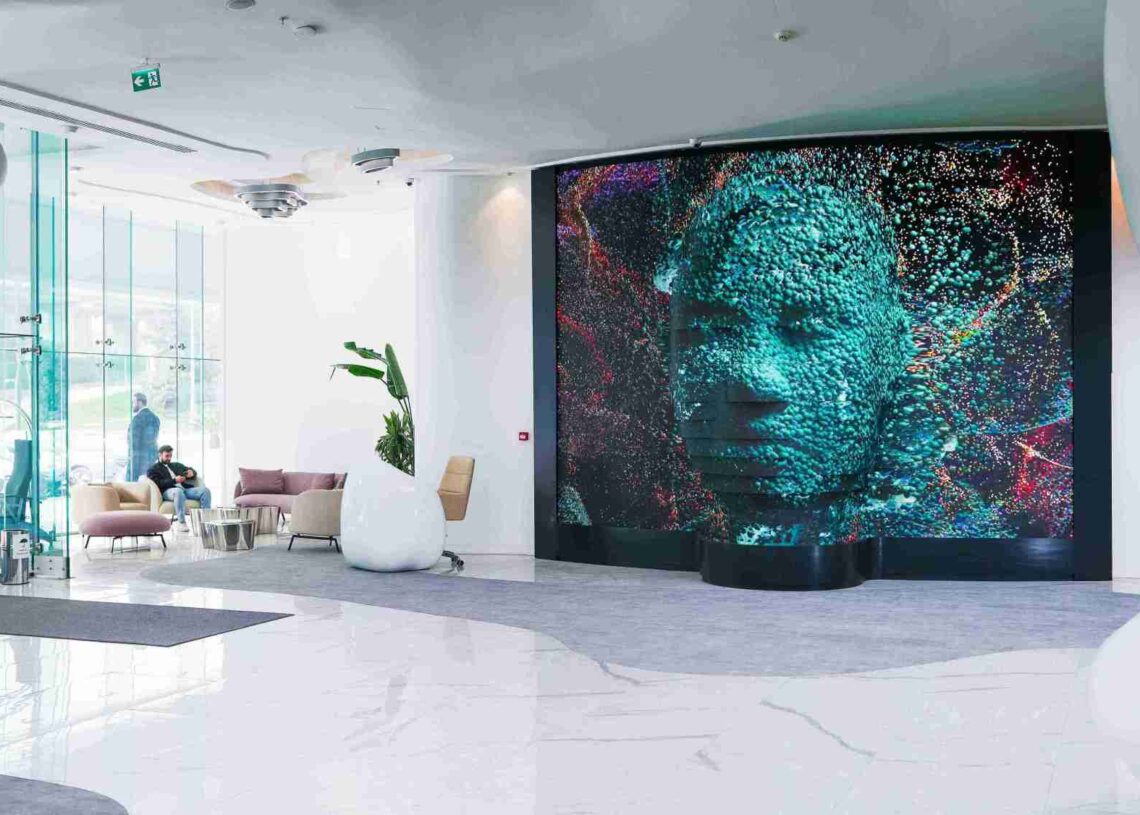
After the adrenalizing experience of Istanbul at rush hour, Elithair’s main complex was a blast of calm. The foyer is vast and sympathetically lit, the air clean, cool, and crisp; it is dominated by a gigantic cybernetic face, which has built-in electronic displays just beneath its surface that rattle it through a flux of different appearances, a virtual skin of building blocks set in place then torn away, the gigantic cybernetic face free to dissolve and reform anew. It is hard to overstate just how much the gigantic cybernetic face dominates my memories of the Elithair complex. It is a bold and unusual choice for a place where doctors come to work and transmits a zeal for some version of the future. They didn’t have anything like this back home when I went to get my tonsils out.
Nearly all of the staff were bi or trilingual, which was great, as my ability to speak Turkish doesn’t exist. Most of the patients seemed to be English or German, and when I first arrived, those waiting in the foyer for rides back to their hotel or airport provided a sneak preview of what was to become of me and my scalp, craniums bulging with injected saline kept above eye level by Elithair-branded headbands that give you the look of a galaxy-brained tennis genius or a patient from Theme Hospital. After a short wait, I was led to a nurse. Bloods were taken and documents exchanged. And then I was done, free to explore the neighborhood.
I was visiting with my girlfriend, so Elithair put us up in one of their couples’ rooms in a nearby hotel, which is essentially a full apartment with its own kitchen and lounge. Outside, the air was humid at nightfall and charged with the muezzin’s call to prayer, which was genuinely one of the most electrifying sounds I had ever heard as it mingled with the crowd noise from Galatasaray’s Rams Park stadium (Gala 3, Karagümrük 0) on the early evening breeze. I ate a pile of red meat to celebrate my last day as a balding man and walked home past stray dogs bunkering down for the night on the man-made banks beside the lazy man-made river, watching them peer up at the high rise skyline and wondering what they think it is.
As friendly and discreet as everyone was, and as comfortable as they made me feel, a weekend at a Turkish hair clinic is unavoidably full of humbling moments. One of these arrived early the next day, when I sat down with the consultant who was going to use a felt tip pen to draw my new hairline on my forehead, a moment of such mind-blowing indignity that I’d become perversely excited about it. The line she drew was higher than I’d hoped, which was demoralizing, but then they explained that the furrows that appear on your brow when you scrunch up your face are muscle, and hair won’t grow in muscle. Well, OK. Before long I was face down on the bench, kicking off a nine-hour procedure that might have been grueling if it weren’t for the efforts of Elithair’s medical team, who put up with my constant fidgeting and the BBC World Service babbling in my ears and day turned to night outside.
It’s always going to be slightly uncomfortable, having a team of people making nearly 10,000 cuts in your scalp across a full working day. It’s not my idea of a dream Saturday. Yet it would be wrong to describe any part of the procedure as truly “painful.” During the quarter of an hour that you’re knocked out by the general anaesthetic, the team there inject the local, skull-numbing anaesthetics that take the edge off the rest of the procedure.
After a night’s sleep, there’s a thorough debrief. You’re given a medical checkup, videos to watch, products to use—all the information that you need to make sure it works, basically—and then you’re sent away in a chauffeur-driven car to the airport. Turns out one weekend is all it takes to undo years of hating every photograph you’re in and avoiding reflective surfaces.
A few months later, things are starting to take shape. I’m sure that for a while people will look at me and see someone who is losing their hair. It gratifies me to know that in fact it is the exact opposite.
Elithair have just produced their own guide to Turkish hair transplants. Give it a read.
This content is sponsored.
The post A Trip to a Turkish Hair Clinic appeared first on VICE.