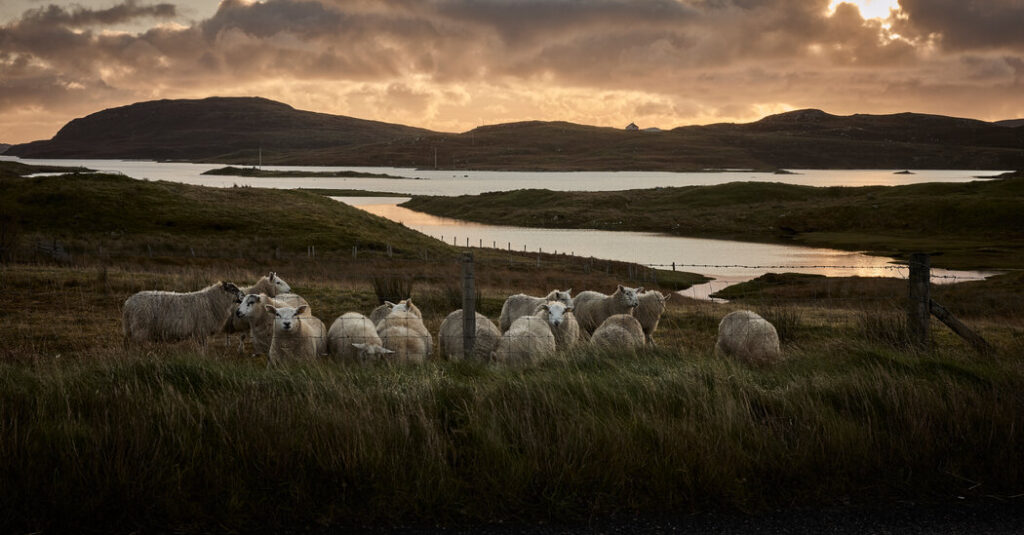
Sometimes things of great beauty and craftsmanship can come from the most unlikely of places. Such is the case with the Harris Tweed produced by Carloway Mill, one of only three such mills in the world but all on the same island in the Outer Hebrides, off Scotland’s western coast.
First, Carloway is not an easy place to find. It is down a winding one-lane road, where sheep dart across without warning and matted Highland cattle watch passing cars with vague curiosity from nearby fields. And the mill itself is not much to look at.
The exterior of the mill is nondescript, comprising a series of three weather-beaten sheds. Inside it is all gray cement and brick walls, noisy when its 19th century machines are whirring and cold on this October day — the boiler recently had broken down. While there are just 10 mill employees, the space is stuffed with bolt after bolt of tweed that seems to be everywhere.
There are purple tartans flecked with yellow, and black and white houndstooth next to pink herringbone and a sea foam green flecked with blues and yellow. Each 50-meter (164-foot) bolt was wrapped with a piece of masking tape and stored upright, so visitors need to squeeze past to get into the tiny factory shop, which houses a small fashion collection that is for sale.
Donald MacArthur, 76, one of the employees who often gives tours, has to shout above the clamor to explain all the goings on.
But this is just part of what the owner, Timothy Aldred, calls the “wacky and weird charm” that is Carloway Mill.
“When you walk in there, it’s rich and it’s dirty and really is as crude and industrial as you get,” Mr. Aldred, who bought the mill in 2019, said in a phone interview a week later. “But the irony is that it produces the world’s most beautiful blended handmade fabric and the fact that we make it on older machines also adds to its luster.”
Both Christian Dior and Ralph Lauren used Harris Tweed in recent collections, according to the Harris Tweed Authority, which holds the registration of the Harris Tweed name and supervises the industry.
And driving around Lewis and Harris — the 215,000-hectare (530,000-acre) island has two names to match the two distinct topographies — there are signs everywhere that indicate just how integral the wool is to the island itself. (In 2024 the authority certified 580,000 meters, or more than 360 miles, of the fabric.)
Shops in Stornoway, the island’s largest town, sell everything from tweed caps to dog collars. Search the term Harris Tweed on VisitScotland, the country’s official tourist site, and almost 1,400 results turn up, including home visits with some of the approximately 200 weavers on the island who create the fabric on their home looms.
“For a long time, the Harris tweed industry has played a vital role in social, cultural and economic life on the Outer Hebrides,” Joana Nascimento, the author of the 2023 book “Working the Fabric: Belonging and Island Life in Scotland’s Harris Tweed Industry,” wrote in an email. “The unique skills and knowledge required to produce Harris Tweed have been passed on through generations, and some of the production stages have long involved people working together to ensure the quality of the cloth.”
A Fashionable Textile
Harris Tweed is a product of the bleak and rugged landscape of the Outer Hebrides, where winters are dark, wet and windy.
For centuries the crofters, a Scottish term for families on small rented patches of farmland, would spin their sheeps’ fleece into yarn, dye the yarn with local plants and organic matter and then use small home looms to weave it into what was traditionally called clò mòr, the Gaelic term for big cloth.
It wasn’t until the 1820s that the term tweed came into use, when a London milliner misread a label on the fabric.
And it wasn’t until the mid-1840s that anyone began to particularly associate the tweed with Harris, the southern part of the island. (Historically, other kinds of tweed have also been made in Ireland, England and in other parts of Scotland).
That was when Catherine Murray, Countess of Dunmore, began using the hearty fabric to dress the gamekeepers on the Harris estate left by her late husband. Recognizing the quality of the fabric, she promoted it among Britain’s landed gentry as a fashionable textile for hunting and sporting wear.
Its success, however, led to imitations. So to protect their product, landowners, weavers and mill owners from throughout the Outer Hebrides banded together in 1909 to form the Harris Tweed Association and the following year it trademarked a certification symbol called the Harris Tweed Orb, a Maltese cross atop a globe. (Authorities say information on the design’s origins were lost during the bombing of London in World War II, but they assume it represents authority, power and protection.)
In 1993, an act of Parliament created a legal definition for Harris Tweed: It had to be made from pure virgin wool dyed and spun in the Outer Hebrides, handwoven by islanders in their homes and finished at mills in the island chain. It also replaced the association with the Harris Tweed Authority.
“Like other resourceful approaches and solutions in the history of the industry, this step was vital to safeguard the unique quality and reputation of Harris Tweed, and the livelihoods that depended on it,” said Dr. Nascimento, a research fellow in social anthropology at the University of Cambridge. “It was also crucial to ensure that its heritage and different kinds of craftsmanship remain alive today.”
Under One Roof
The craftsmanship involved in creating tweed can be seen today at Carloway Mill, founded in the 1960s when machinery from several old mills was moved under one roof, according to Mr. Aldred, a design engineer and businessman.
Carloway’s founders, he said, “had to have a real passion to do the more traditional side of the industry, because that’s what the mill specializes in.” But passion does not pay the bills, and the mill, which has had a string of owners, was saddled with debt for decades, struggling to compete with the two other mills on the island — Kenneth Mackenzie Ltd and Harris Tweed Hebrides.
“They’re super modern,” Mr. Aldred said. “Our wash tub is from 1812, theirs is from 2024.”
Soon after Mr. Aldred took over, he decided things needed to change. “We are a not-for-profit making company,” he said, adding that as of this year they have become registered as the Carloway Tweed Mill Heritage Centre and with proceeds funneled back into the business. “It is a total passion project.”
Aside from a contract with a school uniform company — “They want the old, thick, super heavy-duty tweed because it lasts for 10 generations of school uniforms,” Mr. Aldred said — Carloway now manufacturers products only for its website sales, the small shop at the mill and its three shops in Oban, a ferry hub on the Scottish mainland. Non-clothing items like blankets and dog coats, he said, are being sold under the Carloway label while the clothing line, which includes outerwear for men and women, is being sold under the Aldred label.
Dyed-in-the-Wool
According to Mr. MacArthur, it takes about four weeks to produce 50 meters of Harris Tweed, from start to finish. (Weavers send 56-meter lengths to the mill, but once it is washed and dried, it shrinks.)
The wool no longer comes from sheep on the Outer Hebrides, but, according to Mr. MacArthur, in 240-kilo (530-pound) bales from Yorkshire, where the British wool trade is based. Once at Carloway, the wool is washed and then dyed, a process that takes four to eight hours depending on the desired color. “And that’s where you get the expression ‘dyed-in-the-wool,’” he said.
The wool is weighed to create certain amounts and then run twice through a blending machine, partly to ensure any tiny lumps are removed. Mr. MacArthur said there are specific mixes to get the different flecks of color in the tweed.
For example, the tweed that Carloway calls Jaffa — named for Jaffa Cakes, the popular orange-flavor sweet — uses a mix of wools dyed hot pink, yellow and orange.
After lanolin oil is added back into the wool, it goes to a mechanical carding machine with combed rollers that thoroughly mixes the fibers before they are separated into yarn. “It takes one hour to run and 45 minutes to clean,” said Mr. MacArthur, as he and a colleague pointed to the mound of light orangy fluff that had to be pulled from under the machine and discarded.
The yarn then is twisted on another machine to make it stronger and finally wound onto bobbins, which are collected by the weavers — the mill works with 20 or so freelancers across the island — who take them and design instructions home to their looms.
Once the woven tweed is returned to the mill — the deadlines vary — Mr. MacArthur inspects all of it for flaws and, using a needle and yarn, repairs any thin spots (some that can be seen only with the use of a light box).
It is a big job, but one that the good-humored Mr. MacArthur, who goes by the nickname D.I. — “as in detective inspector” — said he has loved. “When I left school, I wanted to make money,” he said. “The loom was there, and the mill was there, so you tended to go to one of these jobs.” He has worked in the Harris Tweed industry for more than 60 years.
The tweed then is washed with soap and hung from sharp tenter hooks — “See, that’s where that expression comes from,” Mr. MacArthur said — on a frame so it dries in shape. Once the tweed is pressed, a representative of the Harris Tweed Authority stamps it with the Orb logo at the mill.
“Every length of Harris Tweed must be certified by the Harris Tweed Authority before it can carry the Harris Tweed Certification Mark — the Orb Device,” said Kelly MacDonald, the authority’s operations manager. “Only once those standards are met is the Orb Device hand-stamped onto the reverse of the cloth using a beeswax transfer.
“The process is both rigorous and deeply traditional, and it remains the final seal that transforms a beautiful piece of tweed into legally certified Harris Tweed.”
The post A Bleak Island, a Struggling Mill and a Very Distinctive Fabric appeared first on New York Times.