The generals say all goals of the war will be achieved. The economists say despite the pressure the economy will outlast Ukraine’s. Even President Donald Trump says that Russia is much stronger and Kyiv has no cards left to play in the war.
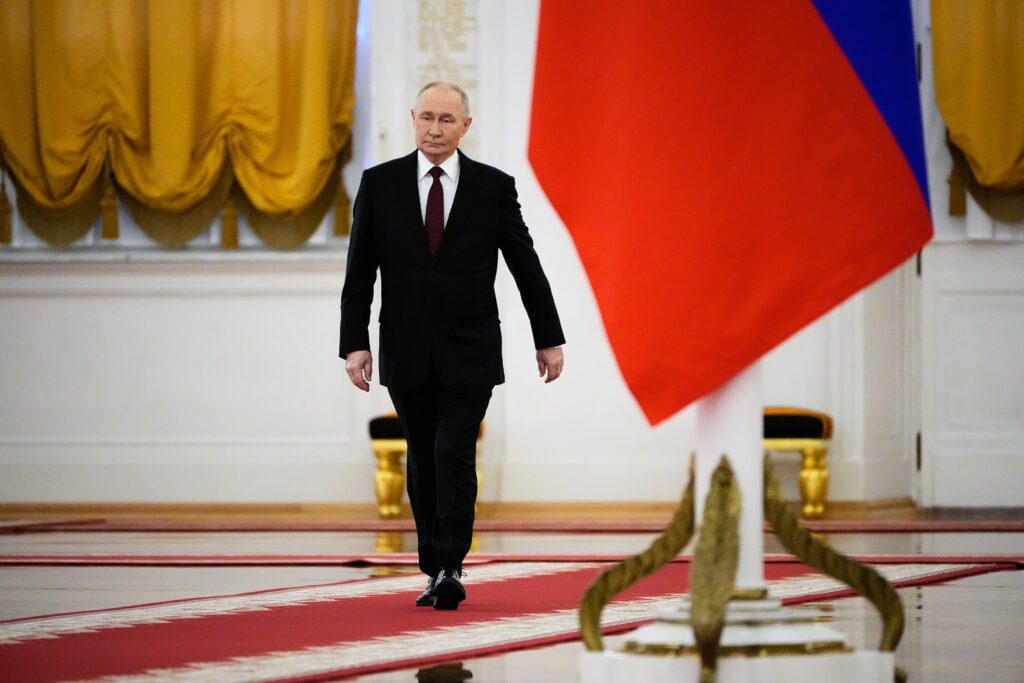
Hearing only reassurance, it is little wonder that President Vladimir Putin sees no reason for real concessions on Ukraine. From the vantage point of the Kremlin, the war is going according to plan.
It is unclear whether Putin will accept the latest U.S. peace plan, which most analysts have called slanted toward Russia, since it does not achieve all of his goals in the war. Since he believes he is winning and thinks the economy is strong, there is little reason for any sort of concessions.
Putin has long been surrounded by a chorus of supportive voices, but over the past 25 years of his rule, the range of views reaching him has narrowed dramatically.
Boris Bondarev, a Russian diplomat who resigned in 2022 over the full-scale invasion, described in an essay how he had a front-row seat as this narrowing of opinion became embedded deep inside the state apparatus.
“One of the invasion’s central lessons had to do with something I had witnessed over the preceding two decades: what happens when a government is slowly warped by its own propaganda,” Bondarev wrote. “The war is a stark demonstration of how decisions made in echo chambers can backfire.”
Yet it was not always this way.
An archival Instagram project called Achtopotv offers glimpses into that earlier period, resurfacing moments when Russian public discourse reflected a far wider range of opinions than it does today.
One of the clips shows a young Russian senator and historian, Vladimir Medinsky, in 2005 arguing passionately against the restoration of monuments to Joseph Stalin. He warned of the dangers of glorifying a system built on mass repression and the sacrifice of individuals for imperial ambitions.
Two decades later, Medinsky is Russia’s chief negotiator in talks with Ukraine and one of the most prominent advocates of Putin’s attempt to pull the former Soviet satellite nations back into Moscow’s orbit. A new bust of Stalin appeared in the Moscow subway this spring.
Another video unearthed by the project shows Putin in 2000, his first year in office, saying that independent media and civil liberties are necessary to keep Russia from “sliding into totalitarianism,” and arguing that a free press was vital for the country’s future.
In the ensuing two decades, Putin shed his interest in independent media and civil liberties and turned his focus to restoring the sphere of influence of the old Soviet Union — and those around him fell in line.
Perhaps the most stunning transformation is that of Dmitry Medvedev, who as prime minister swapped the presidency with Putin in 2008-2012 and whose term was marked by a brief liberal thaw, a friendlier attitude toward the West and a love for Western gadgets and social media.
Now, he has reinvented himself as a hawk who repeatedly wished nuclear destruction on the West in his blog posts. Analysts have attributed his transformation to a bid to avoid political obscurity and make up for his past more liberal views.
Russia analysts have identified different events as watershed moments. For some it’s Putin’s return to power in 2012 after Medvedev’s slight thaw. Others put the 2014 annexation of Crimea as a point of no return. Andrei Soldatov and Irina Borogan, Russian investigative journalists reporting on special services, wrote in their book “Our Dear Friends in Moscow” that the transformation began much earlier, in Putin’s first terms, describing how many of their colleagues and acquaintances adopted the Kremlin’s point of view in private early on.
By the time Russia invaded Ukraine in February 2022, it had become unimaginable for any senior official to oppose any of Putin’s decisions in public. During the now-infamous Russian Security Council meeting three days before the full-scale invasion, many of Russia’s top officials appeared visibly startled when Putin called on them one by one to deliver a speech, on camera, and endorse his plans.
Behind the scenes, however, there was at least one exception. Dmitry Kozak, a longtime aide who had worked with Putin since the 1990s and served as his chief negotiator on Ukraine, was his go-to man for some of the most sensitive tasks. He was reportedly the only senior figure to present arguments against military action during that meeting.
His alleged remarks did not appear in the televised version of the meeting and he has not appeared publicly since. His duties at the Kremlin slowly drifted to a rival aide until his resignation this fall.
Bondarev, the former diplomat, described how for years diplomats were sent abroad with the task to echo the Kremlin’s version of events without questioning it. Then, in cables and internal reports, he said, the diplomats were gradually expected to tell the leadership that Russia’s narrative had succeeded and that Western opposition had been disarmed.
“Eventually, the target audience for this propaganda was not just foreign countries; it was our own leadership,” Bondarev said. “My colleagues in the Kremlin repeatedly told me that Putin likes his foreign minister, Sergei Lavrov, because he is ‘comfortable’ to work with, always saying yes to the president and telling him what he wants to hear. Small wonder, then, that Putin thought he would have no trouble defeating Kyiv.”
Such ideological U-turns are not unusual in politics, and it is often difficult to distinguish public positioning from personal conviction, but their consequences escalate dramatically as power concentrates, now culminating in how the war in Ukraine might end as both Moscow and Washington exert pressure on Kyiv to give up.
Russians and other observers have noticed a similar phenomenon around Trump, with a Cabinet that evolved from including some voices of dissent in his first term to one now that is much more uniform in its support of his policies.
Roman Badanin, the editor in chief of the exiled investigative outlet Proekt, wrote this spring that Trump’s new briefings featuring loyalist bloggers reminded him of Putin’s annual press marathons. “Every year, the Kremlin gathers thousands of loyal reporters to ask the president sycophantic questions,” he wrote. “It’s amazing how similar these two are.”
What has unsettled many Russians most has been the speed with which powerful figures in Washington have adjusted their positions. Marco Rubio, now serving as secretary of state, was once one of the most forceful Republican voices arguing that abandoning Ukraine would shatter American credibility.
Trump’s main envoy, Steve Witkoff, has been criticized for advising Russia how to negotiate with Washington to get a better deal, including extracting territorial concessions from Ukraine. Bondarev said on X that while Witkoff’s faults lie in that he “sees the world exclusively through the prism of Putin” and his approach “worsens the situation for Ukraine,” he is simply following the orders of Trump.
“It’s unpleasant to admit — he owes [Ukraine] nothing,” Bondarev wrote. “He works for the U.S., or, as he understands it, for the U.S. president … His goal is to hand Trump some kind of ‘peace’ here and now.”
The first year of Trump’s second term has been the subject of a joke among Russia’s anti-war exiles: America appeared to be “speedrunning” parts of Russia’s recent political history.
“It’s a common human trait of adaptability, including political adaptability,” Badanin said. But, particularly in authoritarian countries like Russia, “anyone who’s ever entered the system, even if well-intended at the start, over time becomes either an indirect or direct accomplice to something bad.”
The post With an army of yes-men, how Putin’s world turned into an echo chamber appeared first on Washington Post.