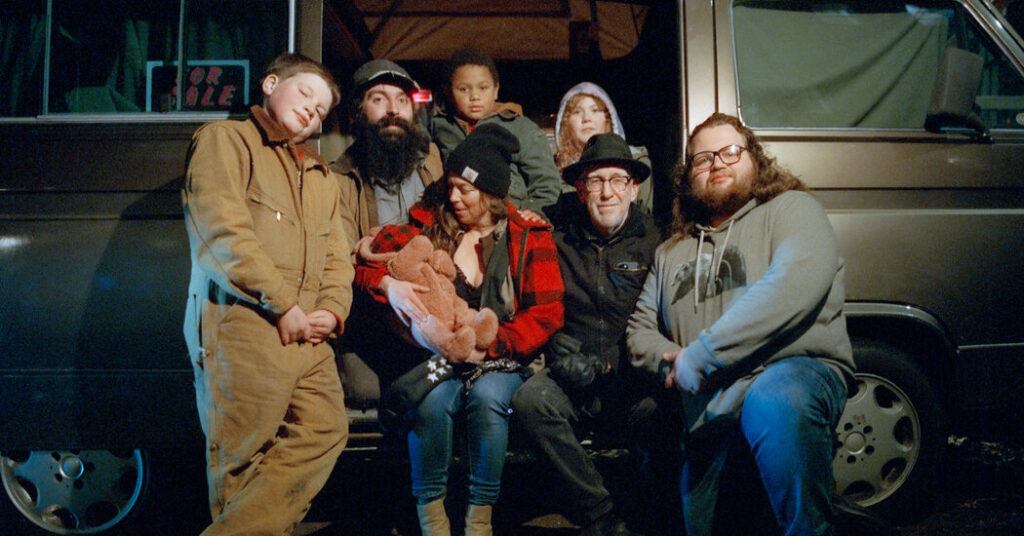
For the last several years, Kyle Dalton has taken unpaid time off from his job as a sales rep in Canada to live in a trailer without running water so he can sell Christmas trees to New Yorkers.
“The first year when I told my friends back home what I was doing, they were like, ‘Must be nice to live in New York City for a month,’” said Mr. Dalton, who works for a beverage company in Newfoundland. “Then I told them about my living arrangement.”
Mr. Dalton, 28, and his friend Charlie May, a 31-year-old Salt Lake City ski instructor and river guide, share an 7-foot-by-20-foot trailer parked on South Fourth Street in Williamsburg, Brooklyn. They hang their clothes on wall hooks above their cots. A power box from nearby Domino Park powers the trailer’s mini refrigerator, space heater, microwave, hot plate and toaster oven.
Mr. May, who has been coming to New York City for the past seven years to sell trees, said the trailer is “ultra pimped out” compared with the other trailers he has lived in.
At night, the men tape black garbage bags over the trailer’s four windows to block the lights from nearby buildings and an ice rink. The trailer doesn’t have a bathroom, so they use a portable toilet outside.
“I was told in my first year to update my Tinder bio to ‘Canadian boy in Brooklyn looking for shower,’ ” Mr. Dalton said. To keep clean this season, the roommates joined a nearby gym.
There are people like them all across the city, crammed in trailers and vans and trying to stay warm as they sell tens of thousands of Fraser, noble, balsam and Nordmann trees. They are an essential part of the holiday season — about 200,000 trees and wreaths are later collected by the Department of Sanitation each year for composting — but unlike Santa, they don’t have elves to help.
Mr. Dalton and Mr. May work 24-hour shifts (yes, you can knock on their trailer door in the middle of the night) selling trees for $30 to $500. Although they say the money is good — around $5,000 to $10,000 for the season, depending on the area and foot traffic — they aren’t out there just for the cash.
“I’m an only child,” Mr. Dalton said. “Some of these guys that I work with are like my brothers. I look forward to seeing them all year. It’s my favorite Christmas tradition now.”
Mr. Dalton and Mr. May work for Greg’s Trees, a Vermont-based company that has six stands in Brooklyn and Queens this year. Each stand was set up a week before Thanksgiving and features crafts, hand-painted Christmas cutouts for photos, custom wreaths, decorations and ornaments.
Eric Kang, 52, has worked at the McCarren Park location of Greg’s Trees in Williamsburg for the past 12 years. He calls Quebec home, but he said that he considers the people in the Brooklyn neighborhood his “extended family.”
“The same families come back every year, sometimes on the same day, to buy their trees, so there’s a connection to the community here that I love,” said Mr. Kang, who also does seasonal work rehabilitating watersheds. “I know the people in the deli around the corner and the people at the coffee shops, the business owners, the business managers.”
For the last two years, his 24-year-old son, Kashmir Kang, has joined him. Kashmir and two other Greg’s Trees employees sleep in a construction trailer on Driggs Avenue. Eric sleeps in his white van, parked in front of the trailer.
“I’m not going to lie,” Kashmir said, “it’s a little bit crowded in there.”
His father negotiated a deal with a feather factory across the street to get electricity in the trailer. So far, there haven’t been any issues with heating the space despite the frigid outside temperatures.
“I sleep on the top bunk, and every morning I wake up sweating,” Kashmir said. To shower, the four tree sellers use the McCarren Park facilities.
Thousands of Christmas trees from Oregon and North Carolina have been shipped to the location so far this season. Eric expects to sell out by Christmas Eve, which is when he will drive back to Canada. Thirty-six days of nonstop work in Brooklyn let him “be a hermit” from January until May, when he will “just sit in front of the fire with my dog, my wife and my daughter and relax,” he said. “I get all the talking out of my system while I’m in New York.”
Across the bridge in Manhattan, Billy Romp, 72, and his family sell trees for Kevin Hammer, the city’s Christmas tree kingpin with 40 stands across the five boroughs. Mr. Romp said Mr. Hammer takes care of basics like lights and equipment. “Our part is to show up, sell the trees,” he said.
Mr. Romp and his family have driven down from their home in Vermont to sell firs at Jane Street and Eighth Avenue in Greenwich Village for 36 years. His trees range from $75 to $2,000. From mid-November until midnight on Dec. 24, Mr. Romp sleeps in his 1986 Volkswagen camper van on Jane Street. He said the snug camper can sleep five or six people. Depending on the day, one of Mr. Romp’s three children or two or three of his seven grandchildren share the van with him.
For electricity, Mr. Romp runs a wire from the van across the street to the Tavern on Jane. He said he has the night porter’s number, and the restaurant is “the reason I have any comfort at all.”
“Anytime I want to get in there at night, if a fuse breaks or I need to use a bathroom, I can call,” he said.
To shower, Mr. Romp walks to the 13th Street apartment of a tree customer who became a family friend. He loves the neighborhood.
“After all these years, it’s like my home,” he said.
The post Up All Night in New York, Selling Christmas Trees appeared first on New York Times.