Believing in democracy does not require faith that majorities are always right. It does mean having confidence that most of your fellow citizens will, over time, approach public questions with a basic reasonableness. Abraham Lincoln, tradition has it, said it more pithily: “You cannot fool all the people all the time.”
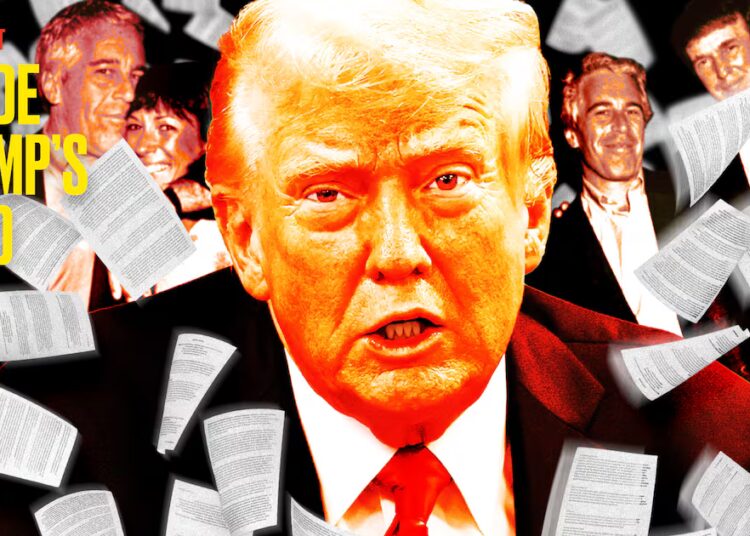
A corollary to Lincoln, that you can’t fool all the people who voted for you all the time, explains the sharp decline in President Trump’s approval ratings.
A significant share of the voters who backed Mr. Trump have decided that he has largely ignored the primary issue that pushed them his way, the cost of living. A billionaire regularly mocking concern about affordability only makes matters worse. They see him as distracted by personal obsessions and guilty of overreach, even when they sympathize with his objectives. Many of his former supporters see him breaking promises he made, notably on not messing with their access to health care.
Some abuses are too blatant to be ignored. A recent The Economist/You Gov poll found that 56 percent of Americans said Mr. Trump was using his office for personal gain; only 32 percent didn’t. A similar 56 percent saw Mr. Trump as directing the Justice Department to go after people he saw as his political enemies; just 24 percent didn’t.
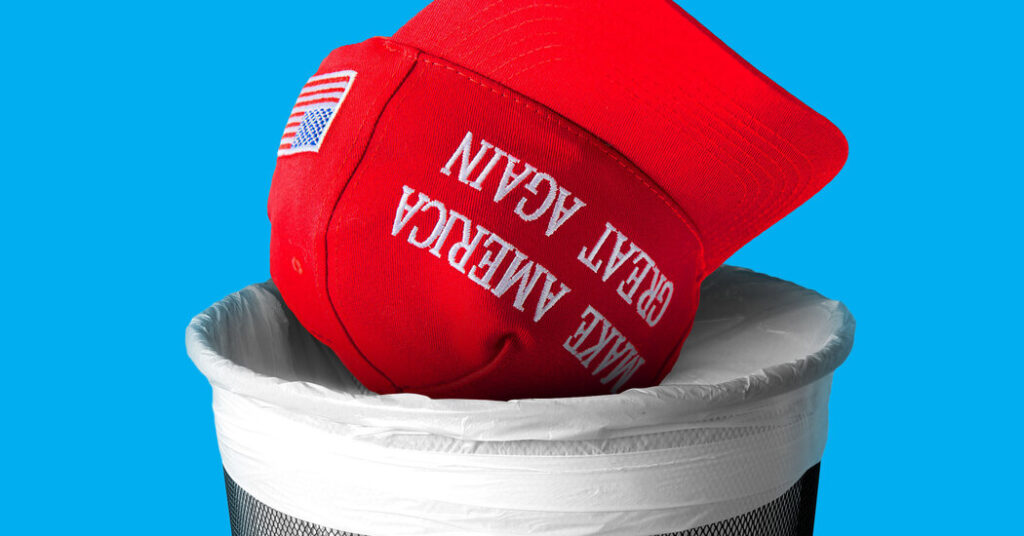
The upshot: A great many Americans who helped put Mr. Trump in office have absorbed what’s happened since. They may not be glued to every chaotic twist of this presidency, but they do pay attention and have concluded, reasonably, that this is not what they voted for.
How many? Let’s take Mr. Trump’s 49.8 percent of the 2024 popular vote as a base line and compare it with his approval ratings. A New York Times analysis of public polling this month found his net approval rating had dropped to 42 percent. A A.P./NORC poll and a Gallup poll pegged it at 36 percent. This suggests that 15 to 25 percent of his voters have changed their minds.
I think of these shifts as the triumph of reasonableness — and not because I agree with where these fellow citizens have landed (although I do). I’m buoyed by the capacity of citizens to absorb new facts and take in information even when it challenges decisions they previously made. It turns out that swing voters are what their label implies. The evidence of their own lives and from their own eyes matters.
All this is obviously good news for Democrats, who extended their 2025 hot streak by winning the mayoralty in Miami on Tuesday. But it’s more than that. It dispels myths about Mr. Trump’s having magical powers to distract and deceive. It shows that for all the legitimate concerns about the breakdown of our media and information systems, reality can still get through.
The decay of Mr. Trump’s standing is a rebuke to widespread claims a year ago that his victory represented a fundamental realignment in American politics, akin to those led by Franklin D. Roosevelt in the 1930s or Ronald Reagan in the 1980s.
Never mind that Mr. Trump’s 49.8 percent of the popular vote fell far short of Roosevelt’s 60.8 percent in 1936 and Reagan’s 58.8 percent in 1984. Never mind that Mr. Trump defeated former Vice President Kamala Harris by just 1.5 percentage points nationwide.
The case for a Trump realignment was built in large part on Republican wishcasting and Democratic despondency, married to a few facts, including substantial Trump gains among Latinos and young men. True, the Republicans secured majorities in the Senate and the House. But the G.O.P. won two fewer seats in the House in 2024 than it did two years earlier — far from the sweeping gains typically yielded by realigning elections.
One of the most emotive factual artifacts of the election was an excellent New York Times county-by-county map that portrayed a sea of red arrows across the nation, reflecting the increase in Mr. Trump’s share of the vote from four years earlier in nearly 90 percent of the nation’s 3,144 counties. Some of his largest gains were in solidly blue states such as New York, New Jersey, California and Massachusetts.
But a nationwide trend in a single election is not the same as a realignment, and the president’s mercurial extremism squandered whatever opportunity the G.O.P. might have had to expand its map. My hunch is that Republicans will regret what they allowed him to throw away.
The Times again produced those fine county maps for the 2025 governor’s races in New Jersey and Virginia and the recent special House election in Tennessee. But this time, nearly all the arrows were blue, pointing toward the Democrats, and G.O.P. gains among Latinos and young men were largely wiped out. Genuine realignments don’t collapse so quickly.
Another response to 2024 was a backlash against Trump voters. Mr. Trump does better with voters who lack college degrees, and he once declared, “I love the poorly educated.” Some who were aghast at his victory blamed the outcome on the irrationality of low-information voters.
But to view some large share of the electorate as irrational is wrong and ought to be anathema to anyone who claims to hold a democratic worldview. Far more persuasive is the analysis that the political scientist Samuel L. Popkin offered in his 1991 book, “The Reasoning Voter.” He provided a wealth of data to show, as his title implies, that voters “actually do reason about parties, candidates and issues.” They draw on “information shortcuts” to “think about who and what political parties stand for” and “what government can and should do.” They engage in “low-information rationality.”
That so many swing voters used a Trump vote to express their dissatisfaction with the 2024 status quo has certainly had calamitous consequences. What should hearten friends of democracy is how many voters have weighed what Mr. Trump has done and found him acting, well, unreasonably.
Especially striking are the findings of a Public Religion Research Institute poll this fall that asked whether Mr. Trump had gone “too far” in a variety of his actions. Among respondents, 54 percent said he had gone too far on tariffs, as did 55 percent on cuts to grants to universities and 60 percent on cuts to Medicare, Medicaid and the Affordable Care Act. Mr. Trump and the G.O.P. are especially vulnerable on cuts to enhanced Affordable Care Act subsidies: A KFF survey last month found that 74 percent of Americans said they should be extended, not eliminated.
Even on immigration, Mr. Trump’s signature issue, his radical approach was unpopular: In the Public Religion Research Institute poll, 65 percent of respondents opposed deporting undocumented immigrants to foreign prisons, 63 percent opposed arresting undocumented immigrants who have resided in the United States with no criminal records, and 58 percent said that Immigration and Customs Enforcement officers should not conceal their identities with masks or use unmarked vehicles.
Mr. Trump’s opponents have no cause for complacency. In the wake of the 2008 financial implosion, the pandemic and postpandemic inflation, volatility and unhappiness have been hallmarks of public opinion. Poll numbers are fickle.
But in 2025, Trumpian flimflam hit its limits — even in the G.O.P. when a majority of Republicans in the Indiana State Senate defied the president’s demand for a midterm congressional redistricting. His power to intimidate is ebbing. A reasonable majority exists. It’s searching for alternatives to a leader and a movement it has found wanting.
E.J. Dionne Jr. is the author of “Why Americans Hate Politics,” “Our Divided Political Heart,” “Why the Right Went Wrong” and, most recently, “100% Democracy,” with Miles Rapoport.
Source photographs by Peter Dazeley and blackred/Getty Images
The Times is committed to publishing a diversity of letters to the editor. We’d like to hear what you think about this or any of our articles. Here are some tips. And here’s our email: [email protected].
Follow the New York Times Opinion section on Facebook, Instagram, TikTok, Bluesky, WhatsApp and Threads.
The post The Reasonable Majority Is No Longer Silent appeared first on New York Times.