It’s hardly surprising that, in an electric world where Jell-O-mold cars are designed for creating the least drag, so many motorheads are yearning for the auto aesthetics of yesteryear. After all, classic cars from the 1970s and earlier undeniably had style—trouble is, auto companies don’t make them anymore.
That’s a sales boon for restoration workshops, but, barn finds notwithstanding, the supply of period vehicles is inevitably limited. But this scarcity has resulted in an opportunity for an Indonesian firm, which, in a legal gray area, handcrafts drop-dead gorgeous copies of the 1950s Mercedes 300SL Gullwing and other legendary sports cars.
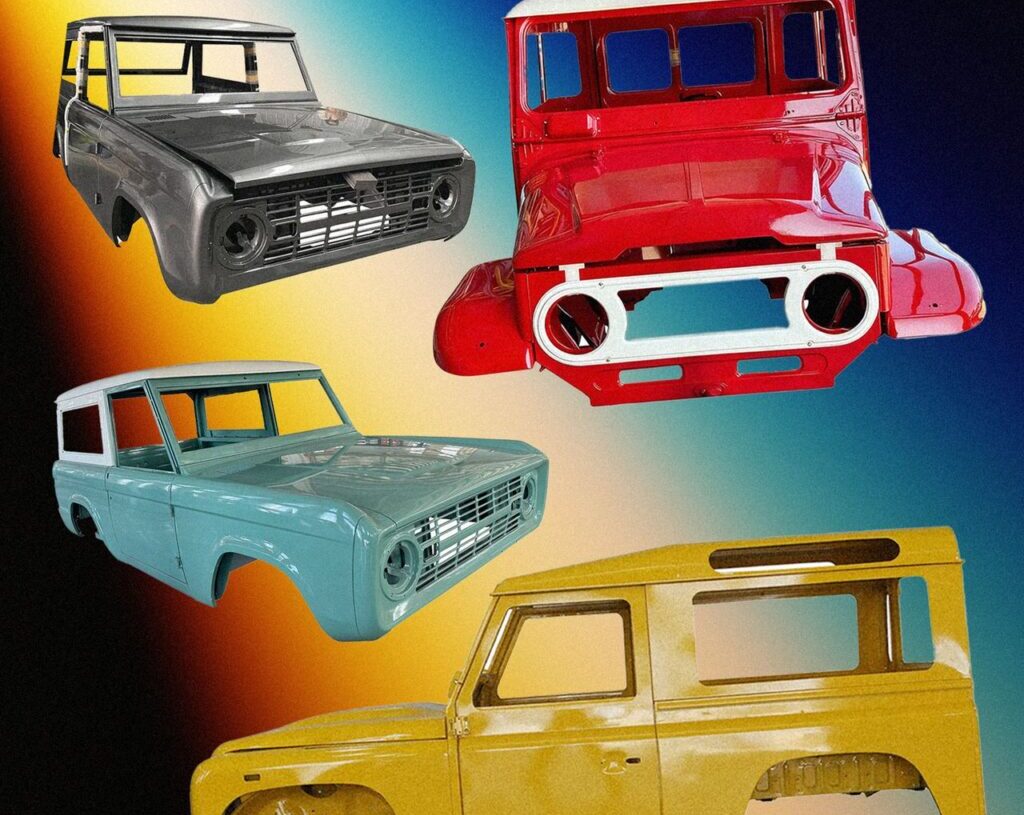
And it not just Indonesia. Chinese factories are stamping out 3D-scanned body shells for icons such as Ford Broncos of the 1960s and 1970s, and more recent Land Rover Defenders from the 1980s and 1990s.
Equipped with the latest technology, today’s cars are safer and easier to drive than vintage ones, and thanks to AI-infused software stacks and smartphone hook-ups, more personalized, too. Still, they can be dull to drive, and, as if designed in a wind tunnel by committee, often lack individuality. Squint and the Nissan Rogue looks like the Kia Sorento; ditto for the Porsche Cayenne and its Volkswagen Group stablemate, the Audi Q5.
Voluptuous vintage cars may creak, but those that have achieved classic status ooze personality. (To collectors, “vintage” and “classic” refer to cars from specific eras, but in this article the terms are used in their general sense.) Hagerty estimates that there are 45 million such vehicles in the US, worth $1 trillion.
Selling to affluent collectors (almost all of whom are men), there are automotive ateliers in the US and Europe which make “replicars” aping classic outlines from the past. Some equip these new-old cars with non-period flourishes such as polished side exhaust pipes, rear-view cameras, and features now either common or mandatory on modern cars, such as power windows and reinforced frames.
Bodyshell Boom
One of the most copied period cars—usually made under license—is the Shelby Cobra, a sports car developed by American automotive designer and race car driver Carroll Shelby, and manufactured in the early 1960s by British company AC Cars. Originally hand-built with a curvaceous aluminum body, many of the replica Cobra shells now made in the US are popped out of fiberglass molds.
If historicity is preferred, there are also workshops that restore and modify genuine vintage cars, upgrading these “restomods” with beefier brakes, performance engines, and full-blast aircon units. Land Rover in the UK sells “remastered” pre-2016 Defenders for $305,000, while Helderburg of Arkansas takes 25-year-old Defender bodies and rebuilds them with in-house machining, hand-shaped components, and customized cockpits, adding Focal audio systems, Apple CarPlay, and a Tesla-style multi-camera cloud-based security system.
While the Helderburg Lazare, available for $376,000, has a reworked turbo diesel engine, some restomod shops have clients who wish to switch to electric. British specialist Electrogenic transformed Jason Momoa’s 1929 Rolls-Royce Phantom II into a restomod EV. Kindred Motorworks, which works out of a former naval shipyard on Mare Island, San Francisco, bolts proprietary electric motors and batteries into antique Ford Broncos, which, once finished, retail for more than $200,000.
Vintage Ford Broncos and Land Rover Defenders are, apparently, among the most prized period cars restored, modified, and upgraded by restomod shops, according to Lance Stander, CEO of Superformance of California and Florida, licensed maker of upmarket Shelby Cobra cars, some of which his company now equips with electric drivetrains.
“The original Ford Bronco was underpowered, had bad suspension, and was a stereotypical gas guzzler,” says Bill Schwartz, author of Restomods: The New World Order of Handcrafted Cars. Schwartz claims that by adding in better powertrains, overhauling the interior, suspension, brakes, and wheels, the Bronco “becomes a spectacular crate.” Schwartz adds that the classic Defender, once given the modern conveniences that people want, “are more sought after than ever.”
And this popularity is why Chinese factories now make and market, via Instagram especially, brand-new but period-correct Bronco and Defender body shells at prices drastically lower than official parts.
But with these nostalgia-infused shells increasingly available, there’s likely a sizable number of immaculate builds on US roads that are far less authentic than they look. “A lot of the Defenders on the market are replicas,” confirms Helderburg CEO Paul Potratz. “Most people are not aware of this, and it’s really no different than buying a fake Rolex in my mind.”
There also appears to be a growing market for what some original makers might consider counterfeits, but which buyers and workshops call “continuation” cars. Some auto brands have sold rights to classic models to agents, which, in turn, license replica makers, the best of which use the same blueprints, materials, and building techniques as the original brands.
“Copying something is the best form of flattery,” says Paul Lucas, a kit car enthusiast from England who has built a succession of replica cars, including a faux Ferrari. “I never pretended to pass it off as the real thing, though.”
Driving Sales Outside China
Out of its three production bases covering 120 acres in China’s Jiangsu province, Juncheng makes, among many other brands and models, 1960s- and 1970s-era Bronco and 1980s- and 1990s-era Defender body shells, selling via Alibaba as well as on its website carbody.com. And now the company with 300 staff run by Western 4×4 fan CEO Bruce Guo is developing a ground game in the US and Europe, taking space at motoring expos.
Exhibiting recently at a Land Rover enthusiast show in the UK as well as the Frankfurt auto show, Juncheng also displayed its newly formed body shells and panels on a spacious booth in the international pavilion at the gargantuan SEMA Show in Las Vegas, a motor accessories expo organized in early November by the Specialty Equipment Market Association.
“While the majority of SEMA’s members are American companies, the automotive aftermarket is a global marketplace, where competition is valued, and a variety of choices benefit automotive enthusiasts,” SEMA’s senior director for federal government affairs Eric Snyder tells WIRED.
Asked to view Juncheng’s website, where the company not only sells classic car components but modern parts, too, including Tesla panels, Schwartz assesses that, crucially, the company is “not claiming the factory is making authorized parts or making [them] under license. They’ve got the right-shaped bodies, but they’re not claiming they are official.” Schwartz compares Juncheng’s seemingly accurate body shells to merely “making a shape” and that “anybody can make a t-shirt.”
Schwartz adds that protecting international trademarks is tough, and “to stop Chinese factories is a deep-pockets endeavor.” Crucially, these body shells aren’t just available in China, or being shipped to individual buyers in the US and Europe. Juncheng is exhibiting at international car shows to establish overseas stockists and representation. The pricing is keen, too—its brand new complete 1966-1977 Bronco body retails at less than $12,000.
“Why would you even consider buying Chinese junk?” asked a member of a Bronco restoration forum earlier this year, eliciting the reply: “Where do you think all the body parts the US-based builders are using come from?”
SEMA may wish to protect US producers, but its influential show attracts exhibitors from around the world, not all of whom might be considered entirely legitimate by Ford, Ferrari, JLR, and other leading auto makers.
“SEMA strongly believes in the protection of intellectual property rights,” Snyder stresses. “SEMA encourages its members and show exhibitors to obtain legal protection for the parts and equipment they produce, and has processes in place to prohibit companies from displaying products at the SEMA Show that infringe on patents, trademarks, and other IP violations.”
Can You Copyright a Car Shape?
A key violation—or not, depending on the lawyer you ask—is the copying of a silhouette, known to IP wonks as a “shape mark.” This is a type of three-dimensional “trade dress” consisting of a recognizable shape associated with a brand. The best known such shape mark is the one registered in 1960 for the Coca-Cola bottle.
According to an automotive IP specialist at the international law firm DLA Piper, trade dress must be distinctive rather than merely decorative, and the design cannot be primarily practical. If the design makes the vehicle or part more useful for its purpose or provides benefits in its production or use, it will be deemed functional and not protectable.
“Protecting a car shape is often difficult because the car shape often has to have ‘acquired distinctiveness,’” says DLA Piper partner Michael A. Geller. “That means the car shape is not protectable as soon as the model is developed and released. Instead, it has to be used over a sufficient period of time and, due to that use, consumers associate the shape with the manufacturer. If a car part is not protected by trade dress, it can often be copied. Car companies have tried to get protection for certain car parts through a design patent which are not protectable as trade dress. Some car companies have sued aftermarket parts providers over these parts.”
It’s often foolhardy for companies based in Europe or the US to sue supposed trade dress transgressors based in Asia. Tuksedo Studio of Indonesia gets rave reviews from car websites for its faithfully reproduced 1950s and 1960s supercars—such as the Porsche 550 Spyder, and Toyota 2000GT as well as the Mercedes 300SL Gullwing—but as it’s hand-building them for a domestic audience and not for export, it’s unlikely that Mercedes and the others will sue.
“A plaintiff is going to take action only in a jurisdiction where it has rights in its trademark or trade dress,” says Geller, “and where the defendant distributes a product that infringes that right. There is some complexity to that question, especially under US law about whether the US trademark law can touch foreign commerce. A car company could have all kinds of reasons for not taking action against the Indonesian company, including its size and desire to save costs. But, overall, a car company would be more likely to take action if these types of cars were made or imported into the US, or the company’s home jurisdiction.”
For Ford or JLR to take action against Juncheng, and other Chinese makers of full body shells, such as Jiangsu Gugao (trading as GBT Auto) and Aodun, it would require the Western companies to defend trade dress not of today, but from 40 or more years prior, and that trade dress has to be non-utilitarian.
“Trade dress must specifically be described,” stresses Geller. “So, you couldn’t just say that your trade dress covers the full body shape. You’d have to carve out the functional elements.”
It’s not known whether Juncheng, Jiangsu Gugao or Aodun have been chased for trade dress infringement by Ford or JLR, owner of the Land Rover brand. WIRED contacted all three companies for comment on this matter for this article, but got no reply. “JLR takes the protection and enforcement of its intellectual property rights seriously, but does not comment on specific cases,” a JLR press officer tells WIRED.
In 2020, JLR was unsuccessful when a London court dismissed the firm’s appeal relating to the shape of its Defender. JLR claimed the shape had acquired a distinctive character, but was challenged by Ineos Group’s CEO Jim Ratcliffe after he unveiled the firm’s Grenadier in July the same year. Ratcliffe’s off-roader is similar in appearance to the pre-2016 Defender.
JLR appealed, but the UK’s High Court upheld the findings by the UK’s Intellectual Property Office that the Defender design wasn’t distinctive enough, and that while any differences in design may appear significant to vehicle specialists, they “may be unimportant, or may not even register, with average consumers.”
Also, in 2020, Ferrari lost a legal battle to trademark the shape of its legendary 250 GTO to Italian bespoke car manufacturer Ares Design, which argued that Ferrari had not put its trade dress shape to genuine use for a continuous period of five years since the 1960s. Ford was approached for this piece, but provided no comment by the time of publication.
Cheaper, Stronger
For Juncheng, business is apparently good—it now sells in 90 countries, and the company says its attendance at international car shows is driving interest. “Many international modification manufacturers and dealers have shown a strong interest in cooperating with Juncheng’s products,” it says on its website, “and have conducted in-depth discussions on the technical details of specific products, the possibility of OEM cooperation, and market agency matters.”
“The fact that there are now [new] sources for full car bodies is significant,” says Ed Kim, chief analyst for industry researcher AutoPacific of Long Beach, California. But, Kim adds, buyer beware: “OEM bodies are built to exacting standards. Not just for fit, but materials and quality of welds, too. Bodies made of cheap sub-par steel may not only experience premature corrosion, but they may be much less robust and safe in the event of [a crash].”
Classic Broncos from the 1960s, however, used standard automotive-grade steel that likely had a tensile strength around 300 to 400 MPa. Juncheng lists the approximate tensile strength of it parts online, claiming its chassis components, for example, are made out of steel with a tensile strength between 400 to 600 MPa, mirroring other modern aftermarket frames in being stronger than original OEM parts.
Regardless of quality, any influx of Chinese body shells will force domestic suppliers to raise their game. “If there are a lot of unlicensed cheaper alternatives out there,” says Kim, “that puts price pressure on the legitimate licensed suppliers. It will be upon them to show the customer the benefits of spending more.”
The post The Instagram-Fueled Boom in Copycat Vintage Car-Body Shells appeared first on Wired.