Nestled in the sky-high plateaus of the Chilean Andes, amid grazing alpacas and clear water streams, the squat adobe houses of Indigenous farmers now had tall aluminum gates and iron grilles welded to their windows.
“I live in fear,” said Erika Moscoso, 57, a baker born in the village, who recently installed locks on her doors for the first time to ward off criminals. “We never had this before.”
That fear has filtered through Ms. Moscoso’s sun-scorched patio in the small village of Cariquima, near Chile’s northeastern border with Bolivia, and spread down the country’s spindly length to the capital, Santiago, and extending south into Patagonia.
A sharp increase in murders and other violent crimes in recent years, fueled by the rapid expansion of international criminal groups, has shaken a country long accustomed to relative safety, becoming a dominant political issue likely to help push Chile to the right in a presidential election on Sunday.
But fears over violence extend well beyond Chile.
Across Latin America, organized crime has surged over the past decade, with violence gripping once peaceful countries like Chile, Costa Rica and Ecuador. Polls show that in at least eight countries, including Chile, security is the dominant voter concern, driving many Latin Americans to demand iron-fisted measures and show a greater tolerance for tough-on-crime policies.
That has made a role model out of President Nayib Bukele of El Salvador, who has cracked down on civil rights in order to drastically lower his small nation’s crime rate.
Some leaders, like President Rodrigo Chaves of Costa Rica, have sought to emulate Mr. Bukele’s hard-line security measures, which have even drawn unexpected interest from Uruguay’s leftist president.
In Chile, the issue of security has bolstered the popularity of right-wing candidates, including José Antonio Kast, who is likely to be elected president and met last month with Mr. Bukele’s security minister. Crime has also become a key concern likely to influence elections next year in Peru, Colombia and Costa Rica.
“Organized crime is a hugely transformational force,” said Will Freeman, a fellow for Latin America studies at the Council on Foreign Relations. “Now the region is sorting out the downstream consequences of it.”
Chile is still one of the safest countries in Latin America, and some question the severity of a crisis that is an interplay between reality, politics and public perception. But few dispute that crime has traumatized Chileans in profound and consequential ways.
Across Chile, homicides reached a record high of 1,322 in 2022, government figures show, and though that number fell to 1,207 in 2024, that is still 43 percent higher than in 2018. Less than 40 percent of Chileans feel safe walking at night, according to a Gallup survey. In the United States, that figure is 70 percent.
The crisis started in the north.
At the onset of the coronavirus pandemic in 2020, tens of thousands of migrants, mostly Venezuelans fleeing economic collapse, started trekking through the Atacama Desert to Iquique, a sprawling port city about 900 miles north of Santiago with skyscrapers wedged between a giant sand dune and the Pacific Ocean.
Local authorities became overwhelmed with what they described as a humanitarian and sanitary crisis, with children walking over the pampas amid hard-blowing winds and makeshift encampments taking over the city’s neoclassical plazas.
Though people who have committed crimes are a tiny fraction of the hundreds of thousands of Venezuelans who have arrived in Chile, prosecutors, the authorities and experts say the influx has also included gangs, whose victims are frequently other migrants.
Renzo Trisotti, a lawmaker from Iquique and a member of Mr. Kast’s party, said the increase in migration and crime has created a “very dangerous effect of xenophobia” in the city, which has historically been a cosmopolitan mix of Indigenous communities, Europeans, Asians, Bolivians and Colombians.
“People asked me very firmly to be extremely hard on illegal immigration,” he said.
During a protest in Iquique in September 2021, people burned mattresses and clothing belonging to homeless migrants and chanted “Chileans first.”
Mr. Kast, then a candidate for the 2021 presidential election, traveled to the region, railing against immigration and crime and promising to dig ditches along the frontier. His popularity soared, but he was defeated a few months later by Gabriel Boric, a left-wing leader whose promises of equity and social justice were embraced by voters as bigger priorities.
Since then, worries over security have intensified, and Mr. Kast has mobilized more voters around the issue.
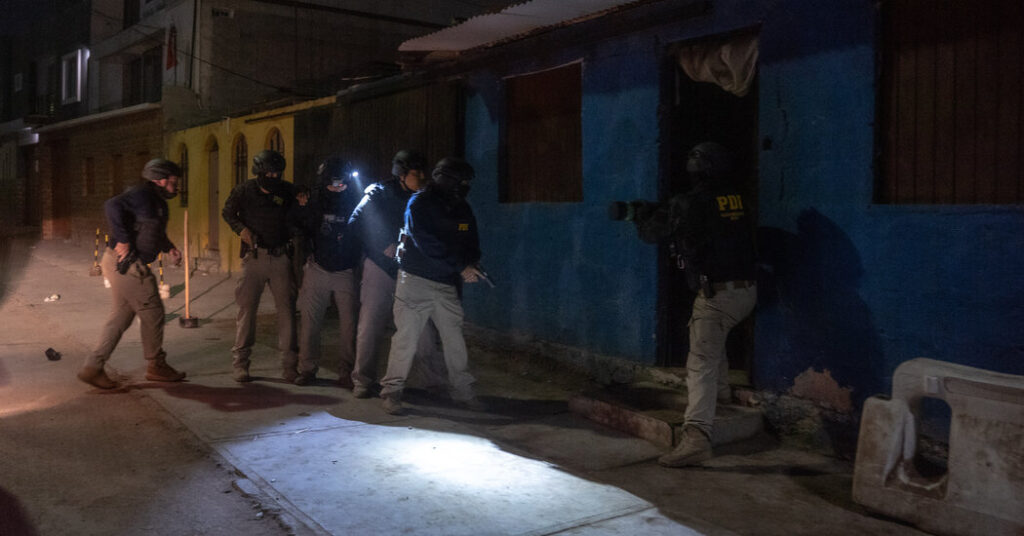
In Iquique, disturbing police reports started documenting a type of violence that was unlike anything Chile had ever known.
“People tied up with a bullet in their head, burned inside a car, murdered and torched,” said Mauricio Macchiavello, the city’s mayor. “Things we never imagined.”
The police said criminal gangs, like Tren de Aragua from Venezuela, had also migrated to Chile and sunk their teeth into Iquique, a city of about 200,000 people.
The number of murder cases in Tarapacá, a region that includes Iquique, climbed to 53 in 2021, from 20 the previous year, according to government data.
In 2022, three people killed by machete were found in a pet cemetery in the region and the body of a trans woman washed ashore on a beach in Iquique, and the authorities accused two Colombian men of killing her. This year, a Venezuelan man was stabbed more than 70 times and decapitated. “Ruthless,” said the head of the regional police, Mauricio Jorquera Ramírez.
“I don’t know if tomorrow there will be a mugging and a gunshot on a street corner,” said Franchesca Barraza Campos, who lives in Iquique.
Still, in many ways, the situation in Iquique has improved. The government deployed the army to the Bolivian border in 2023, and the number of migrants the authorities say they intercept has dwindled from hundreds per day to a few dozen. The number of killings in Tarapacá has fallen significantly after Mr. Boric has created special organized crime and homicide teams and cartel leaders were prosecuted and convicted.
Still, in Iquique, any talk of improvement has been subsumed by the louder clamor about the crisis around crime and migration.
“It stuck,” Mr. Macchiavello, Iquique’s mayor, said. “The fear took hold.”
In Quebe, a small village on the road from the Bolivian border to Iquique, an 83-year-old woman was killed in her home this year. “It pains me and it scares me,” a neighbor of the victim, Cipriana Vasquéz, 60, said, bursting into tears.
As Ms. Vasquéz, a quinoa farmer, walked through town pointing at broken windows and other signs of vandalism, she said her neighbors had insisted that she vote for Mr. Kast.
Mr. Kast has made security his top priority and has promised to change Chilean law to make it a crime to enter the country without authorization. He has vowed to build a “physical” barrier along Chile’s borders, echoing President Trump’s border wall.
Mr. Kast has also warned illegal migrants to self-deport or face deportation if he is elected. His warnings have pushed some migrants to cross into Peru, prompting José Jeri, the Peruvian president, to declare a state of emergency at the border.
As in other countries in the region, crime has soared in Peru in recent years, particularly extortion. Many Peruvians favor applying a heavy hand to criminals, a poll this year found, even if it crosses the line and risks ensnaring innocent people.
In Costa Rica, Mr. Chaves has adopted a tough stance as the security crisis deepens, touring El Salvador’s notorious maximum-security prison and announcing plans to build one in his country.
“A growing part of the public in Latin America is saying, ‘Maybe it’s worth trading some democratic freedoms and rights if necessary to empower the state to take a harder line against these criminal groups,’” Mr. Freeman said.
The rise in crime is not universal. In Brazil and Mexico, the two most populous Latin American countries, the homicide rate has decreased in recent years, though experts say that does not mean criminal organizations have grown less powerful.
In Ecuador, which has become a global drug corridor, President Daniel Noboa has declared 14 states of emergency. When four children were killed during a military patrol, after being mistaken for gang members, Ecuadoreans were shocked, raising questions about the costs of cracking down on crime.
In Chile, even some voters who reject Mr. Kast’s conservative stances opposing abortion and same-sex marriage say they would be willing to trade those rights for increased safety.
“I don’t like that he wants to go back on things on which we progressed,” said Mirna Matcovich, 68, a retired accountant in Iquique. “But we need him to bring back order.”
Reporting was contributed by John Bartlett from Iquique, Chile; Genevieve Glatsky from Bogotá, Colombia; Mitra Taj from Lima, Peru; Emiliano Rodríguez Mega from Mexico City; and José María León Cabrera from Quito, Ecuador.
Emma Bubola is a Times reporter based in Rome.
The post The Crime Wave Reshaping Latin American Politics appeared first on New York Times.