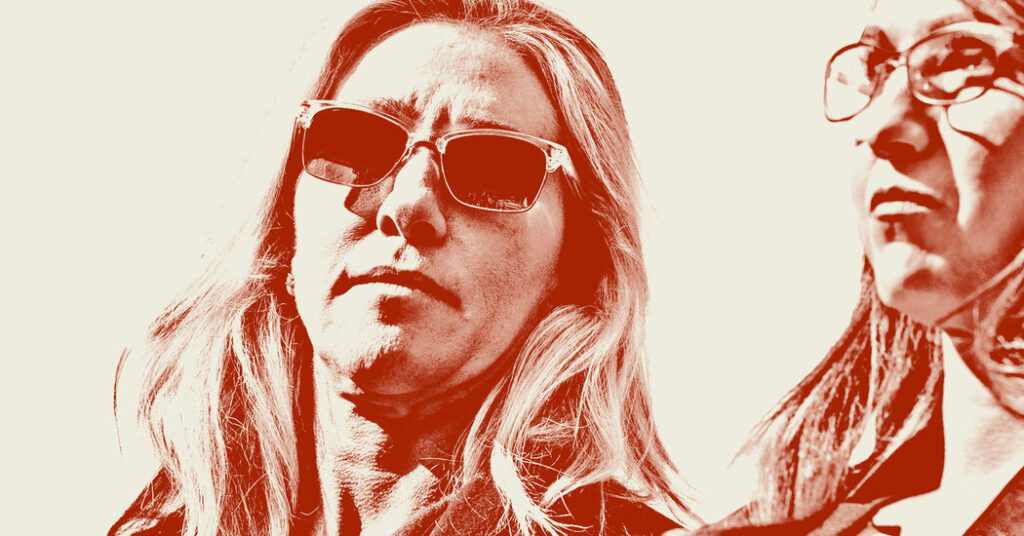
The Republican Party has a misogyny problem. Congressional members like Marjorie Taylor Greene, Lauren Boebert and Nancy Mace have been pushing past their party’s patriarchal views and fighting back. On this episode of “The Opinions,” the columnist David French is joined by the Opinion national politics writer Michelle Cottle and fellow columnist Jamelle Bouie to discuss how Republican women are standing up to their party and whether President Trump’s view of women will leave a lasting mark on conservative politics.
Below is a transcript of an episode of “The Opinions.” We recommend listening to it in its original form for the full effect. You can do so using the player above or on the NYTimes app, Apple, Spotify, Amazon Music, YouTube, iHeartRadio or wherever you get your podcasts.
The transcript has been lightly edited for length and clarity.
David French: I’m David French, a columnist for New York Times Opinion, and today I’m joined by my colleagues Jamelle Bouie and Michelle Cottle. Jamelle and Michelle, hello.
Michelle Cottle: David, hello.
Jamelle Bouie: Hello.
French: So today we’re going to talk about women, specifically women in the Republican Party. For months after the 2024 election, there’s been a lot of talk about Democrats’ problems with men.
But now it’s clear that Republicans have a lot of problems with women, and these problems may be really accelerating. They’re breaking out into the open. We’ve seen women challenging some of the highest-profile leaders of the Republican Party, from breaking with Donald Trump, for example, in the Epstein files, and for breaking with Mike Johnson.
Also, we’ve seen a lot of wildly reactionary sexism in different corners of the right, from people being hired at leading national conservative groups to weird goings-on and student groups on campus. So there’s a lot going on here, and Michelle and Jamelle have been taking a look at this.
So I want to start with a kind of mini-rebellion that we’ve seen from some of the women in the House. You report on Congress, Michelle. You’ve written about this issue. What’s the lay of the land here?
Cottle: OK, so you pointed to the highest profile one of these, which is when three Republican women — and we’re talking Marjorie Taylor Greene, Lauren Boebert, Nancy Mace. We’re not talking squishy RINO, whatever. They broke with Donald Trump and with leadership to push and force a House vote to release the Epstein files, and it got ugly. Trump was bullying them. He wound up in such a nasty feud with Marjorie Taylor Greene that she has wound up saying she’s resigning from Congress early. But there have been other episodes as well.
Elise Stefanik, who is a member of leadership and a loyal Trump soldier over the years, has been going hard at Mike Johnson over some policy disagreements, has accused him of lying. Nancy Mace has broken with leadership and tried to censor one of their colleagues who has come under allegations that, among other things, he has mistreated women. And Mace and others have said they’re not happy with how leadership has handled this problem.
Then you just have more nebulous, generic, broad-based complaints. There’s been reports by multiple news organizations that Republican House women are unhappy with this speaker and leadership plan in particular, in terms of how their issues are treated. They feel like they’ve been passed over for opportunities. It’s getting a little bit tense over there, which is a long-running problem for the party, but it’s getting even hotter these days.
French: It seems as if the right, especially the new right, really lionizes women who absolutely fall in line and who are absolutely obeying the party line. So they’ll lionize them as mama bears, for example, when they’re taking on left-leaning school boards. But so long as they are loyal foot soldiers implementing the party’s will, they are celebrated: Look, we’re not sexist at all. Look at how much we have put forward these really strong women as part of the right.
But as soon as there’s any mold-breaking here, as soon as they start to not fit exactly with what sort of the dominant party line is, the turn is incredibly rapid and incredibly vicious. There seems to be really no tolerance for disagreement and dissent, and perhaps even extra special venom directed at them. Are you seeing this, Jamelle? Are you finding any of this surprising at all?
Bouie: No. I was going to say, this feels very much like a dog-bites-man situation. You have a political movement whose genesis — we talk about the beginnings of Trumpism in terms of its nativism and xenophobia and racism, etc. But its genesis includes anger, and disdain for opposition to high-profile female leadership. Trump likely isn’t as successful in 2016 if not for Hillary Clinton being his foil.
And the extent to which Trump, in that election and in this past election, defines himself against female leadership — defines himself as defending, not just conservatism, but a masculinist vision of conservatism, one that is predicated on male dominance, cannot be obscured, cannot be hand-waved away. That’s part of the ideological basis for the political movement. There’s been much conversation about how Trump attracted young men to his campaign last year. When that’s part of the ideological formation, part of the social formation of the movement, then it is no big surprise that when that’s placed on top of a political tradition that has always had female leadership or women leadership, but has always also been uneasy with that given the traditionalist impulses of a large part of the coalition, none of this comes as that big of a surprise.
To the observation you made, David, I think one of the things that’s happening here is that as long as women in the movement are within their proper sphere, which is some variation on the home — it was useful that you said it’s school boards. That’s school boards, children, the home. So women can exercise leadership when it comes to that because it relates to the home, the domestic sphere.
I was just thinking — I’m going to make this point somewhat by way of comparison. Ben Carson was secretary of housing and urban development in the first Trump administration. I forget the name of the current HUD secretary, but he’s also an African American man. There’s been a joke, perhaps a note asking: Does Trump think that HUD is the Black cabinet department because of the word urban? Does Trump think that homeland security is the woman-cabinet department because it has home in the name? And certainly both of Trump’s education secretaries have been women — again, education, the home. So within the designated spheres, there is no problem with women in leadership. But once it goes beyond that, once it’s trying to exercise a larger, more comprehensive leadership position to Marjorie Taylor Greene, not simply acting as a representative for her district, but really trying to speak on behalf of MAGA itself, then there’s an issue.
It’s not just the dissent; it’s the fact that, for lack of a better term, you’re kind of getting uppity, and we have to cut that out. We have to knock you back down to where you belong, which is: You can have leadership, but only within spheres reserved for women.
French: It’s very interesting to me because I’ve been living in the middle of MAGA country for almost all of the last 10 years. And I think that a lot of people don’t get how wildly diverse parts of the MAGA coalition have become.
So on the one hand, you might have what you would call your not particularly religious anti-woke heterodox, some of them running away from the center left, who joined the coalition. For a lot of these folks it would be strange to think of the woman’s sphere as the home. Then you have a hyper-traditionalist, fundamentalist Christian movement that is even more loyal to Trump than his anti-woke heterodox folks, that has an extraordinarily and increasingly hierarchical and patriarchal view of women.
So, for example, you guys might be familiar with the podcaster Allie Beth Stuckey, who’s very conservative and very much loved and adored by large parts of the traditionalist right. And yet she endured an online storm because she spoke at a gathering where she said men shouldn’t be watching porn. That was seen as a woman scolding a man, and that’s inherently improper. These two different worldviews don’t really meet very well, but they’re under the same big Republican tent.
And so, Michelle, I want to go to you and get a little historical context. Can you walk us through some of the G.O.P.’s recent history with women, with powerful female leaders and female pundits, influencers? What’s been the lay of the land pre-MAGA up until this moment?
Cottle: So it is important to remember that this is not something that Trump has wrought. It is just something that he has exploited. And as we always say, dialed up to 11. If you just want to go back to 2012 with the post-Romney kind of meltdown of the party worrying about the famous autopsy, there was this movement among Republican women operatives, big fund-raisers — they were trying to make the party more palatable to women, to lose the kind of anti-woman reputation that it had gotten. There were those episodes with Todd Akin talking about “legitimate rape,” those sorts of things.
We’re talking about Elise Stefanik. She was trying to lead her party in a direction that would get more women into the game, whether you were fund-raisers — Mitt Romney’s old deputy campaign manager started a consultancy that was aimed at this. I talked to tons of fund-raisers, and then Trump hit. The party went from being OK with these women doing this, even when it made them a little uncomfortable, because it cuts against the whole idea that you shouldn’t worry about gender. That whole kind of “we can’t even get near identity politics.” So how can we possibly be promoting a particular gender with a program?
It went from being mostly OK with that, to just being like: We don’t care anymore. We’re just going to go all in on this. It’s like: Look at this guy. He’s basically the crudest, most vulgar, sexist creature on the planet, and people love him. So, at that point, you saw those gains in terms of women leaders having a little more backing for their plans. But now, with this most recent election with Trump just going all in on the misogyny and hyper-masculinity, it’s like they’ve lost even more ground. But this has always been an issue for the party. They’ve had a women problem for decades, and they’ve tried to address it in different ways. With Trump, the way they’ve tried to address it is just smack women down as hard as they can on some level.
French: It seems to me you’ve got this very strange dynamic where it’s a one-way ratchet on identity politics. For example, you’re a Republican, you discovered that young men really turned out for you in 2024. Well, doubling down on men isn’t identity politics. It’s just smart politics. But if you realize you have a problem with women trying to do things differently to appeal to women, that becomes identity politics.
Cottle: Because the norm is a white man, David. For the party, the norm is a white man. And it should be what’s in leadership, among others.
French: Also, there’s just this natural tendency to like the groups that seem to like you and dislike the groups that seem to dislike you. So you’re going to rationalize why everyone who likes you is right, and you’re going to rationalize why everyone who dislikes you is wrong. And when it gets into gender dynamics, that dynamic can get really ugly. We have seen circumstances where people on the left have really denigrated young men, and then you see people on the right really trying to jam women into this tradwife box.
Here’s the way I thought about it, and Jamelle, I’d love your thoughts on this. So, as long as you are the loyal character in the play that has been designed for you, like the mama bear role in the school boards, for example, you’re going to be loved, you’re going to be welcome, you’re going to be revered. But if you demonstrate any independence at all, especially if that independence is related to your sex or your race, then you’re going to be drummed out because of the specific experiences you’ve had. Then you become the problem.
You’re woke, you’re horrible, you’re terrible, whatever, and you’re out.
Bouie: Yeah. That seems like a pretty fair description of what the dynamic is. What’s striking to me is how in the last year, Republicans won the presidency, they captured the trifecta. Just a couple of years after the Supreme Court overturned Roe v. Wade, and Dobbs, and Trump was able to successfully distance himself from that decision, despite the fact that it wouldn’t have been possible without Supreme Court confirmations.
And although there was a gender gap last year — quite a large one (there typically is quite a large gender gap) — he overall was able to do pretty well with women across demographics, despite the background conditions. It’s striking to see how much he has squandered that in the year since the election. It’s striking to see Republicans not just failing to respond to their declining position with women voters, especially younger women voters, but continue to double down on this.
I think it’s right to describe it as male identity politics, and a particular kind of male identity politics for maleness is defined against almost traditional masculine values. Trump himself is this petulant, whiny figure who doesn’t take responsibility for his actions. He doesn’t really exhibit any of the traditional masculine virtues — the kinds that might be represented by a Gary Cooper type. You’re getting none of that from Trump. And the figures who have emerged from the manosphere, who have this cultural cache on the worst possible extreme — like the Tate brothers, Andrew Tate. That whole sphere of people, they also represent maleness, or masculinity, as being about a lack of responsibility, a lack of honoring any obligations — masculinity as unfettered license to do what you like and to dominate other people. And I’m of the view that this is primed to inspire a backlash — not simply from women, but from people who find that whole mode of being just not appropriate for public life.
French: There’s a story recently from The Harvard Crimson about a conservative debating society called the John Adams Society. It essentially seems to have put into place a very quiet plan and program to remove women from it entirely. There just aren’t women in the group anymore. I have now heard from a number of people at a number of colleges where, that if you are a conservative woman in college or in law school, you’re finding it tough in some of these student organizations to have any presence, to have any voice at all.
It’s even become pretty well known in certain schools that one conservative group is very friendly to women and another conservative group is absolutely not friendly to women. What I’m seeing is a very meaningful, real-world change where it is actually at the grass-roots level, you’re seeing more and more exclusion and marginalization of women. And this, I think, is going to have a radiating effect. This is daughters calling their moms and dads and saying, I’m shut out. This is young women finding that they are viewed suspiciously for having career ambition at all. My thesis is that this is actually going to end up being far more impactful than any kind of online sexism, which we all know gets confined into the online echo chamber.
And so, Michelle, my question for you is: Am I saying too much? Are you sensing or seeing that this approach toward women is really leaking out into this wider world, that people are experiencing it in their lives rather than watching it on their computers or phones?
Cottle: What I’m worried about is taking that and blowing it up to what we’re seeing at large, which is the huge sorting among younger people. Whatever is driving it — disrespect for conservative women in conservative spheres or the backlash against men being generally piggish. There was a #MeToo backlash among some young men who felt like society had just decided to blame them for everything.
You’ve got all these pieces floating around, which is splitting up the younger generation. The gap between young men and young women on political issues is much bigger than what you see in the older generations. And that’s terrible. I don’t know how you have a society where you’re increasingly driving the genders apart for various reasons and having them just occupy different online spaces, but increasingly just making it awkward for them in real life as well. I’m actually really worried about that.
Bouie: I want to make two points. One is just a quick interjection about the Harvard story. It’s kind of ironic that it’s the John Adams Society, of all places, that’s trying to make a woman-only space unwelcome — given that Abigail Adams was, quite famously, not just John Adams’s wife but his confidante. She had an important influence on his thinking; he was in constant correspondence with her and saw her very much as an intellectual equal. So it’s sort of like ——
Cottle: Irony is dead, Jamelle.
Bouie: —— find a different guy. The second thing is that if I had to diagnose some of this, I think it runs somewhat downstream of what you might call the zero-sumification of American society where everything is considered in zero-sum terms. If this person gets something, then I lose something. And that goes down to, I think, how a lot of young men think about their own prospects. If women are doing well, then I necessarily must be doing poorly. If I’m not 25 and making $100,000, it’s because women are taking the opportunities from me.
French: Right.
Bouie: Which is obviously nonsense. First of all, many young women are feeling lonely and left out. The problems that we associate with young men extend to young women as well. But there isn’t the same kind of societal panic about it. But the other thing is that it doesn’t harm you as a young man or as a man, period, for women to find fulfillment in actualization and get ahead, right?
That isn’t actually a zero-sum equation whatsoever, but I think so many of the cultural and political messages in this society are zero-sum. The other day, I just watched the president talk about this in terms of immigration. We’re getting Somalians and not Norwegians — like very zero-sum. Not the topic of this discussion, but that’s just straightforward racist.
Cottle: But that is important. Trump’s entire worldview is that it is a zero-sum game. You cannot have a win-win as far as he is concerned. That’s how he views all of this.
French: I feel like we are at the precipice of a really dark future, where one party is the party where women are welcome. Please come. Come one, come all. And then here’s this other party. This is where the men are welcome. And come one, come all, if you’re male. So this is this very broad, wide gender gap that we’re starting to see, especially among Gen Z. The question that I have for both of you, who follow the ins and outs of the Democratic Party much closer than I do, is twofold.
One: What really, truly is the Democratic Party like for women? Is it actually a healthier environment for women? And two: What are the prospects for the Democrats preserving an appeal to women while also extending a hand to men, especially those men who are not down with this super, hyper-traditionalist tradwife patriarchal view of women?
Bouie: From my vantage point, it seems that women are an important part of Democratic leadership. The party obviously has nominated two women for the presidency. I call this a cultural issue in terms of how it’s perceived. The unifying thing for the Democratic coalition is a belief in the use of government, and particularly the federal state, to solve problems. And those problems often relate to the domestic sphere. They are health care. They are education, and child care. These are all issues that are associated with the home, that are associated with women.
When people talk about how the Democratic Party is culturally hostile to men, I don’t think that’s true in the sense that if you are a Democratic man, people are going to be mean to you or going to be ostracizing you. That’s nonsense. I think what people are trying to gesture at is that the Democratic Party, and this is not a new thing, is coded as the domestic party. So it’s just ——
Cottle: The mommy party.
Bouie: The mommy party. Right.
Cottle: The mommy party versus the daddy party has been around for decades.
Bouie: The responsible mommy party versus this exciting divorce dad party.
Cottle: OK, I wasn’t going in that direction.
Bouie: That was a joke. But look at the men who are of prominence in the Republican Party right now, like Elon Musk; Donald Trump, who is not a faithful husband — we’ll just say that. The Republican Party is sort of the orbit around which a lot of the tech billionaires revolve — and a bunch of them are also not what you would call the faithful husband.
Cottle: Very bro-ish.
Bouie: It’s very bro-ish. There’s a cultural dynamic happening. And to an extent, I think that just might be baked into the cake. I’m not sure what you can do to change that, because it’s the case that what unites Democrats is this belief in the use of the government to solve problems, specifically problems relating to how people live their lives.
Are there ways I think you could sell that to younger men that might appeal to them? Like, hey, you want to open your own business? Universal health care will make that easier for you. There are ways you can massage that. But in terms of just the basic construct, I’m actually not sure how much you can actually do to separate the Democratic Party from that domestic image in the absence of events that may necessitate military leadership. So for example, F.D.R. leads the United States to the Second World War, and so people also associate F.D.R. with masculine leadership.
The other thought I had is that this is a place where I do not think you can discount Trump’s own image as a kind of patriarch. He has this big family, and he has all this money, and he does whatever he wants. There’s this thing going around on the internet right now — a theory of political behavior — and it’s basically that everyone’s 12. So if you’re Elon Musk, of course you’re obsessed with robots and cars and going to space. You’re 12 years old, right? Trump is like a 12-year-old’s idea of masculine authority.
Cottle: So if you’re looking as a comparison, David, I mean, you’ve got the numbers in the Democratic Party for one thing. Just look at the House. I think there are like 96 women on the Democratic side and 33 Republican women. There’s never been a Republican woman elevated above what is conference chair, which is third or fourth depending on if you’re in the majority or the minority.
You have exactly one woman leading a committee, which is shameful, and it’s not even an elected committee; she got appointed. It’s Virginia Foxx leading the rules committee. So it’s not just what policies are or whatever; it’s just the signals that get sent within the upper echelons of the party as to who matters and who’s important and who’s qualified to lead. And the word from women in the House that has been trickling around is that this leadership is worse than previous ones. I don’t know how you want to grade that, but you definitely see it in even the structures of the party at certain levels.
French: I think the thing that is most troubling to me that I have seen arising on the right is the idea that if a certain number of women become a part of your coalition, then there are inherent problems once women reach a certain critical mass in a profession. And this was the Helen Andrews argument, for example, that just took off on the right.
It’s this idea that if there’s X percentage number of women in any profession, institution, organization, that it’s going to become woke. It’s going to become inherently toxic. And this is something that I had not ever heard really in my life, except in some of the most patriarchal fundamentalist sectors of American life, now bursting out fully into the open. So my question to you is this: My inherent bias going forward is the more stuff that spills out into the open, the more it’s going to harm the Republican Party, because it is just not where people are in their daily lives.
We have so many millions of people — millions of families where women are indispensable breadwinners, if not primary breadwinners — that this kind of argument is just going to fall.
Cottle: I’m about to rain on your parade, David.
French: OK, OK. That’s what I was worried about. Go ahead, Michelle.
Cottle: If that is the case, that would be fantastic. When people get to know someone in a group that they previously feared, then they’re OK with that group. But what we are talking about here is if the woman’s the primary breadwinner, somewhere out there is a man who’s ticked about it — it’s back to that zero-sum game. They’re taking my jobs, they’re taking my position atop the traditional hierarchy. I mean, part of the problem and part of what Trump has been so successful at exploiting is that this is a period of tremendous social change.
When I grew up, if you were the dumbest, poorest, most backward man, it didn’t matter — you were still a white man in a culture where white men ruled. It was right out there; it wasn’t even something you hid. That was just the attitude. That doesn’t work anymore. And while that’s great in terms of progress, it also engenders deep resentment in certain corners. Eventually, maybe it works itself out the way you’d hope, but for now, these transitional periods are always really hard. Nothing is ever as terrifying as the moment when a group is clinging to its previous prerogatives and watching them slip away.
And that’s basically what Trump has been beating the drum on. You see it not just with older folks, but with young men who are angry because they thought their lives were going to be X, Y, Z — and it’s not. They don’t know what it means to be a productive man anymore. And they’re like, “Well, I guess that means I need to double down on ultimate fighting and listening to Andrew Tate in the morning.”
Bouie: I strongly believe that people’s explanations for their lives don’t just emerge out of a vacuum. It’s not a coincidence that a bunch of young men began thinking that women were responsible for their problems. That’s been a deliberate message of a set of basically ideological entrepreneurs who are on podcasts, on the internet, on social media, who are acting as influencers, who are selling something to people. And when I say selling, I mean quite literally: Buy my supplements, buy my classes, buy my books. It’s like ——
Cottle: Tom Cruise in Magnolia. I’m going to teach you how to be a man.
Bouie: —— quite literally. And they’re taking advantage of people’s anxieties. I really want to emphasize that this is just a natural part of growing up. You enter the world and you have to figure out your way. It’s hard — and it’s always been hard. Even in the mythical golden age of being a man in the United States, which didn’t exist, it was hard. It’s hard for young women, too.
But you have these opportunists who see that it’s hard to figure yourself out and because they’re selling something, because they have an agenda, they turn it into a story.
What they offer is: Oh, your issue is those people. Whether it’s women, immigrants — whomever it is — they are responsible for your anxiety. They’re responsible for the fact that you feel inadequate. They’re responsible for the difficulties you’re having. And there’s not enough people out there saying what’s true, which is: This is hard. This is a hard part of life. It is difficult. We don’t live in a society that makes it particularly easy. We don’t live in a society that offers a lot of support.
And the solution is to be present with other people — to find community with other people.
Cottle: One of the reasons I think the pandemic was so disastrous and will have a long tail is that basically, yes, it kind of warped people’s ability to live in a community, and they became even more isolated and freaked out and paranoid and online.
Bouie: Like people should just go to church, but that’s a different conversation.
French: Now, Jamelle, “go to church” is a recommendation I can absolutely get behind, but that’s not going to be my official recommendation for the podcast. But it’s that time now. So, what are your recommendations? Jamelle, let’s start with you.
Bouie: I’m going to recommend a book again this time. Full disclosure, I was on a book prize committee and we awarded the book our prize.
Cottle: So you really like it.
Bouie: So I really like this book. I think it’s one of the best books of the year. It’s by a University of Virginia historian, Justene Hill Edwards. It’s called “Savings and Trust: The Rise and Betrayal of the Freedman’s Bank.”
This is a somewhat obscure story in American history. In short, at the tail end of the Civil War, the United States established a savings and loan bank for the formerly enslaved. So people could invest their savings, they could build a nest egg, and tens of thousands of Black Americans invested in it.
But the trustees of the bank gave out the money in speculative loans. At the end of the day, the bank closed and a lot of people lost all the money they had saved. There are just clear echoes to the present. When you think about the 2008 financial crisis and the way that commercial banks and lenders targeted vulnerable low-income communities with predatory loans. And you see in this story some of the origins of that; people invested their trust in something, and that trust was betrayed. It’s a sad story. It’s a phenomenal book and it’s a wonderful book of history. So that’s what I recommend.
French: Michelle?
Cottle: All right. So I am going to suggest that as we’re in the high holiday stress period, rolling through a very particular kind of brain decluttering, whatever social media app is making you the most mental, strip it off your phone. I did this myself. It was X, because in the wake of the Charlie Kirk killing, my feed got so crazy with conspiracy theories and just super ugliness. I couldn’t pick it up at night and just glance at it without being caught in going down some dark rabbit hole.
So I just stripped it off, and I haven’t had it on there since. I still have an account. I use it when I go on my computer, but that’s a very different thing than just being able to scroll through it when I’m lying down, waiting for the train or at a restaurant or whatever. And I am a happier person.
French: That’s an excellent recommendation, Michelle. Very challenging recommendation.
So I’m going to recommend a podcast this time. This is called “Unicorn Girl,” and it’s a podcast by the same people who did a very popular podcast about a scam called “Scamanda.” It topped podcast charts for a long time. This is a follow-up by the same people and the story itself is just wild. At some point you think: No, that can’t possibly have happened, and it happened. And then that’s just the intro to the story.
This is about a woman who came to prominence by creating an anti sex trafficking organization and becoming an influencer in the anti sex trafficking space. She is, I think, the most dangerous form of con artist, which is a mixture of the genuine and the fake.
There’s some stuff that she actually did, and then there’s a lot of stuff that’s just dramatically fake. And so you realize how people are brought in by genuine things, and then it makes them more receptive to the rest. It puts the con artists in the category of, this is a wonderful person, this is a heroic person. And then once someone occupies that category in your mind, there’s almost nothing they can’t get away with. And then the second thing is — I’ve been so interested in scams and cons during this Trump era and the combination of how difficult it is to pull someone out of a scam, and how hostilely you’re treated when you provide factual information that someone is a con artist. And then how people ultimately get conned.
I think this podcast hits all of that. And one of the key insights is the best con artists come at you through your point of vulnerability.
Bouie: Yeah. I’ll have to check that out. I’ve long had this idea that you could tell the story of the United States in scams and cons from beginning to end.
Cottle: Oh, the United Grifts.
French: Michelle, Jamelle, thanks so much.
Cottle: Thank you.
Bouie: Always a pleasure.
Thoughts? Email us at [email protected].
This episode of “The Opinions” was produced by Vishakha Darbha. It was edited by Alison Bruzek and Kaari Pitkin. Mixing by Carole Sabouraud. Original music by Pat McCusker, Carole Sabouraud and Aman Sahota. Fact-checking by Kate Sinclair. Audience strategy by Shannon Busta and Kristina Samulewski. The director of Opinion Audio is Annie-Rose Strasser.
The Times is committed to publishing a diversity of letters to the editor. We’d like to hear what you think about this or any of our articles. Here are some tips. And here’s our email: [email protected].
Follow the New York Times Opinion section on Facebook, Instagram, TikTok, Bluesky, WhatsApp and Threads.
The post Republican Women vs. the G.O.P. appeared first on New York Times.