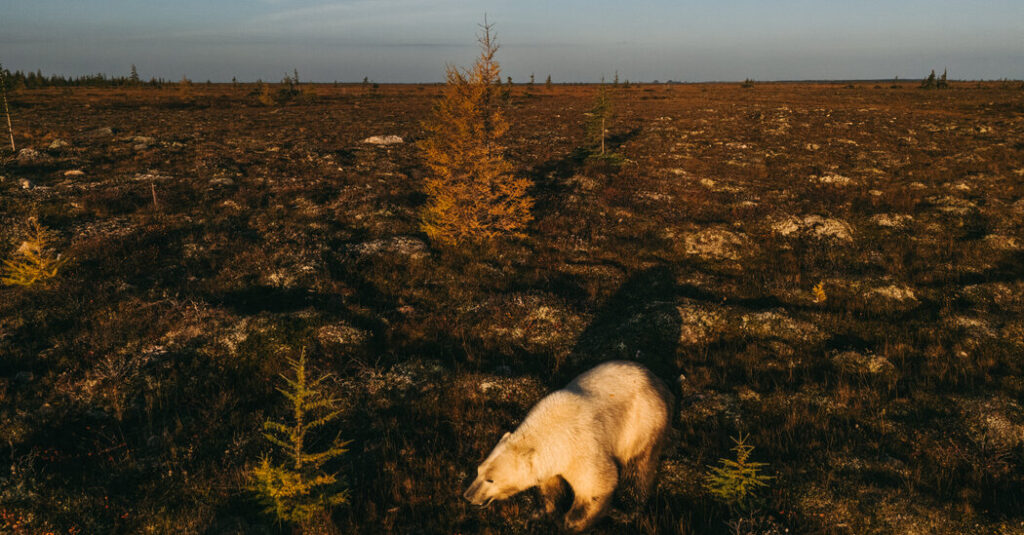
We were standing before the gate to a favorite hangout for polar bears in Churchill, Manitoba: the town dump. Our photographer, Renaud Philippe, had used a drone to track a mother and her two cubs across the tundra, and it was now flying back — we had no doubt — with amazing, intimate photos and video of the family.
But then the drone started losing power, fast. The remote control showed that its battery was down to 9 percent, though the drone was not too far from the gate. Eight, seven … maybe it could make it home. Six, five, I swear I heard its buzzing. Four, three, two — no, no, it landed on the other side of the gate. A 100-meter sprint from the gate.
Renaud let out some expletives popular in Quebec and, before he could say anything else, I told him there was no way we were jumping over the gate. Not when, as locals had warned us, Canada’s most dangerous wild animal tended to hide behind large rocks and surprise the unwary.
We were in Churchill in late September to report on efforts to revitalize its port, and the railway that links the town to southern Canada. These are two of Canada’s biggest pieces of Arctic infrastructure, but they had been left to atrophy after the end of the Cold War. The once-strong presence of Canadian (and U.S.) military in the town was remembered by only those over 50. And with the deregulation of the exports of wheat and barley in 2012, grain exporters stopped using the port. People moved out of Churchill.
[Read: Is This Polar Bear Town Canada’s Key to the Arctic?]
“This playground used to be packed full,” an Inuit woman, Loriann Sivanertok, 34, told me as she watched her two children at an otherwise deserted playground in town.
But could increasing global competition in the Arctic help revive Churchill? With climate change making the Arctic more accessible, the United States, Russia and China are all moving to gain an edge in a region that could offer untold natural resources and quicker shipping lanes. The Canadian government is considering a “Port of Churchill Plus,” a major project that could turn the town into a hub for military and commercial activities in the Far North.
Polar bears were also part of the story. Branding itself the polar bear capital of the world, Churchill had been reinvented as a tourist destination. Would that be threatened by the government’s plan?
I’d traveled enough in the North to be aware of the risks of polar bears. But in Churchill, they were everywhere. They had gravitated toward the town from inland, and were waiting for the ice to form across Hudson Bay to go hunting for seals. One bear wandered into the town center, drawing crowds. Another was captured and put in the town’s polar bear jail before it was airlifted away.
No wonder the authorities were too busy to help Renaud get his drone. After more than 24 hours, it was Leroy Whitmore, the town’s former fire chief, who saved us. Armed with a rifle, he drove his A.T.V. to the drone’s exact GPS coordinates.
Mr. Whitmore, who now owns a polar bear tour company, was also worried about the government’s big plans for Churchill. Like many people in town, he had a dark family history directly related to government policies. His mother belonged to the Ahiarmiut, a group of inland Inuit forcibly relocated several times by the Canadian government. She had been sent to a residential school in Churchill, gotten married and stayed — but never transmitted her culture to her children.
As an adult, Mr. Whitmore, now 50, said he had tried to learn about Inuit life on his own, and only with great difficulty.
“I had to teach myself how to hunt, how to soapstone carve and how to build an igloo,” he said.
Mastering igloo-making took seven winters. I asked whether someone had advised him.
“YouTube,” Mr. Whitmore said.
Trans Canada
This week’s Trans Canada section was compiled by Ian Austen, a Canada correspondent based in Ottawa.
-
Matina Stevis-Gridneff, our Canada bureau chief, traveled to the Northwest Territories, where three diamond mines that have brought significant revenues and employment are planning to permanently close by the end of the decade. The first is scheduled to be shuttered in March.
-
Matina reports that Canada has started a $1 billion program to attract top researchers from around the world and create an “accelerated pathway” for holders of U.S. H-1B visas, which are issued to highly skilled people working for American companies.
-
An atmospheric river has brought flooding to parts of British Columbia and forced the evacuation of hundreds of people. Rain has not been seen at such levels there since 2021, when there were widespread floods that submerged farms, ravaged highways and forced 17,000 people out of their homes.
-
Stephanie Nolen, The Times’s global health reporter based in Halifax, has looked into access, attitudes and approaches to medically assisted death around the world.
-
Kirsten Hillman, Canada’s ambassador to the United States and the chief trade negotiator with the country, is leaving those posts.
-
Peter Eavis reports that online shoppers in the United States buying from Canadian retailers are sometimes charged tariffs that greatly exceed the value of their purchases.
-
The Austrian government set up a commission to determine whether the country has any claim to the Florentine Diamond and other jewels that recently surfaced in Quebec after they were thought lost or stolen for more than 100 years.
Norimitsu Onishi reports on life, society and culture in Canada. He is based in Montreal.
How are we doing? We’re eager to have your thoughts about this newsletter and events in Canada in general. Please send them to [email protected].
Like this email? Forward it to your friends, and let them know they can sign up here.
Norimitsu Onishi reports on life, society and culture in Canada. He is based in Montreal.
The post Reporting on Arctic Sovereignty in the Polar Bear Capital of the World appeared first on New York Times.