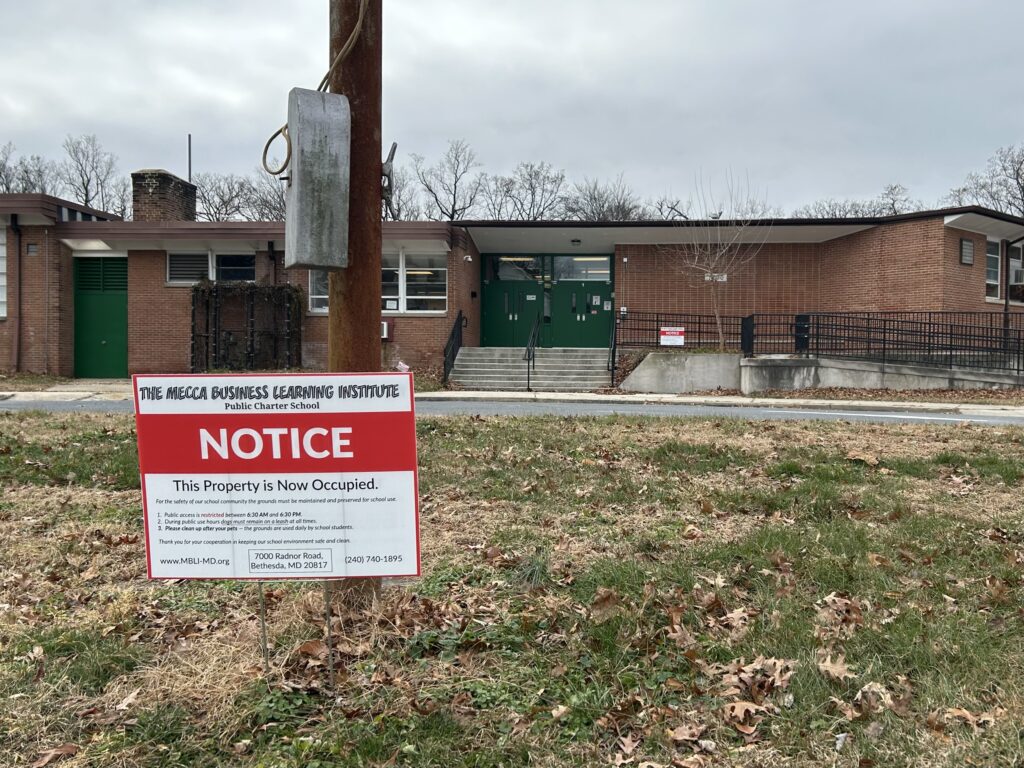
Montgomery County’s superintendent is recommending the school board shut down the county’s sole charter school only months after it opened, citing concerns from other district officials about transportation and other services for students with special needs.
But operators of the MECCA Business Learning Institute (MBLI) are pushing back, accusing Montgomery leaders of exceeding their oversight authority and requesting the Maryland State Board of Education intervene.
The charter school’s founders worked for years to open in Maryland, and MBLI welcomed its first students in Bethesda in August. It serves about 100 middle-school students, according to the Montgomery County district, and focuses on business and entrepreneurship.
In a letter dated Monday, Montgomery Superintendent Thomas Taylor accused the charter school of missing a deadline to create a plan on how it would comply with laws to provide accommodations for students with special needs. “The overall result is a school environment in which student safety, educational continuity, and staff capacity are compromised, creating significant and ongoing harm that MBLI has been unwilling or unable to remedy,” Taylor wrote.
The charter’s leadership said it intended to submit a plan, but that the school system did not detail the alleged violations until Dec. 1, and that they fully understood earlier what issues Taylor’s administrative team had identified.
“Like any new school, we have encountered areas needing clarification or adjustment, and each time concerns have been raised, MBLI has responded promptly, sought guidance, and taken concrete steps to address them,” the charter school’s leadership wrote in a statement. They added that despite their “good faith efforts,” the school system’s actions and public communications have raised “serious procedural concerns that cannot be resolved informally.”
Charter schools are publicly funded and free to attend but are run by private operators. In Maryland, local school boards get to decide whether to allow a public charter to open, and members have often been reluctant to do so. Montgomery County, which houses the state’s most populous school system, has only had two public charters — including the one Taylor now is recommending to close. The other charter school shut down in 2014 because of financial problems.
‘Repeated reluctance’
LaChaundra Graham and Tracey Cooper — the MBLI charter school’s co-founders — first applied to open in Montgomery in 2021. But then-interim superintendent Monifa McKnight recommended against the school’s approval, saying it lacked a transportation plan and did not provide evidence of funding needed to support the school.
That year, MBLI also sought to open a school in Prince George’s County. It also was rejected, with that school system’s charter school office finding that the proposal “did not meet the standard” in part because it had incomplete details of a special-education program and “no mention of students with disabilities.”
The charter school’s leaders applied to open again in Montgomery County in 2022. McKnight recommended a conditional approval that time, because the operator passed vetting from a review panel, though it needed to meet certain financial obligations to open. But the school board again voted against it. The charter’s leaders appealed to the state education board, which directedMontgomery officials to conditionally approve a charter in 2023.
It was an unusual step for the state board, but the body said “extraordinary relief” was necessary because of the local board’s “repeated reluctance to give [charter school] applicants a chance.” The state board noted that Montgomery board members had criticized MBLI for not having a set number of students committed to enrolling — a request, the board said was an “insurmountable barrier for approval.”
A rocky start to the school year
The MBLI charter school opened in August with students in the sixth and seventh grades. It had aspirations to slowly phase in more grade levels, until eventually it could become a school for sixth- to 12th-graders.
The charter school’s leadership wanted to open in Germantown, but construction delays forced MBLI to open at a temporarily facility in Bethesda.
Another MBLI location was concurrently scheduled to open in West Virginia, but the school’s leadership voluntarily relinquished its charter, according to that state’s charter school board. The West Virginia board’s chairman, Adam Kissler, said in an email that the charter school’s founders were qualified and fully compliant with the law, but West Virginia didn’t provide enough funding for it to open.
Within a month of the charter school’s opening in Montgomery County, the school system began raising concerns about its operations — conversations that continued throughout September and October, both sides acknowledge.
According to an audit written by Margaret Cage, the school system’s chief specialized support officer, administrators detailed their concerns in a meeting on Oct. 2. Among them, she wrote, were a “failure to deliver required transportation services” and “inadequate progress monitoring” for students with special needs. Cage said the district had given “repeated guidance” of its expectations.
Tensions escalated in November when Taylor issued a rebuke of the charter school and threatened to recommend its charter be revoked if problems were not fixed. He acknowledged some of the charter school’s past requests for clarification. But Taylor said its leaders repeatedly had misstated that Montgomery County Public Schools is the “special education operator,” and accused them of not understanding the charter agreement or state charter law.
“Your responsibility as the leader of the charter school requires that you have a stronger command of policy, regulations and generally accepted business practices,” Taylor wrote on Nov. 14. “This is ironic to me given the theme of your charter school.”
In a reply, the charter school’s leaders said they were working with the school system’s office of special education and “had addressed problems in a timely manner.”
On Nov. 20, the charter school was told at 4 p.m. that some Montgomery district administrators would be at the school the next morning to review Individualized Education Programs, a legal document that outlines the supports and services a student with disabilities needs.
Cage sent the school the team’s findings on Dec. 1, outlining a need to correct some issues with its special-education services, such as training all staff on how to deliver the services and monitor progress. One student was missing a complete IEP file, she wrote, and she also detailed other needed changes such as updating a student’s academic goals.
Cage attached an audit summary that included more specific details about each student. The Montgomery district would not provide the summary to The Washington Post, saying it is protected under federal privacy laws.
The charter school’s leaders said the audit Cage provided was the only correspondence it had received with enough information to help it respond to the district’s request for a corrective action plan. They added the IEPs reviewed in the audit were files they inherited from schools students had attended, and that charter school leaders hadn’t yet written their own plans. Leaders said they asked on Dec. 2 whether the school system wanted staff to “redo” the IEPs, but didn’t receive a written response.
Taylor recommends revoking the charter
After the November review, a reporter from the Montgomery Banner contacted Graham, who also is the school’s chief executive, about the district’s concerns regarding special education. Graham forwarded a document that included names and student IDs of 16 students, as well as a summary of the services they receive — but later told the news outlet that the release of student information, which is protected under federal privacy laws, was an oversight.
In his Monday letter, Taylor called the disclosure “an egregious violation” of privacy laws and said school system administrators had to contact families involved and respond to complaints.
He cited other concerns, including a letter in which school employees wrote saying they had “no faith” in the principal. He also noted the school’s enrollment declined from 250 students in August to about 100.
But his sharpest reprimand focused on the lack of a corrective action plan. Taylor said the deadline had passed for the charter school to submit the information, and he would formally recommend the school board revoke its charter.
In a news release, MBLI leaders said they had planned to provide a corrective action plan within 15 days of receiving Cage’s audit report, which would be on Dec. 16.
“The district’s stance toward MBLI has not reflected the collegial, collaborative relationship that should exist between a school system and an authorized public charter school,” the charter school’s leadership wrote to Taylor Tuesday.
In a petition filed to the state board of education, MBLI leaders alleged “a pattern of actions” from the school system that conflicted with its charter agreement and undermined state law. For example, they claim Montgomery County school officials contacted principals at prospective charter students’ homebound schools, who then contacted the families to dissuade them from enrolling in the charter school.
The state board’s process to consider the petition can take months. Montgomery County Public Schools has time to respond, before state board members review the legal questions at hand.
While the state board overviews the charter school’s petition, the Montgomery County school board is set to discuss Taylor’s recommendation on MBLI’s charter on Jan. 8. A final vote is expected on Jan. 22.
The post Montgomery County school leaders want to close its sole charter school appeared first on Washington Post.