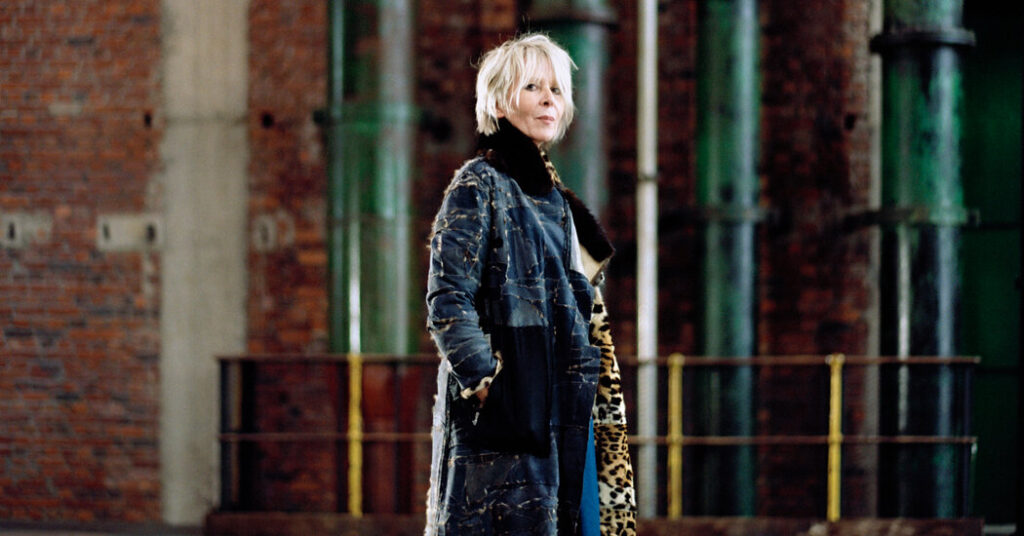
Marina Yee, an artist and fashion designer who was one of the Antwerp Six, a group of singular young designers who for a brief moment in the 1980s turned Belgium’s second largest city into a fashion capital, died on Nov. 1 in Antwerp. She was 67.
The cause of death, in a hospital, was pancreatic cancer, Rafael Adriaensens, Ms. Yee’s business partner and the curator of her archive, said.
Until the Antwerp Six came along, Belgium was known for chocolates, as the well-worn joke goes. But in the early 1980s, the Belgian textile industry tried to change that by pairing young fashion designers with manufacturers, plucking star students from the Royal Academy of Fine Arts Antwerp.
In 1986, Ms. Yee, Walter Van Beirendonck, Ann Demeulemeester, Dirk Bikkembergs, Dries Van Noten and Dirk Van Saene, a group of friends who were graduates of the school and who had all designed small collections, rented a van and took their wares to London to exhibit them at a British trade show. The fashion press was bowled over by their work, but struggled with their names, resorting to calling them the Antwerp Six.
To their irritation, the name stuck.
Each designer’s work was individual and idiosyncratic, though they were all inspired by street style, indie music and the club scene, and by avant-garde Japanese designers like Rei Kawakubo, whose oddly shaped garments, embellished with cutouts and ragged edges, were upending ideas about what fashion should be.
For the fashion establishment, it was a regressive moment, the era of the big-shouldered power suit, of designer logos run amok and of other signifiers of wealth and excess. The Belgians, like the Japanese, were rebelling against all of that, making clothes, as the fashion critic Amy M. Spindler of The New York Times wrote in 1993, “that didn’t seem oblivious to the realities of an often unhappy world.”
With her tousled hair and kohl-rimmed eyes, Ms. Yee resembled a punk Julie Christie. She was her own best model, a beguiling presence who repurposed thrift-shop finds in exotic combinations — men’s shirts worn backward, scraps of fabric stitched together or appliquéd to slouchy vintage blazers, unfinished hems with threads dangling. Hers was a fashion of bricolage.
So was that of her former boyfriend, Martin Margiela. Unofficially, the Antwerp Six had seven stars, linked by their friendship and schooling, but Mr. Margiela left Belgium early on, in 1984, to work as a design assistant for Jean Paul Gaultier. It was Mr. Margiela who found fame first, followed by Ms. Demeulemeester and Mr. Van Noten, who also became household names.
Ms. Yee dropped out.
“She was too bohemian,” Geert Bruloot, a curator and the unofficial organizer of the Antwerp Six’s early adventures, said in an interview. “Her drawings were works of art; she inspired everyone. But the creativity stopped at the moment the clothes had to be produced. The moment she had to adhere to a strict program — the budget, the fittings, the rigidity of the system — that’s where she let go.”
But perhaps there was another reason. In 1989, Mr. Margiela held his first show under his own name, at the Café de la Gare, an experimental theater in the Marais district of Paris. Ms. Yee and Mr. Margiela hadn’t been together for 10 years, but she went to see the show with Mr. Bruloot.
Models with tousled hair and kohl-rimmed eyes stomped through the cafe barefoot or wearing boots shaped like Japanese toe socks, tracking red paint onto sheets laid on the floor. They wore wide-legged trousers with frayed hems, vintage jackets with the seams exposed, skirts turned the wrong way around. It was the first salvo in a fashion movement that the street photographer Bill Cunningham would call “deconstructionism,” though of course the term deconstruction had been coined a few decades earlier by the French theorist Jacques Derrida to refer to a form of literary analysis.
The show was an eerie homage to Ms. Yee, who wept as she watched versions of herself parade around the space, as she told the writer Avery Trufelman, who is working on a book about the Antwerp Six. “I think it was the worst moment of my life,” Ms. Yee said. It killed her already shaky confidence in her abilities.
“As the first silhouettes appeared, Marina burst into tears,” Mr. Bruloot said. “I held her in my arms. It was Marina on the stage. But Martin was inspired by a lot of things around him. Like Picasso. I don’t think Picasso invented cubism; it was already out there.”
Yet after the show, as Mr. Margiela recalled in an email, Ms. Yee told him that she saw the performance as “a declaration of love after all these years.” They reunited and lived together in Paris.
“Both more experienced, we felt it could definitely work this time,” Mr. Margiela said. “But my fast-growing success as a fashion designer suffocated her.”
Marina Mariette Alfons Yee was born on April 17, 1958, in Temse, Belgium, one of four children of Liliane de Bruyne and Jean Yee, who became a colonial administrator in the Belgian Congo, where the family lived for a few years before returning to Belgium. Mr. Yee went on to be the director of a chain of department stores, and the family moved around the country before settling in Hasselt when Marina was 15. She and Mr. Margiela met there as schoolmates.
They were kindred spirits, interested in clothes and art, trawling flea markets and thrift shops like “magpies,” as Ms. Trufelman put it, “collectors of inspiration and detritus, which they might hoard and incorporate into their art projects.”
“It was love at first sight,” Mr. Margiela said.
“Our styles were so close,” Ms. Yee told Ms. Trufelman. “Martin and I were sister cities.”
After design school, Ms. Yee made a few collections that she sold under the label Marie. When she left the business — and Mr. Margiela, for good — she moved to Brussels. There, with a boyfriend, Jan-Willem Thonnon, who was also an artist, she ran a coffee shop called Indigo. She continued to make artwork and clothes, scouring the flea market that abutted her restaurant, in the Marolles district. Cardboard boxes, vintage tools, clothing and textiles, dried plants, scraps of fabric and printed material — these objects were her media.
It was not always a comfortable life, her son, Tzara-David Thonnon, said. Money was scarce, and the rent was often overdue. Though she worked constantly, collaborating with other designers and making costumes for theater and the opera, he said, “she struggled to make her artwork.”
But in 2007 or so, she began to teach, working in the fashion department of the Royal Academy of Fine Arts in Ghent. She retired in 2023.
“That was a rock of stability she could climb on top of,” Mr. Thonnon said. “Money was not as critical, and it gave her a platform to relaunch her brand.”
She did so in 2021, encouraged by Mr. Adriaensens, who became her business partner. At her death, Ms. Yee had been applying origami techniques to vintage jackets, folding and tucking and draping the fabric in curious and lovely ways. She was cutting up old pairs of jeans and stitching them, patchwork style, onto bomber jackets.
Mr. Bruloot described a recent visit during which Ms. Yee was working over a man’s trench coat on her dressmaker’s dummy. She had been inspired by the wind blowing up the back of her own coat, she told him, and was endeavoring to recreate that shape. “That’s how she worked,” he said.
“It seemed to me,” Mr. Margiela said, “that she finally found a space, freed from our critics, which she probably needed to fully express her talent in designing fashion.”
In addition to her son, Ms. Yee is survived by her siblings, Stefan, Bruno and Dominique Yee.
In March, the MoMu Fashion Museum Antwerp will present the work of the Antwerp Six to celebrate the 40th anniversary of their brief collaboration and influence in a show co-curated by Mr. Bruloot.
“I felt for a long time as if I was failing at life,” Ms. Yee told the fashion Substack 1 Granary in June. “Now I can laugh about it, but I was close to tears back then.”
She continued: “Others were featured on the cover of Vogue, whilst I was stuck at home. To keep your spirits high and believe in yourself at a moment like that proves difficult. But now, look at how far I’ve come. Some would say it took too long, but maybe it just had to be that way.”
Penelope Green is a Times reporter on the Obituaries desk.
The post Marina Yee, Elusive Avant-Garde Designer, Dies at 67 appeared first on New York Times.