All it took was one black square on Instagram for Ivan Urgant, Russia’s king of late-night comedy, to be erased from Russian public life.
That square, expressing his opposition to Moscow’s invasion of Ukraine, led him to be expunged from the cast of the hit holiday movie series he had headlined for eight years. He vanished from ringing in the new year on Russian television. And after a decade on air, his popular late-night show on the flagship state network Channel One went dark.
Unlike other antiwar entertainers, Mr. Urgant stayed in Russia. The result is an uncomfortable in-between life. He is still working, but removed from the spotlight; still joking, but muzzled out of fear.
An unspoken Kremlin ban keeps the once ubiquitous megastar away from television, film and prominent events. He now makes money in Russia as a toastmaster at lavish weddings and birthdays for the rich, according to people who know him. He serves as an announcer at corporate events. Sometimes he sings at private parties with a guitar.
Outside Russia, where he is still free to appear publicly onstage, Mr. Urgant avoids mentioning the war beyond oblique references, worried that the Kremlin’s retribution could escalate and further upend his life and career.
“There was once a TV presenter, wealthy and known everywhere,” Mr. Urgant, 47, sang at a recent performance in Berlin. “But one day he went out online, and put up a tiny black square.”
Mr. Urgant’s descent from high-flying superstardom to caged existence shows how President Vladimir V. Putin has reordered the Russian cultural landscape, at times personally. De facto blacklists, behind-the-scenes threats and McCarthyite smear campaigns keep Russian entertainers in a state of fear and in step with his war.
Prominent Russians have appealed directly to Mr. Putin in attempts to rehabilitate Mr. Urgant, one of Russia’s most popular entertainers, according to people familiar with the discussions. But the Russian leader has bristled in response, those people said, speaking anonymously out of fear of retribution.
At times, the people said, Mr. Putin has cited false information about Mr. Urgant’s alleged disloyalty, most likely passed to him by the Russian intelligence services in spravki, or dossiers, that are regularly prepared on the nation’s cultural figures.
The Kremlin did not respond to a request for comment.
Hundreds of prominent entertainers, businessmen and government officials have held their tongues about the war in attempts to hold on to careers and lives in Russia, where criticism of the military is outlawed and public dismay about the war is treated as betrayal.
Mr. Urgant did not respond to requests for comment from The New York Times. But he has made it clear that he has not abandoned hope for his career in Russia. Asked at a Moscow film premiere in 2023 whether he would one day reappear on Russian television, Mr. Urgant replied, “Of course, I will return.”
All the while, he has stood his ground. Some Russian actors and musicians have taken down their 2022 posts opposing Mr. Putin’s invasion in order to continue working. Others have atoned for perceived disloyalty by visiting Russian-occupied areas of Ukraine. Mr. Urgant’s original Instagram post remains online.
Hoping to return to the air, Mr. Urgant wants to avoid inflaming pro-war Russians who have been calling for his head, those who know him say. But he also wants to remain true to his beliefs and retain the approval of Russia’s liberal creatives, many of them now in exile, who long breathed excitement and artistry into his late-night show.
“It is awful what is happening with my friend, who is in amazing form,” Sergei Svetlakov, a Russian comedian who has worked with Mr. Urgant, said in a YouTube interview last year.
Mr. Svetlakov criticized Russians who have demonized the entertainer without knowing the facts. “It’s simply some kind of sickness,” he said. “Snow that gradually turns to brownish black.”
Comedy and Power
In the 1990s and early 2000s, a brief period of openness when Russia’s television channels were free and privately controlled, the nation found catharsis for the bleak times that followed the Soviet collapse in merciless political comedy. The weekly program “Kukly,” or “Puppets,” excoriated politicians and oligarchs of the Boris Yeltsin era by mimicking them with giant dolls.
But after taking office in 2000, Mr. Putin set about bringing the nation’s television channels under state control, smarting at sharp comedy that came at his expense. He is believed to have taken particular umbrage at a “Kukly” episode that retold his political rise through a German fairy tale about an evil, disfigured boy. (The network’s owner fled into exile.)
As light-touch political comedy began creeping back onto Russian television after Mr. Putin consolidated power, Mr. Urgant, the scion of a famous Soviet acting family, was rising in the world of Russian entertainment with his agile improvisation, boyish charm and musical talent.
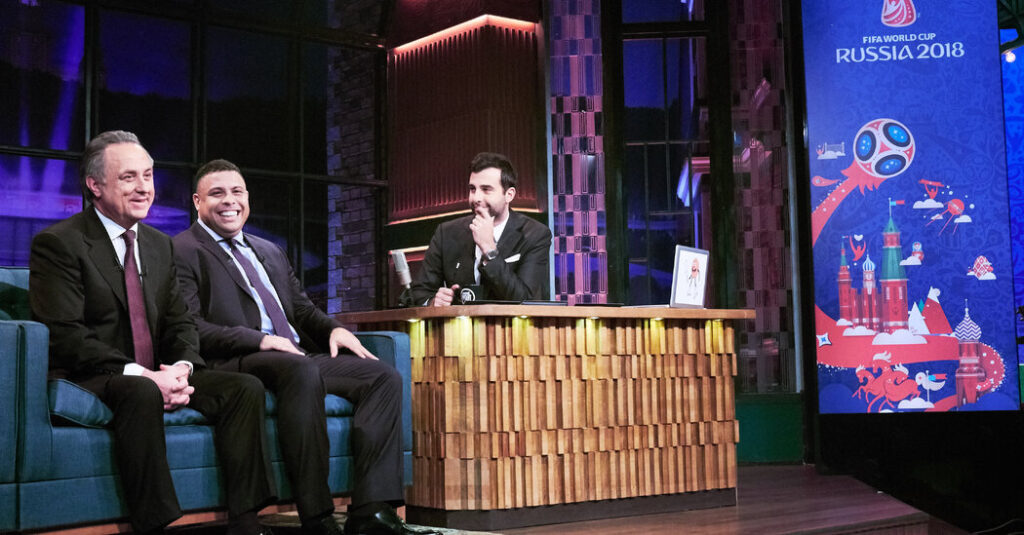
Mr. Urgant in 2012 became Channel One’s choice to host “Evening Urgant,” a daring attempt to import the American late-night genre and inject vitality into Russian state television. Before the launch, Mr. Urgant, a longtime fan of American comedy, flew to New York on a learning tour and briefly met Jon Stewart.
The program became a wild success. Audiences marveled at the top Hollywood stars Mr. Urgant booked as guests, including Robert De Niro, Pierce Brosnan, Mila Kunis, Justin Timberlake, Jackie Chan and Stephen Colbert.
The Russian comedian knew he could not take aim at Mr. Putin in the way that “Saturday Night Live” pilloried American politicians. But for many viewers, the thrill of the show was the sense that Mr. Urgant got away with an inch more than others did.
Although he never overtly mocked the Kremlin, he cracked jokes at the expense of Mr. Putin’s Belarusian ally, Aleksandr G. Lukashenko; state-news propagandists like Vladimir R. Solovyov; and the nationalist politician Vladimir V. Zhirinovsky. He even made a veiled reference to the 2021 imprisonment of the Russian opposition campaigner Aleksei A. Navalny.
But the space to joke like that would soon disappear.
‘Fear and Pain’
As Russian troops massed on the border with Ukraine in early 2022, Mr. Urgant appeared visibly upset by the possibility of an invasion. In an on-screen monologue, he jokingly suggested that the war be “postponed by 700 years.” The studio audience erupted in applause.
The day Mr. Putin launched the assault, Mr. Urgant quickly took to Instagram and posted the black square.
“Fear and pain,” he wrote. “NO TO WAR!”
The Russian authorities pulled the plug on the show. At the time, a Channel One spokeswoman cited “important sociopolitical events” as the reason.
But the reality was that the rules of the game for Russian entertainers had suddenly changed — opposition to the war would not be tolerated.
The next month, an account on Telegram called “Evening Urgant. Ivan Urgant” posted a clip of a burning Russian personnel carrier in an antiwar gesture. Mr. Urgant did not immediately disavow the post, fueling a wave of attacks by zealous pro-war Russians.
Nearly two months later, the entertainer said on Telegram that he had not published anything. But it was not until the end of the next year that Mr. Urgant explicitly said he had no idea who had created the clip or why, and added that the network had tried to get the fake account removed.
“But if tomorrow, for example, they report that I drink the blood of babies at night, I’d like to deny it in advance,” he added.
The real issue, the pro-war politician and novelist Zakhar Prilepin said on Telegram, was that Mr. Urgant’s show for years had been a home for pro-Western dissenting Russians who in 2014 opposed the Kremlin’s annexation of Crimea and invasion of Ukraine’s east. Mr. Prilepin, an ultranationalist who has promoted a Russian cultural “purge,” accused Mr. Urgant of using his show to cultivate the type of Russians who were fleeing Mr. Putin’s mobilization.
The criticism drove to the heart of the public pro-war attack campaign against Mr. Urgant: The face of the flagship state-controlled channel had refused to back the Kremlin when the time came for war.
“They have a thing about so-called traitors, people they considered one of their own,” said Anton Dolin, an exiled Russian film critic. “Urgant hosted the New Year’s show on Channel One. This is the highest-rated television show of the year. Such a person doesn’t have a right to put up a black square in their estimation.”
‘Just Life’
The result, for now, has been a pariah status for Mr. Urgant in Russia.
For example, after photos surfaced in 2023 of him giving a talk to students at an elite Moscow university, the vice dean who had invited him to speak was fired. When Mr. Urgant agreed to perform at a music festival in St. Petersburg in 2024 to benefit people with autism, he was later pulled from the lineup.
At the same time, a weekly late-night show led by a war-abiding comedian, Pavel Volya, was introduced on the Russian state-controlled channel TNT. And Mr. Urgant’s longtime co-host, Dmitri Khrustalyov, embraced the war. Mr. Khrustalyov, who has continued to appear regularly on Channel One, at one point rode in a tank with children from Russian-occupied territory in Ukraine and taught them to shoot “the enemies of Russia.”
Mr. Urgant has taken a live version of his bygone show on tour abroad. Onstage in Berlin last month, he showed his trademark wit, took a few jabs at Mr. Khrustalyov and joked about spies in the audience. But the entertainer confined the show to safe topics like German sausage and beer, and his sense of loss was there to see.
For his final number, Mr. Urgant sang a tender rendition of his mother’s favorite song, “My Darling.”
The ballad, about betrayal, shows that “there are things that can be changed, and there are things that can’t be changed,” he said. “There’s no need to be sad about it — it’s just life. We have to love it the way it is because we won’t get another one.”
Alina Lobzina contributed reporting.
Paul Sonne is an international correspondent, focusing on Russia and the varied impacts of President Vladimir V. Putin’s domestic and foreign policies, with a focus on the war against Ukraine.
The post He Was Russia’s Late-Night King. Now He Works Birthdays and Weddings. appeared first on New York Times.