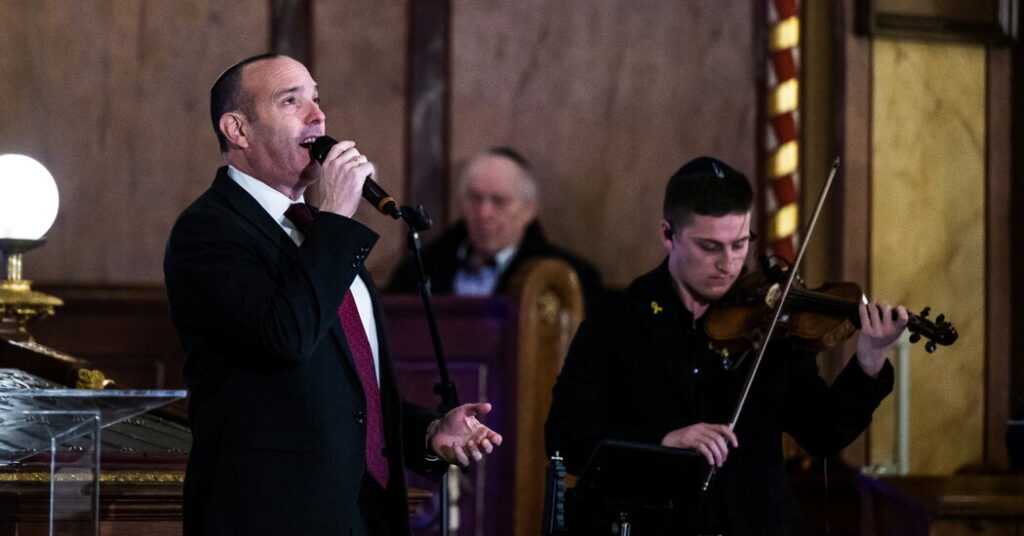
A pair of concerts featuring the Israeli military’s official cantor planned for Sunday evening, the first night of Hanukkah, has drawn a prestigious Amsterdam concert hall into the Middle East’s divisive politics.
The annual Hanukkah concert in the Concertgebouw hall has been a longstanding tradition, but this year’s event drew an outcry when its organizers invited the cantor, Shai Abramson, to lead the event. Critics objected to his involvement with Israel’s army — given its military campaign in the Gaza Strip, where a humanitarian crisis has grown as tens of thousands of civilians and fighters have been killed since the 2023 Hamas-led attack on Israel — and to YouTube videos in which he sings prayers arm in arm with Israeli soldiers.
An initial concert featuring Abramson was canceled, although as a compromise he is now scheduled to sing at two private evening performances for guests of the organizers, the independent Chanukah Concert Foundation, but not at a public Hanukkah family concert on Sunday afternoon — an outcome that some on both sides are still unhappy with.
As a result, protests and counterprotests are planned in a city where tensions around Israeli visitors have been high since November 2024, when pro-Palestinian protesters clashed with supporters of the Israeli soccer club Maccabi Tel Aviv, in what officials described as antisemitic attacks, a day before a match with the Dutch team Ajax. The associated street violence lasted two days.
This is also the second time in recent years that the Concertgebouw has reversed course after facing criticism for canceling an Israeli performance. In May 2024, the music venue canceled a concert by the Jerusalem Quartet, citing security concerns related to threatened protests, but later agreed to allow the performance to go ahead with expanded security measures.
In the case of Sunday’s planned event, the Concertgebouw issued an “urgent request” to the foundation in September, urging it to find a different cantor. Its concern lay in Abramson’s “active involvement in a controversial war,” the concert hall said at the time. “We wish to remain distant from this controversy, which is unrelated to music.”
But David Serphos, one of the Chanukah Concert Foundation’s three board members, said that the foundation did not understand where the “urgency” came from, given that the venue had known for months about the plan to have Abramson lead the concert.
“We were quite adamant about keeping him as the cantor,” Serphos said in an interview. “First and foremost, we didn’t see any reason not to have him. We have a contract with him, we know him very well, and we saw no reason to uninvite him.”
Serphos added that Abramson had performed at the annual concert three times in the last five years without incident. The most recent was two years ago at the Concertgebouw, two months after war in Gaza began.
The foundation responded to the Concertgebouw’s request by threatening a lawsuit.
The concert hall announced in September that it had canceled the program and cut ties with the foundation. But that led to an outcry from local and international Jewish groups, which said the cancellation amounted to antisemitism, and the Concertgebouw again changed course.
In mid-November, it announced that a compromise had been reached, saying that “both organizations agree that this harmful situation must end.”
Simon Reinink, the Concertgebouw’s director, said in an interview that the hall remained concerned about the involvement of Abramson, describing his presence in Amsterdam as “highly controversial.” But Reinink said the agreement “helps ease tensions and shows that we can move forward together in a constructive way.”
The two sides arrived at the solution with the help of Jaïr Stranders, an independent theater artist who describes himself as a “bridge-builder” and who knew the players in the dispute.
“I could understand both sides,” he said. “I can 100 percent understand why the Concertgebouw said it’s not the opportune moment to have this cantor who is so associated with the I.D.F. sing here,” he added, using the acronym for the Israeli military. “But if the outcome would be that it’s another incident where Jews are made to feel that there’s no space for them, or that they can’t live a Jewish life as they like. That’s also not good.”
Leading up to the concerts, volunteers with Cultural Boycott of Israel, an initiative of 700 cultural groups in the Netherlands and Belgium, have been handing out protest fliers in front of the Concertgebouw.
“At first they took a principled stand, and then after all kinds of pressure, they reversed their decision and called it a compromise,” said Marijn Lems, a Cultural Boycott organizer. “They have egg on their face from all sides, basically. They couldn’t have done this in a worse way.”
On Sunday, several groups plan to protest in the Museumplein, a large public square opposite the Concertgebouw. Organizers of a counterprotest have invited supporters of the concert to show up with Israeli flags, recite holiday prayers and sing the Hanukkah song “Maoz Tzur.”
Zyanya Breuer, an organizer with Erev Rav, a Jewish anti-Zionist collective, said the group planned to hold a peaceful “alternative Hanukkah celebration” in the square, with singing by Jewish and Arabic choirs and candle lighting.
“This is a Jewish-led protest with a lot of partners,” said Breuer, “but there are other groups that want to come and make some noise and raise their voice.”
The post Hanukkah Concerts With Israeli Military Cantor Raise Outcry in Amsterdam appeared first on New York Times.