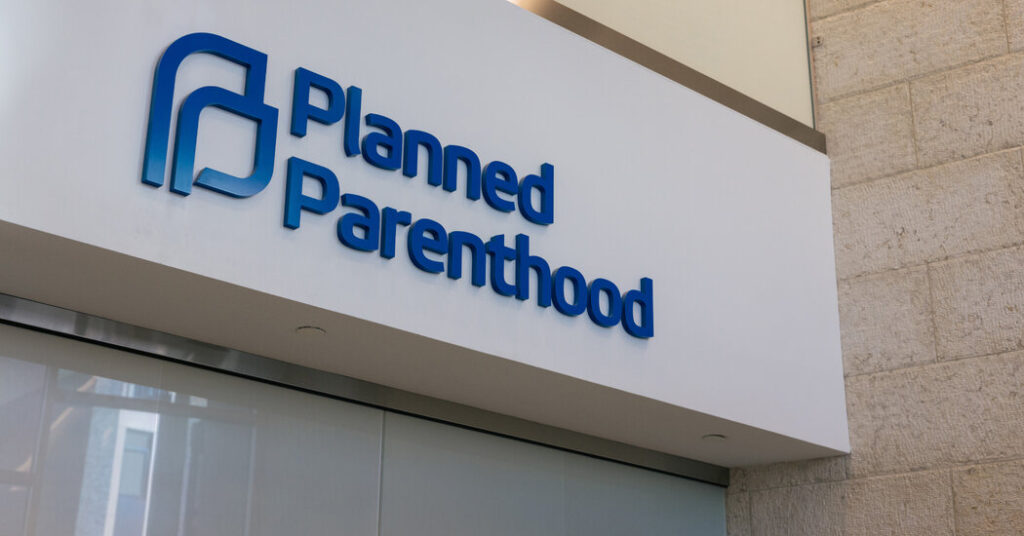
A federal appeals court on Friday allowed the Trump administration to continue withholding funding from Planned Parenthood as mandated in the tax and domestic policy bill President Trump signed in July.
The provision requires the government to stop making Medicaid reimbursements to a subset of the nation’s largest abortion providers, in a manner so narrowly defined that Planned Parenthood claimed it had been deliberately singled out. The decision clears the way for the provision to stay in effect and sends the group’s lawsuit back to a lower court to untangle.
A three-judge panel, made up of appointees of President Joseph R. Biden Jr., voted unanimously to throw out a district court judge’s ruling from July. That judge found the provision appeared to unlawfully designate the organization, with potentially drastic effects.
In an opinion explaining Friday’s ruling, Judge Gustavo A. Gelpí wrote that lawmakers have broad discretion to restrict federal spending, and that the changes affecting the fate of Medicaid funds did not amount to illegal punishment.
The law “establishes new conditions on the receipt of appropriated funds in service of a new policy goal favored by Congress,” he wrote. “And it does so by imposing conditions that appellees can satisfy by halting abortion services.”
Planned Parenthood sued the Trump administration soon after the bill passed in July, arguing that the legislation had been written to force the group to stop providing abortions or surrender millions of dollars in funding. It added that if allowed to take effect, the provision could lead to closures of the organization’s health clinics and decimate its budget.
The bill directed the government to stop making Medicaid reimbursements for any type of health procedure to organizations that both offer abortions and received more than $800,000 in reimbursements in 2024 — a tiny umbrella that covered Planned Parenthood and a few of its largest peers. The ban on reimbursements in the bill was scheduled to be in effect for one year.
In a statement reacting to the ruling, Alexis McGill Johnson, the president of the Planned Parenthood Federation of America, said the law was devised to send the organization’s health centers to “the financial brink.”
“The intent is clear: They want to shut down Planned Parenthood health centers and make it harder for everyone, everywhere to get the health care they need,” she said.
Blocking the provision in July, Judge Indira Talwani of the Federal District Court for the District of Massachusetts wrote that the policy appeared to be punitive and intended to compel the organization to alter its mission. Judge Talwani added that the unique role of Planned Parenthood, which includes an arm that endorses candidates and does political advocacy work, raised free-speech concerns.
The appeals court had paused that order in September while it considered the case, allowing the funding to remain frozen in the months since.
Earlier this month, Judge Talwani blocked the law from taking effect in 22 states and the District of Columbia, which had brought a second, parallel lawsuit. This week, a separate panel from the same appeals court paused that ruling as well, keeping funds frozen.
Federal funds are already prohibited under law from being used to pay for abortions. But Planned Parenthood and other organizations offer a range of primary care and family planning services, none of which are eligible for reimbursement under the law. This includes testing for sexually transmitted diseases, cancer screenings and behavioral health services.
The financial uncertainty caused by the bill and the litigation has been costly for the organization, with states including New York, California and Washington pledging to set aside funds to help keep clinics open.
In August, Planned Parenthood took another financial hit when a Trump administration rule caused it to forgo about $60 million it received annually from a federal family planning program, known as Title X. The rule made such funding contingent on no longer making referrals to doctors who perform abortions.
In a statement on Friday, the group said the provision could jeopardize care for 1.1 million patients served by Planned Parenthood.
The group can continue litigating the case before Judge Talwani. Yet the slow pace at which it has moved leaves open the possibility that the case will not be resolved before the provision expires next year. .
Zach Montague is a Times reporter covering the federal courts, including the legal disputes over the Trump administration’s agenda.
The post Government Can Withhold Funds From Planned Parenthood, Appeals Court Rules appeared first on New York Times.