DUBLIN — On a brisk November evening in Ireland — the country of “one hundred thousand welcomes,” according to a Celtic blessing — Alyona glanced around nervously and then pointed out the place where she said her welcome, as a refugee from Russia’s war in Ukraine, ran out.
A patrol car idled near the entrance to the Citywest Hotel, the suburban complex where she and her teenage daughter have lived since fleeing Russian missiles almost four years ago. Its presence offered little comfort. Police had been watching two weeks earlier, too, on the night a group of Irish protesters surrounded her car, shouted “Stupid pigs!” and “Get out of our town!” and filmed her daughter sobbing in the back seat.
The officers hadn’t stepped in then, she said. And in the days since — amid a torrent of hateful messages on social media, protests and physical attacks on other refugees — she has grown wary: of the police, of neighbors, of the country that took her in so warmly.
“The welcome was real,” said Alyona, 51, who spoke on the condition that she be identified only by her first name to protect her privacy. “For two-and-a-half years, I had huge hope for my daughter here. But now, it has changed.”
For Alyona and thousands of other refugees, Ireland’s famously open arms suddenly feel more like cold shoulders. Protests and attacks have marked a backlash at resettlement centers around Ireland and have begun to spread to neighborhoods where even longtime immigrants feel unsafe.
Dozens of arson cases have been reported at some of the more than 320 centers linked to asylum processing and housing. In October, firefighters had to pluck four children and a mother from the top floor of a building where a hooded man was filmed setting the stairs on fire.
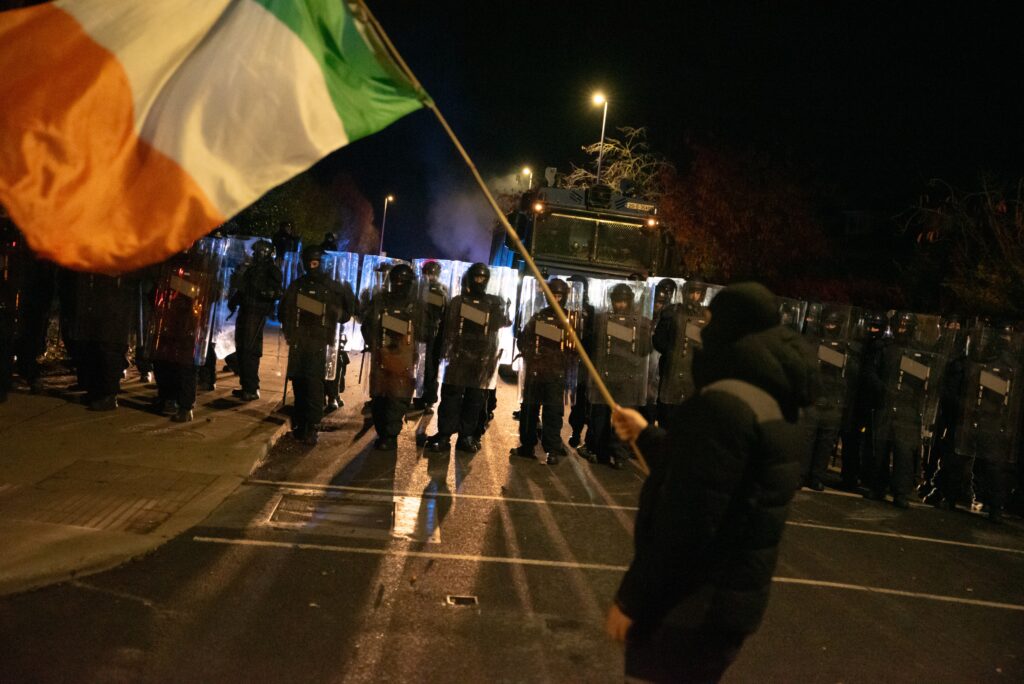
Two weeks before, a mob of about 2,000 — mostly young men, many masked — torched cars, threw bricks and shot fireworks at police and residents over two nights at the Citywest Hotel after a person staying in the relocation center was charged with sexually assaulting a 10-year-old girl. Alyona, and other Ukrainians who were inside, said it sounded like the combat zones they fled.
For decades, Ireland proudly stood against the rising tide of anti-migrant anger washing across Britain, Europe and the United States. Drawing on its own history of conflict and displacement, a country of emigrants became a country of immigrants, throwing open its doors to the world’s dislocated.
The public still largely views migration as a good thing for Ireland. But views are hardening, with a majority now in favor of making it harder for asylum seekers to stay. A recent poll showed almost three-quarters of people support tightening immigration rules.
“There has been a shift certainly,” said Diarmaid Ferriter, a professor of modern Irish history at University College Dublin. “We’re seeing a version of what’s happening elsewhere. The question is: How widespread will it get?”
Ferriter, like others, noted the incongruity of a migrant backlash in a country that produced so many migrants. “It’s ironic because we are the people who had to do what they are doing in droves,” he said.
Since becoming a host country, Ireland has taken in Vietnamese “boat people” in the 1970s and families fleeing conflicts in Bosnia, Somalia and Syria. It built a reputation for welcome and an ever-larger apparatus for resettlement. Its largest intake effort began with emergency legislation the day of Russia’s 2022 invasion.
Since then, the country of roughly 5 million, has taken in more than 120,000 Ukrainians, nearly all women and children.
Ireland’s refugee assistance programs have largely thrived with government spending and public enthusiasm. Aid groups said they were overwhelmed with volunteers lining up to greet Ukrainians at airports, give them clothes and take them in.
But the mood began to shift as the numbers rose. Like other European countries, Ireland has accommodated a surge in asylum seekers from Africa and the Middle East, with officials opening a separate processing center for them in the former convention hall of the Citywest Hotel in 2022.
Protesters complain that government spending to house refugees — almost $500 million in the first quarter of 2025 — comes as Ireland suffers a crisis in housing affordability and availability that is among the worst in Europe. The government acts with too much secrecy, they say, and many are increasingly worried that swelling numbers of single male asylum seekers pose a threat to neighborhood safety.
Advocates for the refugees say that most protesters are peaceful, and some aid groups echo charges that the government has not been clear about its long-term plans for hosting refugees. But, as in other countries, the growing tension is increasingly exploited by political opportunists and fanned into fury by social media disinformation.
In the hours before the October riots, Elon Musk and British anti-migrant influencer Tommy Robinson shared messages seizing on still-unconfirmed reports that a foreign-born man had raped an Irish girl, some of which were viewed by up to 13 million X users, an Irish Times investigation found.
The unease has spread to newcomers of all kinds as nativist groups hang Irish tricolor flags in immigrant neighborhoods and chant “Ireland for the Irish” at rallies. In July, a tech worker from India was stabbed and partially stripped by teenagers in a Dublin suburb.
Software engineer Farid Rahman, 43, came from India 10 years ago as part of the Ireland’s tech boom. His family has lived peacefully in a townhouse near Citywest Hotel ever since, his children playing soccer with neighborhood kids and speaking with ever-stronger Irish accents.
That didn’t help them when a group of a dozen local teens swept through the complex one evening in September, attacking three boys who were kicking a ball around the courtyard.
“They came right through there,” said Rahman’s son, 13, on a recent night, pointing down the lane that connects his neighborhood with a block of public housing, around the corner from the car he hid behind while the assailants punched his friend in the face. “They were calling us monkeys and stuff, ‘Get out of our country,’” said the boy, whom The Washington Post is not identifying to protect his safety.
His father shook his head. “It’s always been good here,” Rahman said. “Now there is a vibe — this is an Irish area, stay away.”
Less than a mile away, Citywest Hotel is the country’s defining flash point.
The tree-lined 764-room facility had served as a covid quarantine center before the government leased it in 2022 as a shelter for Ukrainians fleeing the Russian invasion. But neighbors grew wary in late 2022, when the government converted part of the complex into a processing center for asylum seekers from farther afield. Asylum applications, mostly men from the Middle East and Africa, reached 18,467 in 2024, a record spike of more than 40 percent from the year before.
Saggart, whose population has doubled to roughly 6,000 in a decade, began to feel the strain. Residents complained of men from the processing center gathered in groups at bus stops and near the village center, leaving behind beer bottles and unease.
“It would be kind of gangs of them hanging around the square with alcohol,” said resident Siobhan Tobin.
Concerns deepened last summer when rumors spread that the government planned to buy Citywest outright. By September, the deal was confirmed, a $170 million sale pushed under the emergency powers enacted for Ukrainian arrivals.
“They told us one thing, then bought the hotel and made it permanent,” Tobin said. “There was no consultation even with residents that lived very close to it.”
She joined protests at the gates of the hotel organized by a group called Saggart Residents. They were peaceful at first, locals pressing for transparency about the hotel, about jobs tied to tourism, about the gym on hotel grounds that once served the neighborhood.
Using freedom of information requests, the group tracked a rise in police-involved incidents in and around the hotel complex. When news of the sexual assault arrest erupted, Tobin and neighbors protested at the gates in the following hours. But not at the riots that broke out the next day.
“A lot of people who were not of the village showed up,” Tobin said. “Nobody in Saggart wants violence.”
After the riots, Alyona avoided walking to her English and accounting classes and wouldn’t allow her daughter out alone.
One night in early November, driving home from guitar lessons, they turned into the hotel drive and a group of five protesters, some carrying Irish flags, blocked the car.
“They shouted, ‘Get out, this is our street!’” Aylona said.
One man put his foot under the front tire and dared her to proceed. Her daughter sobbed as another leaned in for a close-up video. Another took pictures of the license plate.
“Why would they do that to a child,” Alyona asked. “Why wouldn’t the Garda help us?”
She filed a complaint with the local police, the Garda, and was told they were investigating. A police spokesman said they could not comment on specific incidents but said more than 30 people have been charged in connection to recent unrest at Citywest. The Justice Ministry did not respond to a request for comment.
The incidents have unnerved refugees and infuriated their advocates. Those who work with migrants say protesters should direct their anger at government offices where policies are made, not at vulnerable families.
“When I see the children in my class becoming targets, that’s punching down,” said Ronan Murphy, a teacher at a primary school near Citywest. “They can’t control any of this.”
Murphy believes that the unrest is driven by a radicalized minority and that Ireland remains, at heart, a welcoming country. He points to the recent election of a pro-migrant president.
Alyona is no longer certain. She will never forget the Ireland that gave her refuge. For three years and three months, she leaned into the embrace of shelter, a weekly food allowance, English classes and a school that her child loved.
But now, her daughter is afraid of fireworks, of seeing her frightened face featured in hate videos, of walking along streets that once seemed to lead to a secure future.
“I took her from a country at war to a safe country,” Alyona said. “Now we are trapped in a mini-war here.”
The post Dublin embraced refugees, but some in Ireland have had enough appeared first on Washington Post.