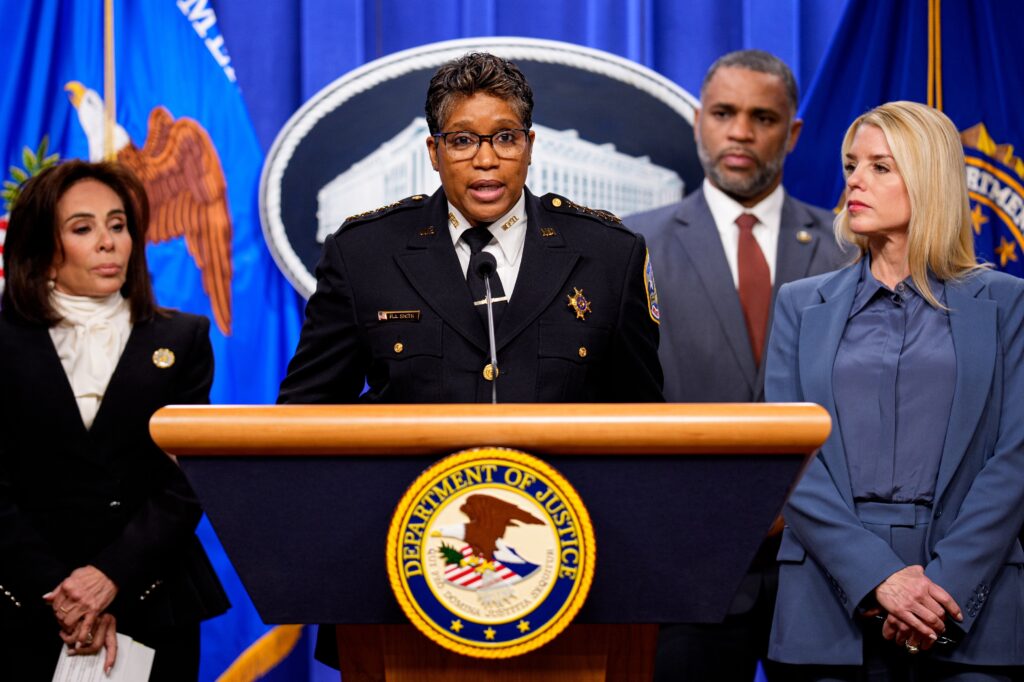
A Justice Department investigation into the D.C. police found that Police Chief Pamela A. Smith created a “coercive culture of fear” that may have incentivized the manipulation of crime statistics, according to a draft of a report obtained by The Washington Post.
Citing a review of thousands of police reports and interviews with more than 50 witnesses, the seven-page report concludes that D.C. police crime statistics were “likely unreliable and inaccurate” because of misclassifications, errors and purposefully downgraded crime classifications.
Though it does not cite specific examples of the chief requesting that a crime be downgraded to a lesser offense, the report ties Smith to the alleged misclassifications by saying they were enabled by her leadership style.
“While witnesses cite misclassifications and purposely downgraded classifications of criminal offenses at MPD for years prior, there appears to have been a significant increase in pressure to reduce crime during Pamela A. Smith’s tenure as Chief of Police that some describe as coercive,” the report says, using the initials for Metropolitan Police Department, the force’s official name.
The draft report, dated Dec. 10, was prepared by Assistant U.S. Attorney Steven Vandervelden in the office of U.S. Attorney for D.C. Jeanine Pirro. Pirro’s office did not respond to questions Friday.
The draft began circulating days after Smith announced she would leave her post as police chief at the end of the year, citing a desire to spend more time with her family. The D.C. police union at the time raised questions about the timing of Smith’s departure, citing active investigations in both the Justice Department and Congress concerning the potential manipulation of crime data.
A spokesperson for the D.C. police did not respond to requests for comment about the report, and the office of Mayor Muriel E. Bowser (D) declined to comment.
Smith has said — and reiterated this week — that crime statistics have not been manipulated under her leadership, and that she did not resign because of the DOJ investigation or a separate ongoing probe by the House Oversight Committee.
Asked by reporters Monday whether the probes motivated her decision, Smith said she was not driven by anything “other than that it’s time.”
“I’ve had 28 years in law enforcement,” she said. “I’ve had some time to think with my family.”
The investigation — conducted by a Justice Department that under President Donald Trump has a pattern of targetinghis political enemies — started in August, the same month Trump declared a crime emergency in the District. That kicked off an unprecedented incursion into city affairs, with his administration seizing temporary control of the police department and deploying federal agents and National Guard troops to city streets. During his attempted takeover of the city’s public safety apparatus, Trump cast doubt on D.C.’s crime statistics in social media posts.
Violent crime in D.C. reached a 30-year low last year after a surge in violence in 2023, according to D.C. police data. Multiple current and former D.C. police officers interviewed by The Post said they believe that crime is significantly down, even as some questioned whether all crimes were classified accurately.
Dozens of D.C. police officers and officials voluntarily cooperated with the Justice investigation, The Post has previously reported, underscoring frustration with Smith’s leadership style. In one case, officers kept a list of more than 150 instances since March 2024 where they believed offenses in a Southeast Washington police district were inappropriately classified to downplay the seriousness of crimes.
The Justice Department report states that after speaking with 51 former and current D.C. police officers and administrative personnel across ranks, investigators concluded that the “main contributing factor and reason for the misclassifications is a culture of coercive fear that emanates from Pamela A. Smith” and some of her senior staff. The report points to 30 witnesses who “provided information suggestive of coercive pressure to lower crime,” while 19 complained of low morale, 19 suggested that some officers who misclassify reports may be seeking a promotion, and 11 expressed fear of retaliation. NBC Washington’s Mark Segraves was the first to report on the DOJ document.
The report also says that under Smith’s leadership, officials who gave presentations were “denigrated and humiliated in front of their peers” over crime levels in their districts.
“They are held responsible for whatever recent crime has occurred in their respective districts,” the report says. “For instance, if a district had a homicide and numerous [assaults with a dangerous weapon] over a weekend, Chief Smith would hold the Commander of that district personally responsible.”
The draft says the DOJ investigative team reviewed about 5,800 police reports as part of the probe and claims that crimes across several categories were misclassified, but does not explain how investigators made that determination. It also draws no direct link between an order from Smith and any of the alleged misclassifications.
Claims of deliberate misclassification of crime statistics can be difficult to prove — in part because supervisors and the rank and file often have reasonable disagreements about how crime should be classified, officers have told The Post.
The draft report stops short of suggesting any criminal behavior regarding crime statistics and calls the alleged problems “data integrity issues.”
The draft report is not the first time that internal complaints have surfaced about Smith’s demeanor toward command-level staff.
Smith has berated staff at meetings of high-ranking police officials and transferred officials to less-desirable shifts after they raised concerns about her decisions, The Post has previously reported — a style that some among the rank and file have perceived as retaliatory and unproductive.
In defending Smith previously, Bowser noted that in her experience, internal complaints about police chiefs are inevitable “from the front line all the way up to the white shirt” and added that women in leadership are often judged differently than men.
On Monday, she gave the police chief high marks for the significant reductions in crime over two years, noting that she came in at a challenging time in 2023 when homicides were peaking.
“The trends the city was facing post-pandemic really required somebody with deep experience that could move a very able organization of men and women at MPD, and that’s exactly what she did,” Bowser said.
D.C. police data shows that violent crime in the District is down 28 percent compared with this time last year and 53 percent compared with 2023, when Smith was appointed chief amid a generational spike in violence. Homicides — perhaps the most difficult crime to conceal — have dipped 30 percent year to date. The city is on pace to have the fewest slayings since 2017.
D.C. police officers are arresting more suspected killers, too. Data shows that they have closed roughly four homicide cases for every five they’ve opened this year. If that persists through the end of the year, it would mark the city’s highest homicide case clearance rate in over a decade.
Jeff Asher, a crime data analyst and co-founder of AH Datalytics, said poorly run command staff briefings that focus heavily on data can “create pressures to lower your numbers” — a problem not unique to the District. Asher said he wished DOJ investigators had more clearly outlined how they determined that D.C.’s crime reports were misclassified.
Asher in August pointed out discrepancies between the data D.C. police publicly report and the data the department hands to the FBI, noting that the city’s public assault and robbery statistics were markedly below FBI figures. But Asher said the cause was not necessarily malicious and overall trends can be trusted: Homicides and gun violence have clearly fallen, he said.
“We know the numbers are inherently wrong, so I don’t find credence in the idea that there is some kind of sacred trust being broken,” he said Friday. “But that doesn’t absolve the agency from clearly having issues with how they’re reporting data.”
Emily Davies contributed to this report.
The post DOJ report on D.C. police says chief created a ‘culture of fear’ appeared first on Washington Post.