The Trump administration’s 20-point plan for Gaza includes several new, internationally-backed bodies that would create the conditions for lasting peace, from stabilizing security in the war-torn enclave to laying the groundwork for its future governance without Hamas.
It’s been two months since a cease-fire, and those grand plans have yet to materialize.
The formation of an international force in Gaza has been dogged by concerns that it could lead to foreign troops engaging directly in combat with Hamas. And there has been a lack of clarity about the composition of a proposed transitional government.
Those elements are supposed to be part of the second phase of a cease-fire that came into effect in October, and saw the release of all remaining living hostages held in Gaza in exchange for some 2,000 Palestinian prisoners and detainees.
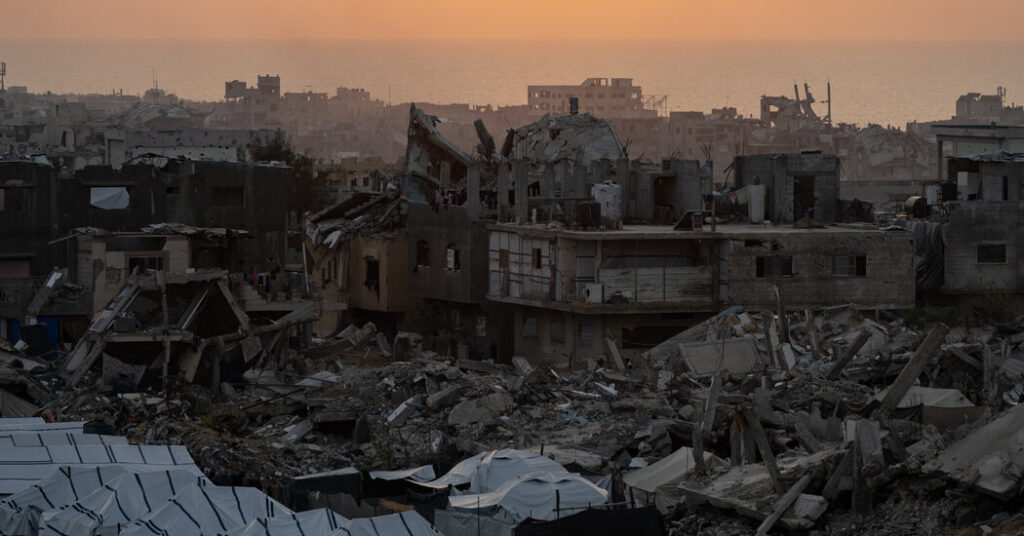
As progress on the plans has slowed, Hamas has filled the vacuum in Gaza, where it is rebuilding its presence by the day, according to analysts. For Gazans, the cease-fire has delivered some respite from the fighting, despite frequent flare-ups of violence, though many wonder if their homes will ever be rebuilt.
Securing Gaza
President Trump’s peace plan called for the deployment of an international force to help stabilize Gaza and train Palestinian police officers. Yet exactly how that force would operate has never been made clear, and the uncertainty has delayed its formation.
Some Trump administration officials, including Vice President JD Vance, have said they hope the force will spearhead efforts to disarm Hamas. In November, the United Nations Security Council passed a U.S.-led resolution that gave an international mandate to such a force, including for “ensuring the process of demilitarizing the Gaza Strip.”
The U.N. resolution was not explicit about how the force would go about that, and its language could be interpreted to mean that a confrontation with Hamas was possible.
No country has publicly committed to sending troops to Gaza, though Azerbaijan and Indonesia have been named as possible participants in the force.
For Azerbaijan, sending soldiers was out of the question if they would be involved in fighting Hamas, according to an Azeri official who briefed reporters on condition of anonymity to discuss sensitive information.
Some countries have said their soldiers would be there only to maintain the cease-fire in Gaza, and have pushed back on suggestions that they should get involved in confiscating weapons from Hamas militants, according to officials and diplomats.
Hakan Fidan, the Turkish foreign minister, told a conference in Doha last week that the international force shouldn’t be expected to do the Israeli military’s job. Turkey has suggested it was interested in joining the force, but Israeli officials have been adamantly opposed to that, citing what they describe as Turkey’s hostile attitude toward Israel.
Still, efforts to form the international force appear to have picked up steam in recent days. The U.S. military is set to hold two meetings about it in the coming weeks, one on Dec. 16 in Doha, Qatar, with a two-star general and a second in January with a four-star general, three Western officials said.
Greater detail about what the force was expected to do in Gaza has also surfaced.
United States Central Command, or CENTCOM, a branch of the U.S. military that is helping develop plans for the force, recently gave a presentation to military officials from dozens of countries. It said that troops would be deployed in parts of Gaza currently controlled by Israel, and a dedicated team would train over 4,000 Palestinian police officers.
The force’s deployment would begin the near the southern city of Rafah and create the conditions for further Israeli military withdrawal, according to the presentation. The New York Times obtained a copy of the presentation and verified with three Western diplomats that it was shown to the officials by CENTCOM.
CENTCOM declined to comment.
The document outlines the deployment of 8,000 soldiers, saying some of them would “secure terrain, routes, and fixed sites to enable flow of humanitarian aid” and “prevent enemy disruption.” The document also says that members of the force would “set conditions for the demilitarization of Hamas” but did not say how disarmament would happen.
The United States has invested extra resources in monitoring the cease-fire and developing plans for Gaza’s future. Some of those efforts have been centered in an American-led facility called the Civil-Military Coordination Center, or C.M.C.C., in southern Israel.
Hamas has long opposed any international force being deployed in Gaza, but Husam Badran, a senior Hamas official based in Qatar, suggested in an interview last week that the group was more open to the idea.
There was “consensus” among Palestinians for international troops being in Gaza, Mr. Badran said, as long as they were there to monitor and maintain the cease-fire, and not get involved in disarmament. “Palestinians can’t accept any force — regardless of citizenship — attacking citizens, entering their homes and trying to find their personal weapons,” he added.
Israel has also appeared skeptical that such a force could successfully disarm Hamas.
On Sunday, Prime Minister Benjamin Netanyahu underscored that disarmament would happen, alluding to military intervention, if necessary. “It can be done the easy way, it can be done the hard way. But eventually it will be done,” he said.
Postwar Governance
Another key part of the Trump administration’s peace plan stipulates that the governing of Gaza would be temporarily handled by a “technocratic, apolitical Palestinian committee,” overseen by what the plan refers to as a “Board of Peace.”
The board would be chaired by Mr. Trump and its membership would include several heads of state, according to the plan. Beyond that, it remains unclear exactly who will be on the board, or the Palestinian committee, and how they will shape Gaza’s postwar governance.
Trump administration officials had planned to make an announcement about the Board of Peace before Christmas, but that will likely be postponed until early 2026, two Western diplomats said on condition of anonymity to discuss sensitive information.
An executive committee was also expected to be involved in decision-making, and would include a host of current and former U.S. and European senior officials, the diplomats said.
They said that Steve Witkoff and Jared Kushner, advisers to Mr. Trump and architects of his peace plan, were expected to be on the executive committee. Tony Blair, the former British prime minister who served as a Middle East envoy after leaving office, was mentioned in Mr. Trump’s peace plan as having a role on the board.
Some Palestinian activists have criticized the possibility of including Mr. Blair, who they argue is too sympathetic to the Israeli government.
Nickolay Mladenov, a former U.N. envoy for the Middle East peace process, is also being considered for a position, potentially acting as a liaison with the Palestinian committee, according to the two diplomats.
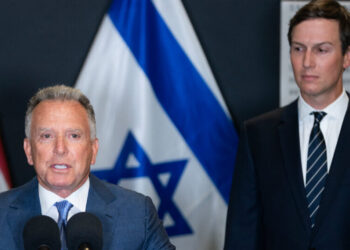
Last week, Mr. Mladenov met with Aryeh Lightstone, a senior Trump administration official helping to develop plans for Gaza’s future, according to three Western diplomats.
Mkhaimar Abusada, a Palestinian political analyst from Gaza City who was displaced during the war and now lives in Cairo, said that Mr. Mladenov was an effective mediator between Israel and Hamas during his time as a U.N. envoy. “Mladenov is good news for Palestinians,” he added.
Adam Rasgon is a reporter for The Times in Jerusalem, covering Israeli and Palestinian affairs.
The post Can Trump’s Grand Plans for Gaza Get Off the Drawing Board? appeared first on New York Times.