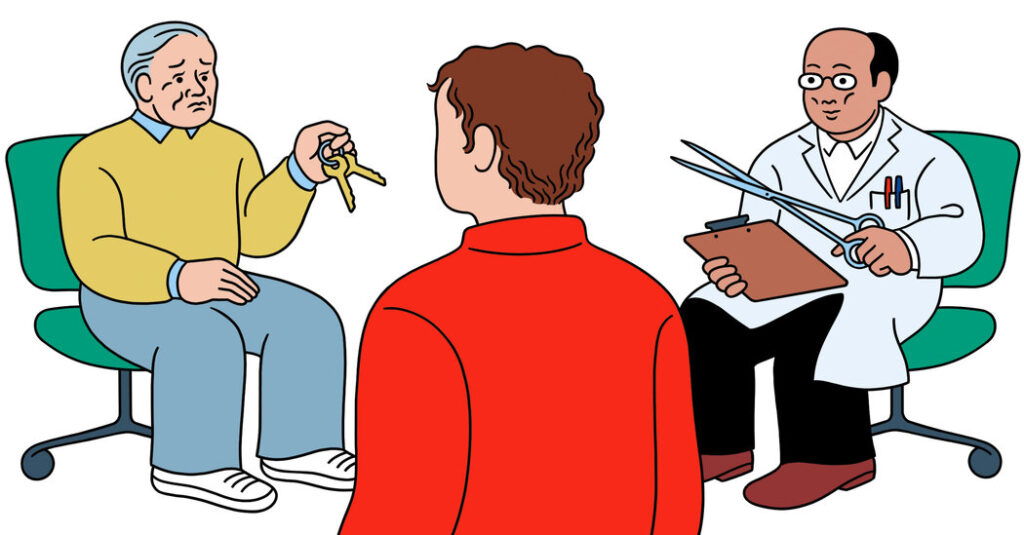
My wife and I have a 24-year-old son, our only child. He was different from the start, and we home-schooled him for a time, before moving to a smaller school district where he managed socially and academically. By high school he was doing respectably and taking medication for his attention issues.
This changed during his senior year, when remote learning and his decision to stop taking his medication resulted in a decline in academics and self-discipline. We moved again so he could attend a nearby junior college, but the same pattern repeated. Because his behavior toward us worsened along with his study habits, we eventually had to insist he move out. We looked into a program for neurodiverse students that seemed promising, but he did not want to be associated with people who were “different.” He instead enrolled in a state university, where he failed every class because he did no work and ended up moving back home.
He then found a job at a big-box store but was fired for working too slowly (he has O.C.D. and would endlessly recheck dates on items). At home, his oppositional defiant disorder and dishonesty became intolerable, so we rented him an apartment on the understanding that he would work and contribute what he could. Eighteen months later, he has no job and probably can’t hold one. He lives on food stamps and Medicaid, rarely bathes, hasn’t brushed his teeth in more than 18 months and refuses basic self-care.
We drafted a simple behavior contract: We would continue to pay for his housing if he kept himself and the apartment reasonably clean and agreed to see medical, psychiatric and dental providers (at our expense). He refused at first, spent a night outdoors, then signed it. But almost nothing changed.
At this point we believe he may never be able to care for himself. I’m 70 and my wife is 61; we’re trying to plan for his long-term support. My view is that if we’re providing housing and financial help, he should have a vasectomy. He admits he can’t care for himself or a child, but rejects the idea. I’ve told him that when his lease expires, I won’t continue supporting him unless he agrees. I am weary of the constant battle and am ready to see him permanently homeless or dead unless he complies. Even if he agrees to the vasectomy, he still needs to change his behavior for us to secure stable, affordable housing for him; he will never live with us again after threatening my wife when she said we might cut off his phone payments.
My wife is unsure about making the vasectomy a condition of support. I think it’s ethical, or at least far less unethical than the idea of him fathering a child. — Name Withheld
From the Ethicist:
You’ve obviously done an extraordinary amount over the years to try to provide your son with the resources to manage his life. But you’re holding two incompatible pictures of him, and they pull in opposite directions. One treats him as someone who, despite unusual preferences, can still respond to incentives. That’s the rationale behind conditioning your offer of housing on his agreeing to ordinary hygiene and medical care.
The fact that this hasn’t worked cues the other picture, in which he has serious mental impairments and, at least without forms of treatment he refuses, can’t manage basic tasks. Most people don’t need external incentives to bathe or brush their teeth, and if they did, free housing would certainly tip the balance. Your son is unable or unwilling to do these things. If this second picture is closer to the truth, he can’t really be expected to respond to bargaining, and it’s inappropriate to treat him as if he could.
You’ve already seen that you can’t change him by offering deals. Presenting him with new conditions, then, just doesn’t make sense. If he can’t live up to a contract, you’re not negotiating with him. You’re using duress to impose a life-altering decision.
Nor is your motive for the vasectomy (preventing him from having a child he’d be unable to look after) his direct welfare. When you push hygiene or medical care on him, you’re acting as a parent protecting your child. Imposing a vasectomy to protect potential others falls a little outside that sphere. And it brings out how — in treating him as too impaired to manage basic tasks but sufficiently competent to weigh a potentially permanent surgical decision when threatened with homelessness — you’re overlaying those two very different pictures.
There’s also a practical question: How likely is he to father a child? You don’t describe him as physically aggressive, and one could wonder how many willing partners someone who rarely washes and never brushes his teeth would find. The risks he poses are already constrained by the self-destructive behavior that troubles you. You’d do better to accept the limits of what you can control — and figure out what form of long-term shelter you can afford — than to try to force outcomes he’s not equipped to sustain.
Readers Respond
The previous question was from a reader struggling with whether to end a friendship that had become toxic. She wrote:
Over the past five years, a close friend has been through a cascade of upheavals. … Through all of this, I showed up. … I feel confident in saying that I was a good friend. This year, she kept pushing me to try an A.I. workout feature on Peloton. I told her I didn’t want to and that it felt triggering to be told when and how to work out. … She blew up, accused me of shaming her and stopped speaking to me for a month. That month was clarifying. I realized how one-sided the friendship had become. … I eventually sent her a thoughtful email, reviewed by my therapist, explaining that the friendship no longer felt reciprocal or healthy. Five minutes later, she sent an expletive-filled text calling me names and blaming me for her suicidal ideation. … What do we owe a friend who is struggling? At what point is stepping back self-protection rather than abandonment? How do we weigh someone’s “rough patch” against patterns of behavior that feel toxic? And if her mental health is genuinely poor, does that obligate me to leave the door open forever? — Name Withheld
In his response, the Ethicist noted:
One person can’t will a friendship back to life. … Plainly, this person simply hasn’t treated you with the care and consideration that a friend is owed. The problem isn’t that she blew up at you; it’s that she never apologized, never tried to repair the rupture, never treated the relationship as something she was equally responsible for. You’re not the one who has walked away. To stay in the close orbit of someone with mental illness can be an act of compassion or charity, but when the support and affirmation goes only in one direction, it isn’t an act of friendship. She also seems to have other people in her life, a spouse and family members, who are better placed to do something and who have greater responsibility as a result. You didn’t abandon this person in a storm; during years of bad weather, you showed up, at some cost to yourself. But you can’t be asked to serve both as a shelter and as a lightning rod.
(Reread the full question and answer here.)
⬥
Sometimes being called out for our behavior — whether verbally, or by a relationship ending — is best for both parties. It can be a necessary wake-up call to take responsibility for one’s self. As my wise mother used to say, “If you do what’s best for yourself, everything else will fall into place.” This is love, too. — Jenny
⬥
I agree with the Ethicist’s response, but there is something that I want to add. It seems that the letter writer took actions, such as flying out of state, setting up a nursery and absorbing lengthy text rants, that only closest friends and family (or paid professionals) would consider taking. I wonder if this “friendship” really was a rescue operation, with the letter writer acting as an overengaged and free therapist. In this situation, where a lengthy pattern has emerged, it is understandable that this troubled and needy person feels abandoned when the relationship is suddenly terminated. It is within the letter writer’s right to do so, but she would do well to examine why she participated in such a lengthy one-way “friendship.” It can be gratifying to help others in need — until suddenly, when the anger is redirected, it isn’t. — Janet
⬥
Five years seems like a very extended “rough patch,” during which it doesn’t sound as if the letter writer realized any benefit from the friendship. It’s odd that they continued as long as they did, unless the fact of being helpful fulfills some need of theirs. Helping someone through a rough patch should result in the friend assuming self-responsibility. When that doesn’t happen, walking away is, oddly, a loving thing to do. It’s important to care about friends, but not if it means sacrificing one’s own well-being. “I felt peaceful for the first time in years” is the most telling line in the letter. — Mel
⬥
I went through something similar several years ago after a good friend endured a life-altering health event. It still weighs on me and upsets me that I eventually chose to walk away. But even with the pain of feeling like I betrayed someone in need, I feel much more at peace without my former friend in my life. For me, the incident actually sparked the deepest and greatest healing period of my life. I’m making peace with the fact that our friendship was one of my greatest teachers — and that it is OK that it had an end date. — Hannah
⬥
I have a handful of friends who are self-absorbed or annoying in one way or another, but there’s always a “but.” For example, “… but he’s someone I can text random observations to” or “… but she helped me move that time!!” With the letter writer’s friend, there was no “but,” or anything that suggested the friend had reciprocated, or even shown appreciation or basic interest. The writer’s reason for staying friends was purely based on the theoretical obligations involved. As the Ethicist suggests, ending the friendship is justified. — Rachel
The post Can I Insist That My Dysfunctional Son Get a Vasectomy? appeared first on New York Times.