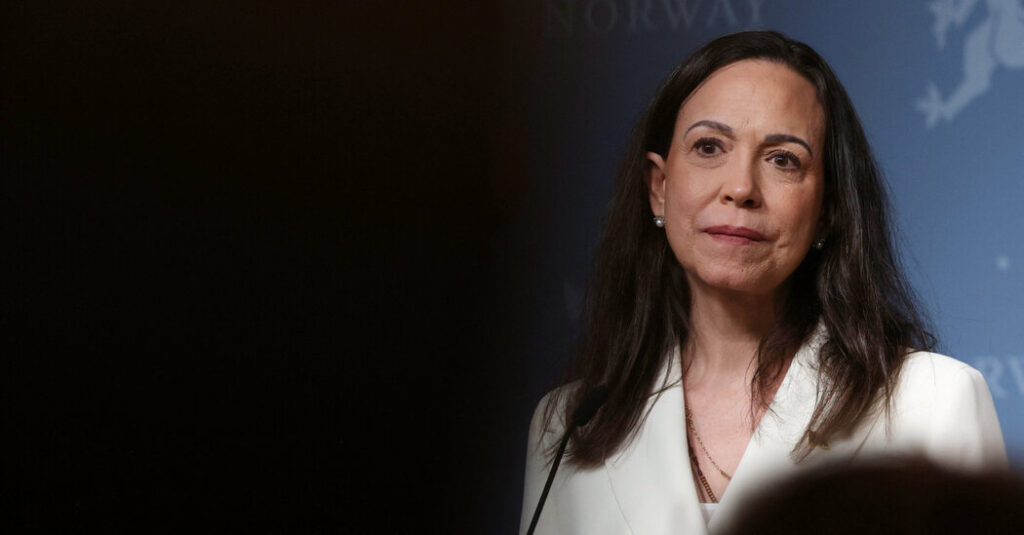
The Venezuelan opposition leader María Corina Machado was determined to make it this week to Oslo, where she hoped to accept the Nobel Peace Prize in person. Emerging from hiding and finding a safe route to Norway would require skirting military checkpoints, enduring hours of rough seas, and making a leap of faith that no U.S. drone strike would obliterate the small vessels smuggling her to a Caribbean island where a private plane was waiting.
She arrived in Norway too late for the prize ceremony. But her perilous escape exhilarated her supporters and underscored how Ms. Machado — who spent the last year in hiding from the regime of President Nicolás Maduro — remains a key player in the intensifying standoff between Caracas and Washington.
The emerging details of her evacuation have also shed light on the usually secretive operations of a company run by U.S. veterans with special operations and intelligence training, who orchestrated the effort to slip one of Venezuela’s most recognizable political figures out of the country without getting caught.
“We were not the first people to try this,” Bryan Stern, the combat veteran who leads the firm, Grey Bull Rescue, said in an interview. Ms. Machado’s rescue was the 800th for his Tampa-based group, which was organized in the wake of the chaotic U.S. withdrawal from Afghanistan in 2021, he said. But it posed a unique challenge, even for operatives with long experience in being hired to evacuate clients from risky environments.
“All of our infrastructure is designed for nobodies, and Maria is a somebody,” said Mr. Stern. “The challenge with this operation was her.”
While a representative of Ms. Machado’s confirmed that Grey Bull Rescue handled her evacuation, not all elements of Mr. Stern’s account could be independently verified. The Wall Street Journal was first to report details of her escape.
Venezuelan operatives had been trying for months to devise a way to spirit Ms. Machado, 58, a former lawmaker and election-monitoring activist who gained renown for uniting Venezuela’s fractious opposition to challenge Mr. Maduro, out of the country so she could make it to Oslo. But it was not until last Friday that a personal contact introduced Ms. Machado’s team to Mr. Stern, he said.
Grey Bull Rescue had spent the last few months working from a base in Aruba to expand its Caribbean operations, anticipating that as the Trump administration escalated a pressure campaign on Venezuela, its extraction services would be in demand. The firm dubbed Ms. Machado’s rescue operation Golden Dynamite — gold, for the 18-karat medal Ms. Machado would be awarded, and dynamite, in homage to the most famous invention of Alfred Nobel, who established the prize.
Four days later, Ms. Machado, wearing a disguise, set off on her journey.
Ms. Machado had a long history in Venezuelan opposition politics before she became a hunted woman in her own country. In 2023, she won an opposition primary to challenge Mr. Maduro in last year’s presidential election. But when she became the front-runner, the country’s highest court barred her from running.
In the summer of 2024, independently verified vote counts showed that Ms. Machado’s chosen replacement, the soft-spoken retired diplomat Edmundo González, had beaten Mr. Maduro by a wide margin. Authorities nonetheless declared Mr. Maduro the victor, and his government went on a repression campaign against critics of the outcome. Before her arrival in Oslo, Ms. Machado was last seen in public on Jan. 9, the day before the inauguration.
Venezuela’s government had said that Ms. Machado would be considered a fugitive if she left the country, and it is unclear if she will be allowed to return without being arrested. Venezuelan authorities have imprisoned hundreds of her supporters.
The first leg of her escape was by land. Ms. Machado and her handlers had to travel from the suburb of Caracas where she had been hiding out to a coastal fishing village. Along the way, they encountered 10 military checkpoints, Mr. Stern said. Despite the fact that her face had recently been plastered on campaign billboards across the country, she evaded capture.
Then came an even dicier part. On Tuesday evening, at about 5 p.m. local time, a fishing skiff carried her from the coast of Venezuela to another boat where Mr. Stern was waiting. Using a series of vessels, they spent more than 10 hours navigating choppy waters and high waves as they crossed the Caribbean Sea, heading to the island nation of Curaçao.
Whipping winds, turbulent waters and dark skies posed only one set of problems, however. The stretch of sea they traversed had been under heavy U.S. military surveillance, as the Trump administration accelerated efforts to counter international drug trafficking by carrying out military strikes on the boats of people suspected of smuggling.
“Multiple boats were involved, and we’re transferring people,” Mr. Stern said of Ms. Machado’s rescue operation. He added that “from the sky, that can look like something that it’s not.”
The Trump administration’s bombing campaign has earned widespread criticism from many lawmakers and legal experts, who have condemned the operations for killing unarmed civilians. The Pentagon has even been accused of potential war crimes over a Sept. 2 attack in which military officials appeared to target the shipwrecked survivors of an initial strike. The administration has brushed off the criticism, arguing that the strikes are a legal anti-terrorist operation.
Ms. Machado has been an adamant supporter of the U.S. military campaign in the Caribbean, which has included at least 22 boat strikes, killing at least 87 people. Her insistence that U.S. military pressure was needed to force Mr. Maduro from power touched off a wave of protests after her Nobel win was announced.
Before they hit the water this week, the U.S. government needed to be looped in. While Mr. Stern stressed that the administration had no role in planning or executing Ms. Machado’s rescue, his team alerted U.S. federal agencies about the mission, he said, to avoid being fired on as they ferried Ms. Machado across the Caribbean.
“We have deep contacts into every part of our government that matters,” Mr. Stern said, rattling off a list of agency acronyms across the intelligence, defense and diplomatic sectors that he coordinates with on a regular basis.
“We’ll transmit up and say, ‘Hey, we’re doing a thing here — we want to de-conflict,’” he added, stressing that the Machado operation involved enough potential close calls without risking an unexpected encounter with U.S. government operatives.
“We are at risk of being killed by F-16s, Mother Nature, drones from the Navy, a bad guy on the boat who just doesn’t like us, seasickness, loss of comms, loss of navigation, a boat sinking,” he said.
It was unclear whether the U.S. military took any proactive steps to aid the rescue mission.
American officials were told that Ms. Machado planned to leave Venezuela by water, so that the United States would not mistakenly target her boat or the vessel of her rescuers, according to American officials briefed on the rescue.
When reached for comment, military officials said they had no knowledge of the operation. A State Department spokesman did not respond to a request for comment.
Mr. Stern said that Ms. Machado — whom he counts as a personal hero — had held her own on the grueling journey, and had looked forward to reuniting with her family.
He said that as waves pounded the boat and drenched their clothes, “We didn’t talk politics; we talked about our kids.”
They reached Curaçao, disembarking in the wee hours of Wednesday morning. About three hours and a much-needed shower later, Ms. Machado was safely nestled in a private plane, wheels up and bound for Oslo.
Julian E. Barnes and Tyler Pager contributed reporting from Washington. Eric Schmitt contributed reporting from Miami.
Karoun Demirjian is a breaking news reporter for The Times.
The post Behind the Venezuelan Opposition Leader’s Daring Escape to Oslo appeared first on New York Times.