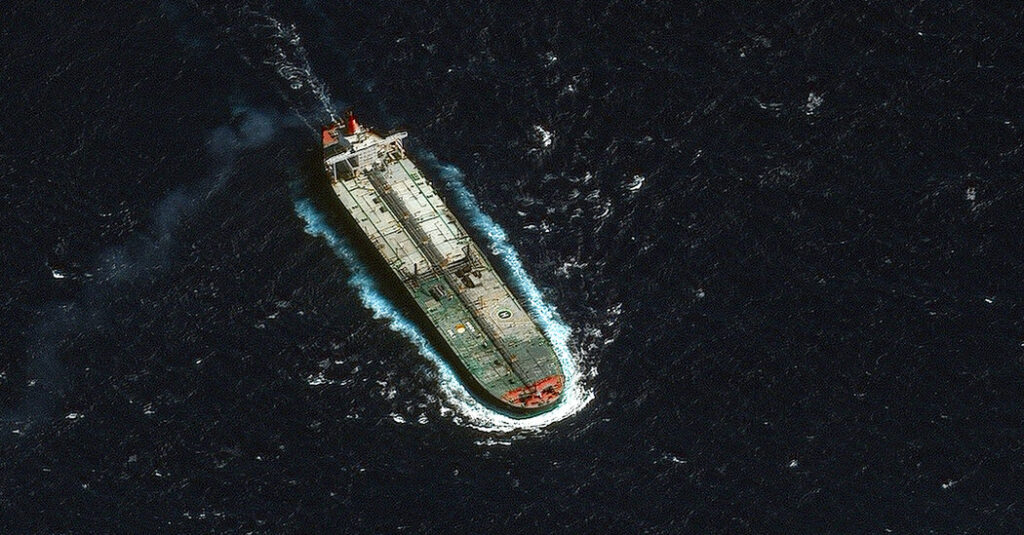
The oil tanker seized by the United States off the coast of Venezuela this week was part of the Venezuelan government’s effort to support Cuba, according to documents and people inside the Venezuelan oil industry.
The tanker, which is called Skipper, left Venezuela on Dec. 4, carrying nearly two million barrels of the country’s heavy crude, according to internal data from Venezuela’ state oil company, known as PDVSA. The ship’s scheduled destination was listed as the Cuban port of Matanzas, the data shows.
Two days after its departure, Skipper offloaded a small fraction of its oil, an estimated 50,000 barrels, to another ship, called Neptune 6, which then headed north toward Cuba, according to the shipping data firm Kpler. After the transfer, Skipper headed east, toward Asia, with the vast majority of its oil on board, according to a U.S. official briefed on the matter.
President Nicolás Maduro of Venezuela and his predecessor, Hugo Chávez, have for decades sent oil to Cuba at highly subsidized prices, providing a crucial resource at low cost to the impoverished island.
In return, the Cuban government over the years has sent tens of thousands of medics, sports instructors and, increasingly, security professionals on assignments to Venezuela. That exchange has assumed special importance as Mr. Maduro has leaned on Cuban bodyguards and counterintelligence officers to protect himself against the U.S. military buildup in the Caribbean.
In recent years, however, only a fraction of Venezuelan oil set aside for Cuba has actually reached the island, according to PDVSA documents and tanker tracking data.
Most of the oil allocated for Cuba has instead been resold to China, with the money providing badly needed hard currency for the Cuban government, according to multiple people close to the Venezuelan government.
Some of that money is believed to have been used by Cuban officials to purchase basic goods, though the opacity of the country’s economy makes it difficult to estimate where that money ends up, or how it is spent, or how much goes to business intermediaries with ties to both governments.
On Friday, Cuban officials condemned the American seizure of the tanker, calling it in a statement an “act of piracy and maritime terrorism” that hurts Cuba and its people.
“This action is part of the U.S. escalation aimed at hampering Venezuela’s legitimate right to freely use and trade its natural resources with other nations, including the supplies of hydrocarbons to Cuba,” the statement said.
The White House did not immediately respond to a request for comment.
The main person managing the flow of oil between Cuba and Venezuela is a Panamanian businessman named Ramón Carretero, who in the past few years has become one of the largest traders of Venezuelan oil, according to PDVSA data and people close to Venezuela’s government.
The U.S. Treasury Department imposed sanctions on Mr. Carretero on Thursday for “facilitating shipments of petroleum products on behalf of the Venezuelan government.” Mr. Carretero, through a legal representative, declined to comment on the government’s decision. He did not respond to detailed questions for this article.
Mr. Carretero’s role as an economic intermediary between Cuba and Venezuela was first reported by Armando.info, a Venezuelan investigative news outlet.
Skipper, the seized tanker, was carrying oil jointly contracted by Cubametales, Cuba’s state-run oil trading firm, and an oil trading company tied to Mr. Carretero, PDVSA documents show. Overall, Mr. Carretero’s trading companies have accounted for a quarter of the oil allocated by PDVSA for export this year, the documents show.
Cubametales has won contracts to buy about 65,000 barrels a day of Venezuelan oil so far this year, a 29 percent increase from 2024, and a sevenfold increase from 2023, according to PDVSA documents. The U.S. Treasury imposed sanctions on Cubametales in 2019 for buying Venezuelan oil, a move that formed part of Mr. Trump’s previous standoff with Mr. Maduro during his first administration.
The oil from Venezuela that does reach Cuba generates electricity and provides fuel for airplanes and machinery. But it is not enough to prevent widespread power outages that have plagued the island amid a broader economic crisis.
Skipper’s planned voyage shows how, in practice, Cuba benefits from oil trade in Venezuela. Cubametales, the state-run firm, listed the ship’s destination as Cuba, suggesting that all of the company’s allocated 1.1 million barrels were heading to the island.
The tanker, however, ultimately headed to China after offloading only a small fraction of the oil to the Neptune 6 and sending it en route to Cuba, according to a person close to PDVSA.
Then, on Wednesday, as Skipper sailed east in international waters between the islands of Grenada and Trinidad, it fell into a U.S. ambush.
Armed American law enforcement agents wearing camouflaged combat gear rappelled from a helicopter onto the tanker’s deck on Wednesday, according to a video released by the U.S. government and a U.S. official with knowledge of the operation. The crew offered no resistance, and U.S. officials said there were no casualties.
U.S. officials said they would seek a warrant to seize the oil, valued at tens of millions of dollars, adding that the crew had agreed to sail the vessel under Coast Guard supervision to a U.S. port, likely Galveston, Texas.
The Trump administration and the Venezuelan opposition have long presented Mr. Maduro’s government as a hub for American adversaries, and the dramatic seizure of the Skipper on Wednesday appeared aimed as much at weakening Mr. Maduro’s alliances as it was at cutting his access to funds.
Venezuela’s communications minister, Freddy Ñáñez, called the detention of the tanker the latest example of Washington’s “piracy, kidnapping, theft of private property, extrajudicial executions in international waters.” He did not comment on the detailed questions sent for this article.
The history of Skipper’s voyages points to a larger, looser network connecting the energy industries of Venezuela, Cuba, Iran and Russia, the four American adversaries that have been, to various degrees, shut out from the formal global oil market by Washington’s sanctions.
Skipper’s crew of about 30 sailors was mostly Russian, a U.S. official said.
Before shipping Venezuelan oil, Skipper spent four years as part of Iran’s covert fleet, transporting Iranian oil to Syria and China, according to data from Kpler, the shipping data firm, and a senior Iranian oil ministry official, who discussed sensitive issues on condition of anonymity.
Iran’s foreign ministry spokesman Esmail Baghaei on Friday condemned Skipper’s seizure, calling it “state sponsored piracy” in comments to local media.
Elsewhere in Venezuela, Iranian contractors have worked on repairing the country’s two main refineries, El Palito and Amuay, according to Homayoun Falakshahi, Kpler’s head oil analyst and an expert on Iran’s energy sector.
Russia supplies Venezuela with key imports of naphtha, a light oil product that Venezuela uses to dilute its sludgy main type of crude and make it suitable for export. A Russian state-run oil company, Rosneft, produces nearly 100,000 barrels a day of crude in Venezuela, and in previous years the company had played a crucial role in exporting Venezuelan oil to China.
These countries’s energy ties have been driven less by shared anti-American sentiment than by commercial opportunities and necessity, according to experts. They have learned from each other how to avoid sanctions and keep oil revenues flowing.
Russia’s ability to build a shadow fleet of tankers and find new oil markets to fund its war in Ukraine, for example, is partly owed to its oil traders’ experience moving sanctioned Venezuelan crude during Mr. Trump’s previous standoff with Mr. Maduro in 2019.
Venezuela, for its part, has learned from Iran, which has worked to evade sanctions imposed by the first Trump administration after it pulled out of the nuclear deal in 2018.
Venezuela, Iran and Russia, however, also compete for the Chinese oil market, whose size and clout have allowed it to continue buying crude sanctioned by the United States, said Francisco J. Monaldi, an oil expert at Rice University in Houston.
“It’s like the OPEC of sanctions: These countries have common interests, but also some opposing interests,” Mr. Monaldi said. “Most of the time, it’s just about business.”
Eric Schmitt and Riley Mellen contributed reporting. Sheelagh McNeill contributed research.
Anatoly Kurmanaev covers Russia and its transformation following the invasion of Ukraine.
The post Behind the Seized Venezuelan Tanker, Cuba’s Secret Lifeline appeared first on New York Times.