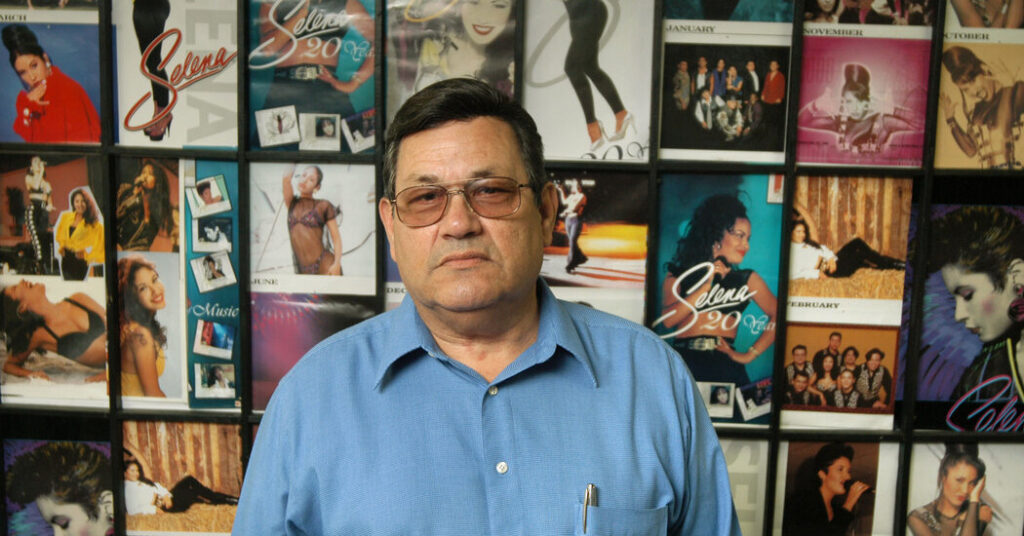
Abraham Quintanilla Jr., the music producer who recognized a talented singer in his young daughter Selena and managed her career as she ascended to the peak of the Tejano music world, died on Saturday. He was 86.
His son, A.B. Quintanilla, announced the death in an Instagram post, but did not cite a location or cause.
With Selena doing vocals, Mr. Quintanilla turned his small family band from Lake Jackson, Texas, into a Grammy Award-winning act, and Selena became known as the queen of Tejano music. But to some fans, Mr. Quintanilla was a polarizing figure, a headstrong, controlling man who, at times, manipulated his daughter.
Mr. Quintanilla taught his children to sing and play music from a young age, and had them perform at a restaurant the family owned, as well as at weddings in the Lake Jackson area, according to the Texas State Historical Association.
In 1982, when Selena was about 10, the Quintanilla family moved down the Texas Gulf Coast to Corpus Christi, where the band performed at dance halls and nightclubs, slowly making a name in Tejano music, a blend of traditional Mexican music and American pop.
Known as Selena y Los Dinos, the band got a big break in 1985, when it was invited to perform on “The Johnny Canales Show,” a bilingual variety show watched by millions. Selena was still a teenager, and the gig was one of her first live TV performances.
“She’s got something,” Johnny Canales said in a 2015 interview with Univision, recalling the first time she performed on his program. “Except I scolded her once because she didn’t know how to speak Spanish.”
As the band toured Texas and Mexico, Selena’s popularity began to rise. By 1987, she won the Tejano Music Award for Female Entertainer of the Year, and in 1994, her album “Selena Live” won a Grammy Award for Best Mexican-American Album.
While Selena’s career began to take off, Mr. Quintanilla tried to maintain his grip on her and the band. When Chris Perez, the guitarist that she would later marry, joined the group, Mr. Quintanilla grew increasingly protective and was slow to accept their budding relationship.
As Mr. Perez wrote in his memoir, “To Selena, With Love” (2012), Mr. Quintanilla was disturbed when he heard that Mr. Perez and Selena had been holding hands.
“I don’t know what’s going on with you guys, but whatever it is, it stops right now,” he recalled Mr. Quintanilla telling him. “If you say a single word about this conversation to Selena, I will deny it, and she’s going to believe me.”
In an interview with Texas Monthly, Mr. Quintanilla admitted that he had seen Mr. Perez as a threat. “What if they got married and he pulled her out of the band?” he said. “All the work we did all those years would go down the tubes.”
The couple eventually married, eloping in 1992 without Mr. Quintanilla’s blessing.
“After that, I accepted him as part of the family. What else could I do?” Mr. Quintanilla told Texas Monthly. “Everybody had their own lives, but we were still a family.”
Three years later, Selena was shot and killed at 23 by the former manager of her fan club. Her death in 1995 sent shock waves through her rapidly growing fan base in the United States and Mexico, and throughout the Tejano music industry.
Cameron Randle, a former music executive, told Texas Monthly that after Selena died, “Tejano became increasingly directionless.”
Mr. Randle added: “Once she was gone, there was a lot of confusion and disorientation. There was uncertainty about who would carry the mantle going forward, and Tejano never really recovered.”
Following Selena’s death, Mr. Quintanilla continued to produce his daughter’s work. In July 1995, the family released “Dreaming of You,” a song that had been recorded before Selena died. It became an instant hit.
But over the years, fans were critical of the posthumous release of other works, complaining that Mr. Quintanilla was trying to profit off his daughter. In interviews, he defended himself, saying that he and his family had obligations to honor their contracts.
“For me, it became a business,” he said in an interview in 2021 with a local Corpus Christi television station.
Abraham Isaac Quintanilla Jr. was born in Corpus Christi, Texas, on Feb. 20, 1939, to Abraham Quintanilla and Maria Tereza (Calderon) Quintanilla.
During the 1950s and ’60s, he played with Los Dinos, a Tejano group. But in a segregated city, he said in the 2021 interview, it was difficult for the band to grow.
“The Mexicans at that time, or Mexican Americans, rejected us because we sang in English,” he said. “And the Angelos rejected us because we were Mexicans.”
It was his dream for Los Dinos to make it in the mainstream American market, he added, but he finally quit the band.
“That dream that I had,” he said, “eventually, it became the dream of my children.”
In addition to his son, Mr. Quintanilla’s survivors include his wife, Marcela, and a daughter, Suzette Quintanilla.
Jesus Jiménez is a Times reporter covering Southern California.
The post Abraham Quintanilla Jr., Music Producer and Father of Selena, Dies at 86 appeared first on New York Times.