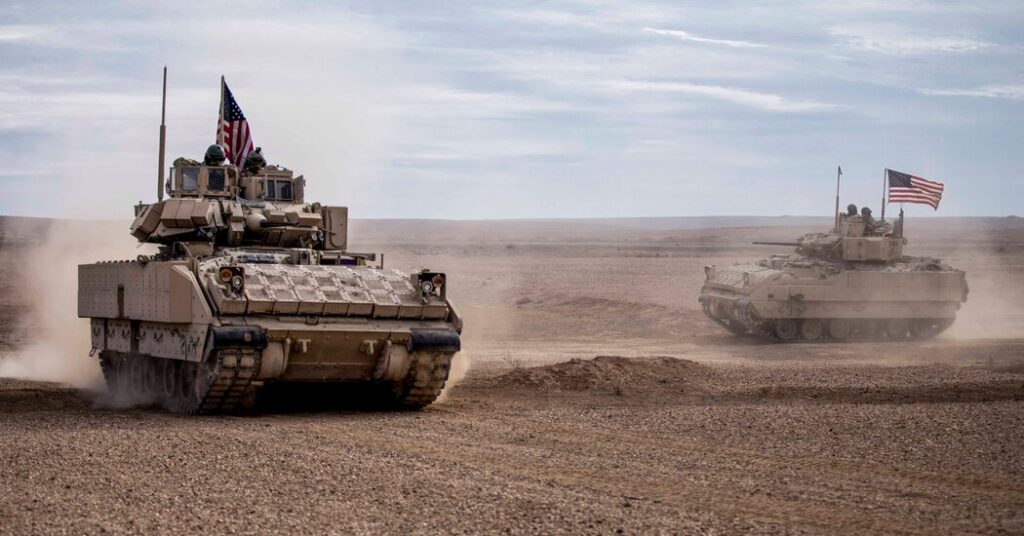
Two U.S. Army soldiers and a civilian U.S. interpreter were killed in central Syria on Saturday, the Pentagon said, in the first American casualties in the country since the fall of the dictator Bashar al-Assad last year.
The soldiers were supporting counterterrorism operations against the Islamic State group in Palmyra when they came under fire from a lone gunman, according to American officials. Syrian security forces subsequently killed the gunman, American and Syrian officials said.
Three American military personnel and two members of Syrian security forces were also wounded in the attack, according to American officials and Syrian state media. In the aftermath, American helicopters were deployed to evacuate the wounded to the al-Tanf U.S. base in southeastern Syria, Syrian state media said.
The attack highlighted the challenges for the nascent Syrian government, led by president Ahmad al-Shara, as it steers a deeply-fractured country emerging from nearly 14 years of civil war.
Since his rebel coalition toppled the government of Mr. al-Assad, Mr. al-Shara has had to contend with threats from the Islamic State and various other armed groups, while simultaneously building a new national military.
The attack also comes months after the United States began to draw down its military presence in Syria, from around 2,000 American troops in Syria at the start of the year to around 1,000 today, according to a Pentagon official.
The decision to do so reflected the shifting security environment in Syria after Mr. al-Assad’s government collapsed, and the diminished threat posed by the Iranian-backed militias and Russian troops who had supported him. It remains unclear whether the lethal attack on American soldiers on Saturday will affect that strategy.
Defense Secretary Pete Hegseth forcefully condemned the attack, writing in a post on X, “if you target Americans — anywhere in the world — you will spend the rest of your brief, anxious life knowing the United States will hunt you, find you, and ruthlessly kill you.”
No group has yet claimed responsibility for the attack though initial assessments suggest that it was likely carried out by the Islamic State, according to a Pentagon official.
A spokesman for the Syrian Interior Ministry, Noureddine al-Baba, said in a statement that the Syrian government had warned American counterparts about the possibility of attacks by the Islamic state, also known as ISIS, on their forces.
“The international coalition forces did not take the Syrian warnings about the possibility of an ISIS breach into account,” Mr. al-Baba said.
Since 2014, American forces have been deployed in Syria across various U.S. bases, including al-Tanf. For years, their main objectives have included combating the Islamic State, guarding strategic areas like oil fields and curbing Iranian influence.
American forces have also partnered with the Syrian Democratic Forces, a Kurdish-led militia that controls much of the nation’s northeast, to provide training and equipment, and maintain pressure on the Islamic State. The group seized control of Palmyra in 2015, destroying invaluable archaeological sites and carrying out brutal attacks on civilians and military personnel.
After suffering stinging defeats in 2017, the Islamic State’s capabilities in Syria were greatly diminished. Remnants of the group remained at large in the remote desert of eastern Syria.
But the group has continued to carry out small-scale attacks since Mr. al-Assad’s departure, primarily targeting soldiers from Mr. al-Shara’s government. There are also growing concerns about the possibility of the group breaking thousands of its hardened militants out of detention, which could further destabilize the region.
Last month, after meeting with President Trump in the White House, Mr. al-Shara signed a declaration of political cooperation with the U.S.-led coalition that combats the Islamic State in Syria.
The move reflected both Mr. al-Shara’s eagerness to establish stronger ties with the United States and the volatility his country continues to face, as it grapples with sectarian violence, deep humanitarian crises and the formidable challenge of rebuilding its military and security forces.
Eric Schmitt contributed reporting from Washington.
Abdi Latif Dahir is the East Africa correspondent for The Times, based in Nairobi, Kenya. He covers a broad range of issues including geopolitics, business, society and arts.
The post 3 Americans Killed in Attack in Syria appeared first on New York Times.