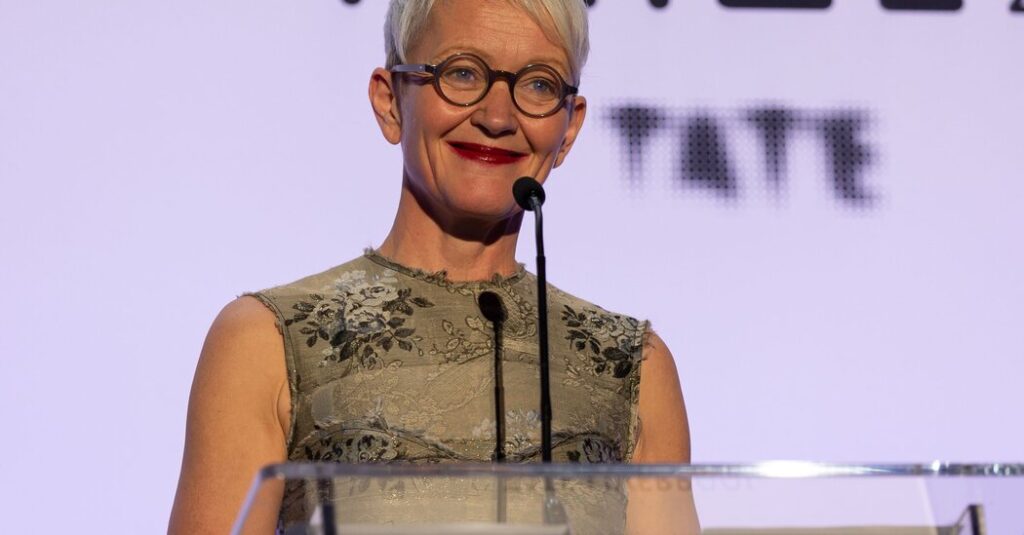
Maria Balshaw, the director of the Tate group, which includes some of the world’s most visited art museums, will step down next spring after nine years in the role, Tate said on Friday.
Roland Rudd, Tate’s chair of trustees, described her as “a trailblazer” and said in a news release that Balshaw had diversified the artists shown at its four museums: Tate Modern and Tate Britain in London, as well as two smaller institutions in Liverpool and in St. Ives, a seaside town.
Yet Balshaw’s departure comes at a troubled moment for Tate, with annual visitor numbers at its two main sites some two million lower than those seen before the coronavirus pandemic, and with the museum group facing financial challenges and a demoralized work force.
In September, Tate published its latest accounts, showing that it had operated at a loss of almost 5 million pounds, or $6.7 million, during the previous 12 months. This spring, it announced that it was cutting staff numbers 7 percent to help save costs. In November, some 150 staff members went on strike over pay.
Hareem Ghani, an official with the Public and Commercial Services Union, which represents some Tate workers, said in an email that there was “considerable excitement” when Balshaw joined Tate in 2017 as its first female director. However, after repeat rounds of job cuts, she said that Balshaw was leaving “at a point where gallery staff are at their lowest in terms of morale.”
A Tate spokesman said that Balshaw was unavailable for interview, but in the news release Balshaw said she was departing because it was “the right time to pass on the baton.”
Her final Tate project will be curating a retrospective of work by Tracey Emin, the popular British artist, that is scheduled to run at Tate Modern from Feb. 27 through Aug. 31. Balshaw did not explain in her statement what she planned to do next.
She succeeded Nicholas Serota, a well-known arts administrator who had run Tate for almost three decades and turned it into an art world powerhouse, including by inaugurating Tate Modern in a former power station alongside the Thames River. When Tate Modern opened in 2000, it quickly gained a global reputation for staging exciting contemporary art shows. Even with its recent reduced attendance numbers, it is now the world’s fifth most visited museum according to The Art Newspaper, receiving some 4.6 million visitors last year.
Shortly after her appointment, Balshaw said in an interview with The New York Times that her priority was “to ensure that everybody, irrespective of background, feels that they can have a connection to Tate,” and that it was “as relevant to young people” in London as tourists visiting from Korea.
Under her stewardship, Tate tried to diversify its audience by staging high-profile shows by Black and Indigenous artists including the painters Lynette Yiadom Boakye and Emily Kam Kngwarray, and by explaining how art relates to contemporary social and political concerns such as rights for trans people.
Although many British art critics acclaimed those shows, some have increasingly accused the Tate of prioritizing politics over art. Waldemar Januszczak, writing in The Sunday Times of London, was among those to savage a 2021 Tate Britain show about the painter William Hogarth for wall texts that he said focused on “wokeish drivel” rather than art history.
Januszczak said in an interview that Balshaw had been hampered by the huge size of Tate’s museums, particularly Tate Modern, which strained the group’s finances. But he said that under her tenure Tate had stopped showing exciting, crowd-pleasing art, and that the next director had “to get some showbiz back in there.”
Balshaw has repeatedly defended her approach in interviews and attributed any drop in visitor numbers to changing patterns in tourism rather than the art on Tate’s walls. In July, she told The Financial Times that she wasn’t concerned about attacks on her leadership.
“If we weren’t criticized,” she said, “we probably wouldn’t be doing our job properly.”
Alex Marshall is a Times reporter covering European culture. He is based in London.
The post Tate Museums Are in Choppy Waters. Now, Their Director Is Leaving. appeared first on New York Times.