Thirty years after Ennio Morricone composed his only opera, “Partenope,” the piece is having its world premiere at the Teatro San Carlo in Naples on Friday.
For some, it will be a bittersweet debut.
“The great disappointment is that Ennio is no longer with us,” said Sandro Cappelletto, who co-wrote the libretto. “It would have been fantastic to see him these days, changing the score, taking something away, adding something else, doing what always happens with premieres.”
“Not to mention the satisfaction of being represented in a theater,” he added. “Ennio loved opera so much.”
Why the opera was not performed when it was written, in 1995, offers a snapshot of the classical music scene in Italy at the time, which snubbed Morricone as a mere composer of film soundtracks.
It made little difference that some of those compositions became iconic — think of the twanging guitar in his score for Sergio Leone’s “The Good, the Bad and the Ugly,” or his sweeping arrangements for “The Mission” and “Cinema Paradiso.” For many in the highbrow crowd, Morricone had no place in an opera theater.
“He really suffered because of this,” Cappelletto said.
Morricone came from an academic, theoretical tradition, having studied composition at Rome’s Academy of Santa Cecilia, one of Italy’s top conservatories. In the 1960s, he performed with one of Italy’s leading experimental contemporary music ensembles. Writing film soundtracks had been a means to putting bread on the table.
After his movie career took off, Morricone continued to write what he called “absolute music” — music free of the constraints imposed by film directors and producers — believing that experimentation to be his “authentic vocation,” according to Susanna Pasticci, a musicology professor at Sapienza University of Rome.
But the demand for his film scores was huge. S.Z. Sugar, the publisher that owns the catalog for Morricone’s “absolute music,” has about 100 titles, but IMDb lists over 550 movie credits.
Both the libretto and the score for “Partenope” are complex. The orchestra consists mostly of wind instruments — with no violins — and the percussion includes drums mostly used in Neapolitan folk music: the tamorra, the tamburello and the putipù.
Cappelletto said Morricone had looked to ancient Greek music for the score, which is based on the modal scales of that period. Morricone said Cappelletto had told him that “‘modality is absolute music,’ so in the score for ‘Partenope’ he discovered compositional freedom.”
Jessica Pratt, one of two singers playing the title role, said the part was a “really hard role to sing, because it doesn’t come from my usual world of bel canto.” It took her longer to learn Partenope than Donizetti’s Lucrezia Borgia, she added. “Even when we’re singing in tune, it seems like we’re out of tune,” she laughed.
The opera chronicles the myth of the founding of Naples, which is celebrating its 2,500th anniversary this year. The work was commissioned in 1995 by a festival in the Campania region, of which Naples is the capital, but the event went under and “Partenope” was never premiered.
Morricone “was expecting that someone would call him” with another opportunity, Cappelletto said, “but 30 years ago, Morricone couldn’t be performed in an opera theater because he was known as the composer of spaghetti westerns.”
The opera found a new champion after Anna Leonardi, the head of publishing for S.Z. Sugar, came across “Partenope” while looking through the company’s archives. “Morricone died with this great regret of never having listened to his only opera,” she said. “So we have an obligation, and a duty, to promote this aspect of his music.”
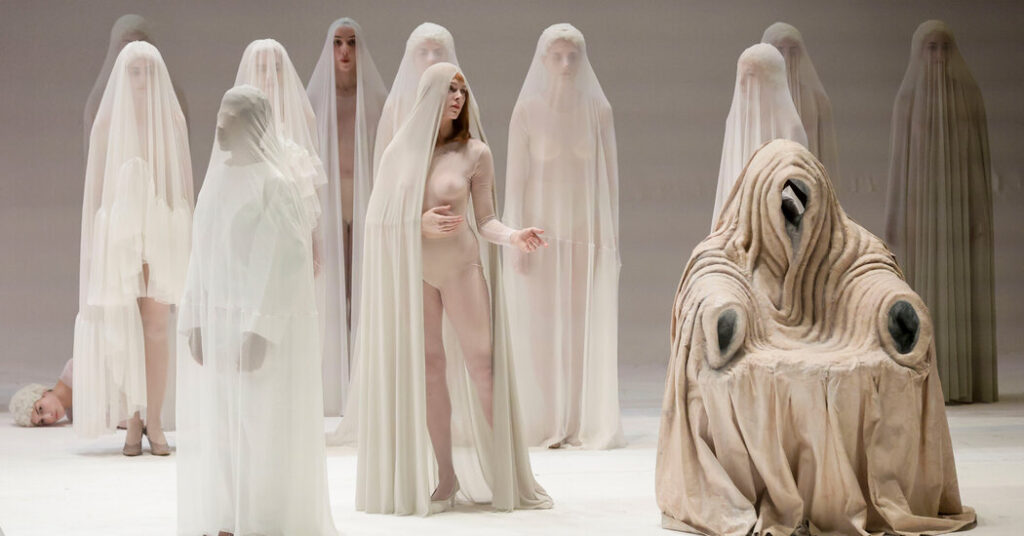
The Teatro San Carlo, Naples’s storied opera house, came onboard and invited the Italian American artist Vanessa Beecroft — known for her large-scale installations with female performers — to direct the production. It’s a good fit.
Onstage, movement is limited, the figures mostly standing still, in arrangements typical of Beecroft.
Alongside the two women who share the role of Partenope, singing and reciting, Beecroft flew in three pairs of identical twins from New York, Los Angeles and Seattle to play other Partenopes. “I wanted this multiplicity and mirroring between the left and right sides of the stage,” she said last week while making last-minute costume fixes.
Cappelletto said that Morricone scholars recognized Partenope as “a work of synthesis between the Morricone of cinema and the cultured, classical Morricone.” Even to an untrained ear, there are moments that recall his celebrated soundtracks.
Unlike in the ’90s, when the opera was written, that is now likely to draw in audiences rather than push them away.
Fulvio Macciardi, who became the Teatro San Carlo’s general manager in October, long after the work was included in the season’s offerings, said he was happy to oversee a “very interesting page” in the theater’s history. Having held top jobs at theaters in Trieste and Bologna, he said he knew that contemporary music often challenged and wasn’t always appreciated by opera audiences.
“That said, I think this work will be redeemed because it’s by Morricone,” he said. “I don’t know if that would be true had it been by someone else.”
Elisabetta Povoledo is a Times reporter based in Rome, covering Italy, the Vatican and the culture of the region. She has been a journalist for 35 years.
The post From ‘Spaghetti Western’ Scores to the Opera Stage appeared first on New York Times.