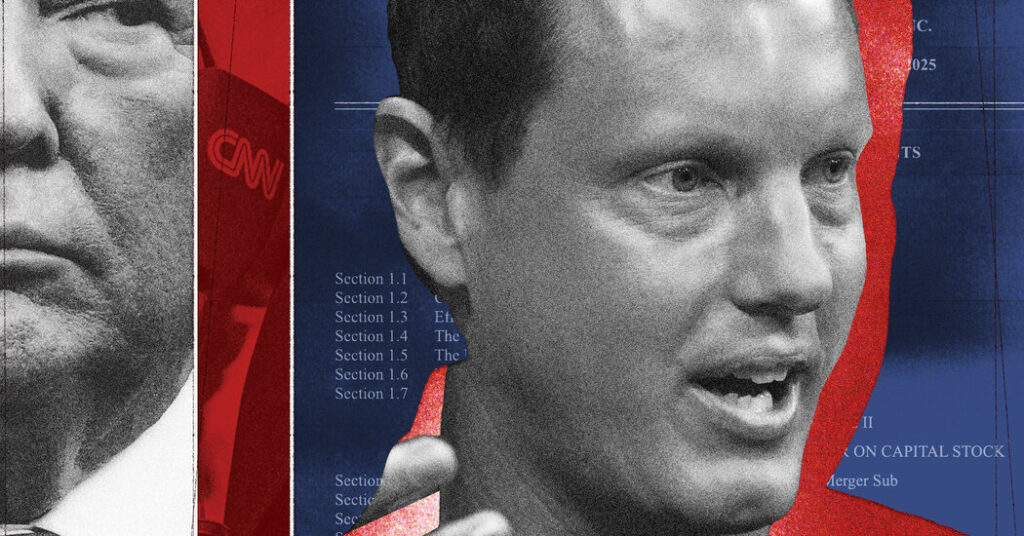
David Ellison boasts a cozy relationship with President Trump, a string of right-coded hires and financial allies in the Saudi Arabian government.
He also may be the best hope to save American moviegoing.
It was only a few months ago that Mr. Ellison, the millennial son of the tech billionaire Larry Ellison, spent $8 billion, much of it from his family, to snap up the Paramount media empire, transforming himself almost overnight into a major Hollywood power player. Then on Monday, the younger Mr. Ellison launched a $108.4 billion hostile offer to take over Warner Bros. Discovery, an audacious move given that Warner’s board had already decided to sell much of the firm to the Silicon Valley streaming giant Netflix for nearly $83 billion.
Such bids usually fail, as they require convincing a lot of shareholders to defy a company’s board. Yet Mr. Ellison is intent on prevailing. Netflix brass historically has made no secret of its disdain for the movie theater, allowing Mr. Ellison to position himself as a savior from their streamification, atomization and A.I.-driven automation of American culture. The 42-year-old sees himself, and wants us to see him, as not just restoring Paramount, battered in recent years, but Hollywood itself. He promises to launch a new golden age, with the combined Paramount-Warner Bros. unleashing more than 30 movies into theaters every year, a number that harks back to earlier eras of studio dominance.
But there’s a catch. Mr. Ellison was able to ascend to Paramount moguldom thanks in part to his closeness with Mr. Trump, and now he is trying to capitalize on the same bond to win the president’s favor for an even bigger prize. And he has leverage: If he buys Warner Bros., he’d control CNN, one of the few relatively unscathed major television-news outlets that is regularly critical of the White House. The Netflix acquisition would exclude the news network.
Mr. Trump always wants his pound of flesh, and any company run by Mr. Ellison would inevitably be prone to influence from the White House, which has pressed media executives to fire people Mr. Trump doesn’t like and promote those he does. In his zeal to save Hollywood, Mr. Ellison is playing a dangerous game. It may well end up devouring him. And combined with the fact that Mr. Trump is leaning toward giving Larry Ellison’s company, Oracle, the nod for a stake in social-media powerhouse TikTok, it could inch us scarily close to a culture of state-run media.
Mr. Trump has said he’ll “be involved” in the decision over who buys Warner Bros, though the few obvious legal levers he possesses are not guaranteed to successfully stop Netflix and clear the way for David Ellison. That hasn’t stopped both Mr. Ellison and Ted Sarandos, Netflix’s co-chief executive, from reaching out to the mercurial president. The Netflix C.E.O. reportedly made a visit of his own, and Mr. Trump, who is known to play rivals against each other, praised him earlier this week. Whether the president will actually be able to use his regulatory tools to successfully back one and block the other, without interference from the courts, the players involved are certainly acting like he can.
How we even got to this moment is its own Hollywood drama.
For years, the younger Mr. Ellison labored in what might be called film-investor purgatory, a space where you’re mainly tolerated for your ability to make other people’s dreams come true. After a short stint as an actor in the unsuccessful 2006 fighter-pilot drama “Flyboys,” — a film his father helped finance — David Ellison started the film production company Skydance, also backed by his dad. Skydance funded a mix of hits and misses, often sequels to franchises — like “Star Trek.”
Commanding fealty but not admiration, the younger Ellison was far from the most impressive film mind on a set. In fact, he was not even the most impressive film mind in his own family. His sister, Megan Ellison, punk-rocker to David’s finance bro, was making a name for herself in the early 2010s by bankrolling and allying with some of Hollywood’s biggest auteurs, like Kathryn Bigelow (“Zero Dark Thirty”) and David O. Russell (“American Hustle”).
That dynamic began to change toward the end of the decade. When a long-gestating “Top Gun” sequel needed money, David Ellison was right there with 25 percent of the film’s nearly $200 million production budget. When it premiered in 2022 at the tail end of the pandemic, “Top Gun: Maverick” became the hit Paramount and Hollywood badly needed, and Mr. Ellison had been transformed into both a top-level producer and something of a savior.
Mr. Ellison’s next moment arrived when Shari Redstone, then-Paramount’s controlling shareholder, was searching for a moneyed investor to bail out its foundering finances. A year of boardroom drama later, Mr. Ellison landed Paramount, one of the country’s few remaining media conglomerates.
It was then that the relationship he had been cultivating with Mr. Trump — they appeared together at UFC mixed martial arts events in April and June — really paid off. Mr. Trump could have significantly slowed down the acquisition via Brendan Carr’s Federal Communications Commission. Instead, the president appeared to publicly endorse the deal, saying that Mr. Ellison would “do a great job” leading the merged company.
There is very little in Mr. Ellison’s biography that points to a latent MAGA streak. If his politics reveal anything, it’s a genial, uncomplicated patriotism. In fact, the younger Ellison once called himself “socially liberal” and donated nearly $1 million to Joe Biden’s re-election campaign last year. Even before his installation at Paramount, Mr. Ellison was heavily involved in the company’s lucrative deal to purchase the streaming rights to Comedy Central’s animated series “South Park” — a show that depicted Mr. Trump as literally in bed with Satan, as well as recently re-upped “The Daily Show” host Jon Stewart, another well-known Trump critic.
But there’s a lot of data on the other side of the ledger as well. Mr. Ellison installed the former head of a conservative think tank to oversee complaints of ideological bias in CBS News coverage, and he brought on center-right contrarian (and TV newbie) Bari Weiss to head the same network. Mr. Ellison also opted against reinstating late-show host and Trump critic Stephen Colbert after executives under the prior regime canceled the host’s late-night show.
Following Mr. Trump’s apparent personal urging to the Ellisons, Paramount agreed to distribute “Rush Hour 4” when other studios wouldn’t touch it, after its filmmaker, Brett Ratner, was accused of sexual misconduct. Mr. Ratner, a Trump ally, has been directing a documentary about Melania Trump for Amazon.
According to The Wall Street Journal, in discussions with the White House about his Warner bid, Mr. Ellison pledged to revamp CNN, potentially handing the vengeful president a significant measure of influence over a network he loathes. Mr. Ellison’s proposed Warner Bros deal already contains a sop to Mr. Trump: He brought on Trump-friendly interests, including Saudi Arabia and the private-equity firm founded by Jared Kushner, Mr. Trump’s son-in-law, to help finance his bid.
The appearance of Mr. Ellison in the president’s box at the Kennedy Center honors Sunday underscored just how closely Mr. Trump can whisper in Mr. Ellison’s ear — and how much Mr. Ellison might listen.
After bailing out Paramount, Mr. Ellison is now possibly on the precipice of another savior moment with his proposed bid for Warner. Perhaps the savior moment. This time, Mr. Ellison doesn’t just redeem “Top Gun.” He can rescue every movie theater it ever plays in. While Netflix says that it “expects to maintain” Warner’s slate of theatrical releases, including “Dune: Part Three,” its track record suggests that over the long term, it would prioritize its straight-to-streaming model. A Netflix purchase of Warner Bros. would almost surely be a disaster for those who care about the communal theatrical experience.
But if Mr. Ellison wins, plenty else may be lost.
Sure, the one-time actor and stunt pilot is just following in the footsteps of many C.E.O.s toeing the Trump line to protect their business interests. A child of Silicon Valley, the younger Ellison knows how a lack of regulation can send valuations to the stratosphere. Yet this kind of MAGA cosplaying can be perilous. Throw meat to the lion, and the lion always wants more.
Mr. Ellison need only look north from the Paramount lot to Burbank, where Disney and its C.E.O., Bob Iger, attempted to placate Mr. Trump with a $16 million settlement (including legal fees) over a lawsuit against ABC News — only to see the president threaten comedian Jimmy Kimmel’s cancellation too and, more recently, suggest the pulling of ABC’s broadcast license.
Would Mr. Trump stop at CNN anchors? Or would he also ask for the head of John Oliver, whose HBO show has gone after the White House on issues including immigration, freedom of the press, tariffs and health care? Would the next “Top Gun” be even more emptily jingoistic than the most recent one? The answer is probably yes; anyone who doubts that hasn’t been paying attention. Too much of Mr. Ellison’s track record suggests he’d be willing to accommodate those requests, potentially servicing the erosion of First Amendment freedoms.
Shortly after “60 Minutes” aired an interview with newly minted Trump critic Marjorie Taylor Greene on Sunday, the president telegraphed to Mr. Ellison that he wanted some changes. “Since they bought it,” Mr. Trump posted on Truth Social of Mr. Ellison’s Skydance, “60 Minutes has actually gotten WORSE!” Mr. Ellison has yet to act. But such clear broadsides raise even further questions about what a CNN- and HBO-owning Mr. Ellison might be asked to do.
What America has in the fight between Mr. Sarandos and Mr. Ellison, in other words, is a nearly impossible dilemma. On the one hand, we face a seemingly more Trump-neutral figure who disdains theaters; on the other, we face an apparent Trump ally who appreciates communal cultural experiences. The country with this merger confronts a choice between an executive who Hollywood believes is open to ripping up the compact of cinema — and a mogul listening intently to the man who tears at the fabric of democracy.
Mr. Ellison should be lauded for his traditionalist intentions with a combined Paramount and Warner Bros. Saving American moviegoing is a beautiful goal. One wishes, however, that it didn’t potentially come at the expense of our democracy.
Steven Zeitchik is the senior editor of technology and politics at “The Hollywood Reporter” and founding editor of the A.I.-themed newsletter Mind and Iron.
Source photographs by Probal Rashid, Chip Somodevilla and Patrick T. Fallon/Agence France-Presse, via Getty Images
The Times is committed to publishing a diversity of letters to the editor. We’d like to hear what you think about this or any of our articles. Here are some tips. And here’s our email: [email protected].
Follow the New York Times Opinion section on Facebook, Instagram, TikTok, Bluesky, WhatsApp and Threads.
The post David Ellison Is Playing a Dangerous Game appeared first on New York Times.