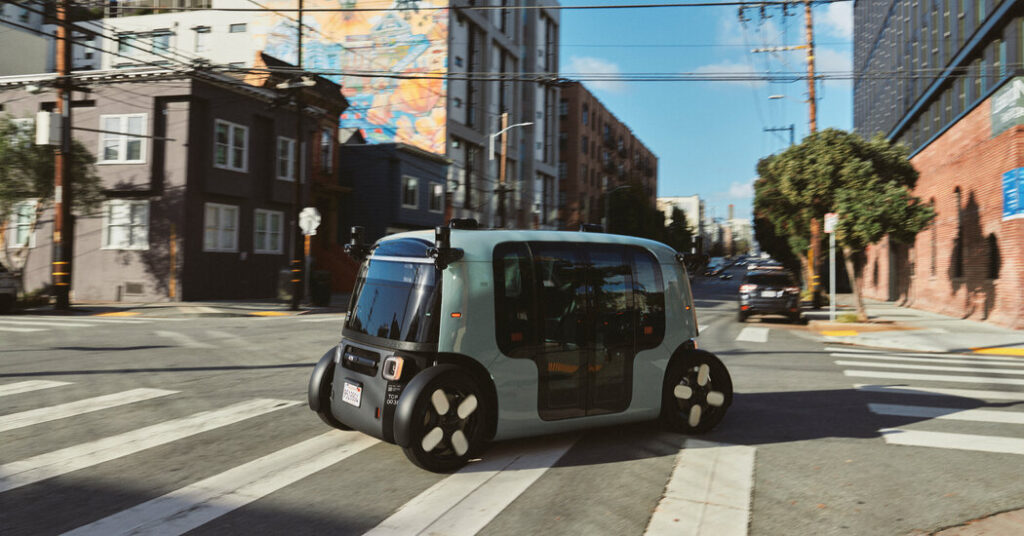
Call an Uber in Austin or Atlanta, and you might be offered a vehicle without a driver. Waymo, the self-driving taxi service owned by Google’s parent company, Alphabet, is expanding rapidly and partnering with ride-hailing companies.
Waymo operated 14 million trips across five U.S. cities this year and is expanding to Dallas, Houston, Miami, Orlando and San Antonio in 2026 with a goal of completing one million rides a week by the end of next year.
All of Waymo’s driverless taxis are electric vehicles, as are self-driving cars from competitors like Amazon’s Zoox and Tesla. All these autonomous E.V. rides have the potential to replace trips in gas-powered vehicles. Transportation is the biggest source of greenhouse gas emissions in the U.S.
Still, there are big questions about the long-term environmental implications of autonomous vehicles. For now, they won’t make a real dent until the industry grows. But even then, increased traffic and the industry’s demand for electricity could complicate things. In the long term, experts say, driverless vehicles could also cause a surge in overall demand for car transportation.
It’s very early days. Here’s what we know so far.
Driverless cars and air quality
Research has shown that replacing tailpipes with batteries can have a positive effect on air quality. A study from the University of Southern California’s medical school found that emergency room visits for asthma declined modestly when as few as 20 zero-emissions vehicles per 1,000 residents were added to the roads.
Other research has found that electrifying 17 percent of cars could lead to “modest but widespread” reductions in ozone and particulate matter. Waymo operates 1,000 vehicles in San Francisco, its largest market.
But as the Trump administration and Republicans in Congress eliminate electric vehicle subsidies and throw support behind gas-powered cars, driverless cars could emerge as a bright spot for E.V. ridership, said Yonah Freemark, a researcher at the Urban Institute.
“I think there’s a lot of technological benefits related to electric vehicles that the administration just cannot get in the way of,” he said.
Electric vehicles are also heavier than gas-powered cars, Freemark said, and additional tire and brake wear could release particulate matter into the atmosphere, which could have a particularly pronounced air-quality effect in neighborhoods near highways.
Carbon emissions
Waymo has said that its cars generate fewer emissions per mile than gas-powered vehicles. The company buys renewable energy to offset its carbon footprint.
Emissions from electric vehicles — with human drivers — can vary based on the energy sources used to power the grids where they’re charged. But E.V.s are generally much greener than gas-powered cars.
Still, replacing human drivers with computer systems comes with additional energy costs. Autonomous vehicles have been called “data centers on wheels” because they require so much computing power. The authors of a 2023 study from the Massachusetts Institute of Technology found that the power required to run one billion driverless vehicles driving for one hour per day could consume as much energy as all existing data centers in the world. (Data center construction has expanded since the study was published.)
Another big unknown is how autonomous vehicles could change the way people travel. We don’t know, for example, whether self-driving vehicles will drive more efficiently than humans, or whether people will use them to commute longer distances. This means the overall emissions outlook is uncertain, said Soumya Sudhakar, a Ph.D. candidate who led the study.
Driverless car gridlock
Which brings us to the question of robot-taxi traffic.
When researchers at North Carolina State University modeled the effects of autonomous vehicles on traffic congestion, they found that driverless cars programmed to drive cautiously tended to increase congestion when they made up a substantial proportion of cars on the road.
The finding has implications for air quality: If a handful of slow-moving robot taxis cause a traffic jam with a hundred idling gas-powered cars, any pollution benefits from the E.V.s could be outweighed by the honking gas-powered cars behind them.
It doesn’t have to be this way, said Ali Hajbabaie, a professor at North Carolina State who worked on the study. The modeling found that effects could be reversed if driverless cars were programmed to drive more aggressively, or if they could communicate with one another and local traffic systems.
“Now you can have a completely different story, and having autonomous vehicles could actually improve traffic operations,” he said.
These Utah beavers are moving. They’ll get new jobs and more space.
Utah is among a number of states, tribes and conservation groups that are leading the country on relocating unwanted beavers. While the animals, whose chewing and damming have long led to trouble with humans, remain controversial, Teresa Griffin, a wildlife manager with the Utah Division of Wildlife Resources, said she was seeing more interest from colleagues than ever.
“At first, we used to just do it in the southwest corner of the state, but now everybody else is kind of getting on board and becoming beaver believers,” Ms. Griffin said.
Beavers possess a singular drive to slow flowing water and create ponds, with skills to match. Across the West, the animals are increasingly valued for their ability to keep water on the drying landscape. Their dams reduce runoff, recharge groundwater, build habitat for fish and other wildlife, help streams recover critical sediment and create watering holes. As wildfires intensify, beavers are more important than ever. — Catrin Einhorn
Read more about how Utah is doing it.
And read more from our 50 States, 50 Fixes series:
Pollution
Starting with formaldehyde, the Trump administration reassesses carcinogens
The Trump administration is proposing to almost double what’s considered safe exposure levels to formaldehyde, a cancer-causing chemical found in many consumer products, as part of a broader overhaul of its approach to regulating carcinogens.
The Environmental Protection Agency under the Biden administration had, for the first time, prepared to regulate formaldehyde based on a fundamental assumption: that there is virtually no safe level of exposure for such carcinogens.
But in a win for the chemicals industry, the E.P.A. under President Trump is upending that approach. A draft memo published by the agency this month assumes a safe threshold exists for formaldehyde. — Hiroko Tabuchi
Lost science
“I was part of a system trying to make people’s lives better. To me, that was a good reason to get up in the morning. I was proud to show support from the American people.”
Jenny Carlson Donnelly was the malaria outbreak emergency adviser for the U.S. Agency for International Development. In her former position, she worked with people in other countries to prevent malaria and analyzed data from mosquito samples. (Malaria causes more than 500,000 deaths per year, many of them children.) In July, she was terminated from her position, amid a wave of cutbacks at U.S.A.I.D. Read more.
And read more from our Lost Science series.
More climate news from around the web:
-
Parts of Omaha have elevated levels of lead and residents were expecting the federal government to clean up local yards, according to Flatwater Free Press and ProPublica. But a Trump administration policy change tripled the amount of lead that had to be in the soil to warrant a potential cleanup.
-
Scientists say that climate change supercharged the storms that killed that 1,750 people in Asia in recent weeks, The Guardian reports.
-
Texas is on track to generate more power from solar farms than from coal plants this year, according to Reuters.
Read past editions of the newsletter here.
If you’re enjoying what you’re reading, please consider recommending it to others. They can sign up here.
Follow The New York Times on Instagram, Threads, Facebook and TikTok at @nytimes.
Reach us at [email protected]. We read every message, and reply to many!
Claire Brown covers climate change for The Times and writes for the Climate Forward newsletter.
The post Will the Self-Driving Cars of the Future Lower Emissions? appeared first on New York Times.