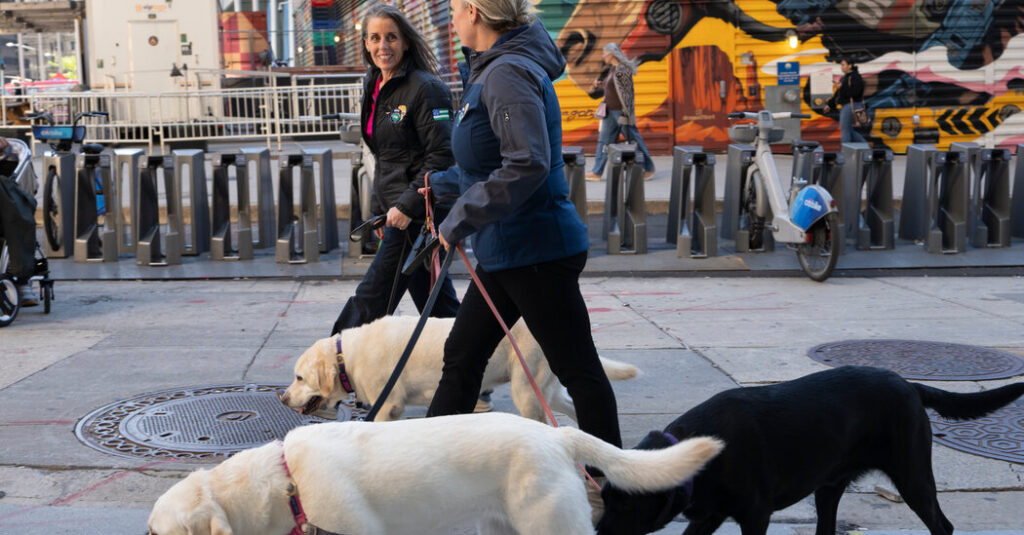
The day a gunman killed four people at a Park Avenue skyscraper in July, Sgt. Karolina Ostrowska-Tuznik said she went to the hospital to meet the officers who had carried the body of one victim, Detective Didarul Islam, out of the building. She brought Emma, a 2-year-old black Labrador, with her.
The dog walked over to one of the officers, who still had blood on his clothes and was especially quiet. She lay at his feet and the officer slowly bent down to pet her.
Emma is part of a Police Department wellness unit that includes dogs that are on call around the clock to respond to officer suicides, sudden deaths, funerals or calls from precincts where officers are feeling burned out. They can help officers feel comfortable enough to open up about their feelings, members of the unit say.
The dogs “have this beautiful ability to connect with people’s pain,” Sergeant Ostrowska-Tuznik said.
But in the past year, two of the unit’s four dogs and their handlers have retired, with no immediate plans to replace them. Under Commissioner Jessica Tisch, the department has been pushing for officers to be reassigned to patrol from what she has described as “desk jobs.” The fate of Emma’s program is unclear.
Kenneth Quick, a former police inspector who helped create the wellness unit before he retired from the department last year, said skepticism around the dog program has always existed.
For decades, the department has relied on dogs to sniff out bombs, search for cadavers or track down narcotics. But unlike other police dogs, the facility dogs, as they are called, “are not arresting anybody and they’re not solving any crimes,” Mr. Quick said.
“The N.Y.P.D., with its staffing issues, the primary function is always public safety,” Mr. Quick said. But, he said, supporting officers with a wellness program that includes therapy dogs is “crucial to the crime-fighting mission.”
In response to questions about the future of the program, the department said that it was “standard practice for any organization to review its performance.”
“Over the past year, Commissioner Tisch has made substantial changes to the N.Y.P.D. to restore public trust in the department and to ensure officers are deployed effectively — and the record-low crime numbers are proof of this work,” the department said in a statement, adding that it wants to bring civilians into some roles and put more uniformed officers on the streets.
The dog program grew out of the Health and Wellness Section, a unit of civilians and officers established in 2019 after 10 officers in the department died by suicide, fueling concerns about mental health. Two Labradors, Jenny and Piper, joined the unit in 2021. In a solemn ceremony at One Police Plaza, the dogs, at the prodding of their handlers, raised their paws in salute. By 2024, Emma and Glory had joined and there was talk of adding six more dogs who would fan out across the city’s five boroughs.
But in October, there was a send-off for Detective Efrain Hernandez and Jenny, who had been his partner for more than four years.
It was not your typical police retirement party. There were speeches, plates of chicken parmigiana and slices of carrot cake. But there were also platters of dog biscuits, and Jenny, Glory and Emma happily gnawed on enormous bones.
Jenny lay plopped in front of Detective Hernandez, draped in a blue sash with the words “Officially Retired” to match her handler’s. The detective said that he and Jenny could be among the last of their kind in the department.
“I have not heard anyone specifically say this,” he told the roughly 20 people at the party in the unit’s offices in Lower Manhattan. “But actions speak louder than words.”
In February, Piper and her handler retired. An officer and another dog, Thunder, spent two weeks training to replace them, but then the unit learned that Commissioner Tisch had not approved that plan, according to a lawsuit by Sergeant Ostrowska-Tuznik, Emma’s handler. The officer was moved off the dog team and Thunder went back to Puppies Behind Bars, a program run out of a prison upstate where inmates raise puppies to become therapy and service animals and teach officers how to handle them.
Then Detective Hernandez announced he would retire. Sergeant Ostrowska-Tuznik said she put in two requests over the summer to have Piper and Jenny replaced, but never heard back.
Her own position is now in limbo, too. She learned she was eligible for a promotion to lieutenant, but she would not be able to take the job unless she left the wellness unit and agreed to go on patrol.
For now, she said, she is staying put. She is suing the department and Commissioner Tisch, claiming gender discrimination because about a dozen men in the department were promoted without having to leave their units. Sergeant Ostrowska-Tuznik said she was also fighting to stay because of a fear that if she leaves, her team will be left with only one dog, Glory, whose handler is eligible for retirement.
“It’s almost like they’re trying to get rid of the whole thing,” she said in an interview with her lawyer, John Scola. The sergeant said she learned that her promotion was contingent on leaving the unit on the day of the Park Avenue shooting.
A department spokeswoman said that if Sergeant Ostrowska-Tuznik left the unit to take her promotion, she would be allowed to keep Emma as a pet.
It is a longstanding policy that officers who have been promoted to sergeant, lieutenant or captain are sent on patrol. The department said nine of the men who had been allowed to stay in their positions were in specialized units where they were already out in the field, like aviation, scuba and precinct investigative squads.
Sergeant Ostrowska-Tuznik argues that she and her fellow handlers are specialized, too. In addition to a two-week training with the dogs, they are taught to intervene in crisis situations and how to respond to family members of officers who have died or been injured. They are trained to sense when the dogs become overwhelmed at events like funerals, where they comfort mourners.
Detective Hernandez recalled how Jenny would collapse at the end of a funeral and “sleep for hours.”
“They absorb negative feelings and the positive ones, and it’s a lot for a dog to take,” he said.
Mr. Quick, the former inspector, who is now an assistant professor at DeSales University, called the dogs a “social catalyst.”
“There is a lot of stigma that prevents officers from coming forward when they’re undergoing mental health issues,” Mr. Quick said. Having officers instead of civilians handle the dogs creates more trust, he said.
It costs $60,000 to train each dog, a cost that is covered through a partnership between Puppies Behind Bars and the New York City Police Foundation, Sergeant Ostrowska-Tuznik said. The dogs also serve as good-will ambassadors, loping around holiday parties and public events unrelated to police work, where their handlers give out baseball cards with each dog’s name, photo and statistics, like their shield number, weight and birthday.
The handlers are encouraged to form an unusually close bond with the dogs, who sleep in their beds or close by and go with them nearly everywhere. Each animal is expected to become almost an extension of its handler, Detective Hernandez said.
Sergeant Ostrowska-Tuznik said, “I spend more time with Emma than anyone else, including my family.”
While she said she was relieved to know she could keep Emma, she believes the dog still wants to work.
Emma, the sergeant said, is not ready for retirement.
Maria Cramer is a Times reporter covering the New York Police Department and crime in the city and surrounding areas.
The post Will the N.Y.P.D. Push Its Therapy Dogs Into Early Retirement? appeared first on New York Times.