In today’s edition … Raphael Warnock feels Democrats have ceded religion to Republicans … The Senate ACA subsidies extension vote is today … but first …
Help us out
Who wants to have their question answered on a Post podcast? Dan has been a regular guest on The Post’s politics show that publishes every Friday and will be on later this week. Matthew joined last week. We, along with host Colby Itkowitz, would love to hear from you! Are there any burning political questions you’d love to have answered on the podcast this week? Send us an email at [email protected], and we may feature your question on the podcast.
Raphael Warnock on keeping the faith
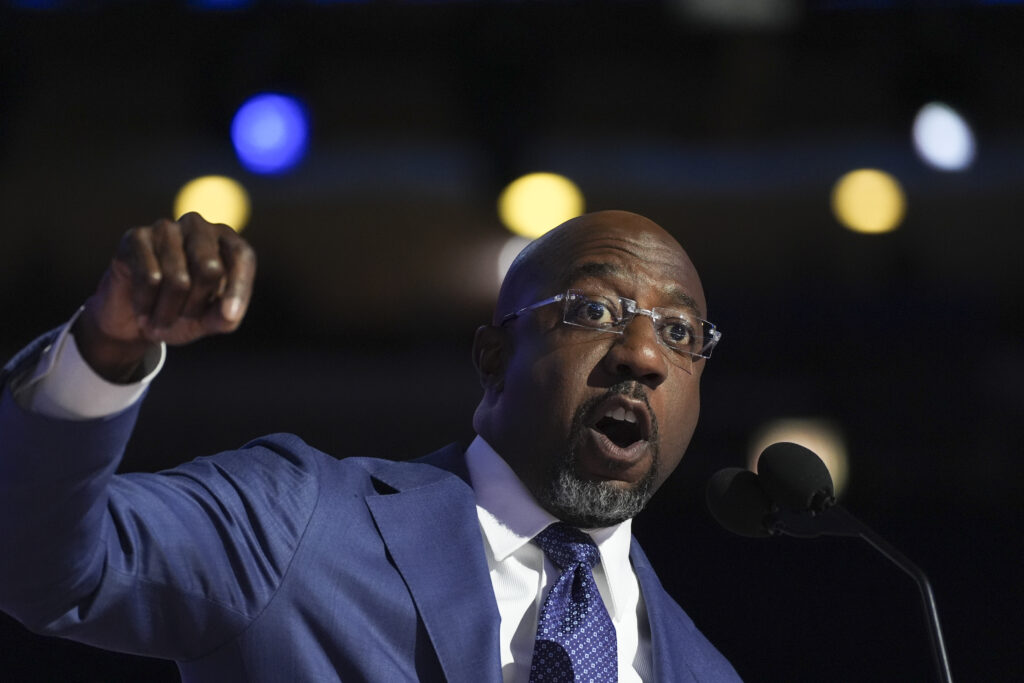
Sen. Raphael G. Warnock (D-Georgia), the only working member of the clergy in the Senate, says the country is in a “spiritual crisis.”
Amid economic uncertainty, years of war and the devastation of the covid-19 pandemic, people are turning to cynicism, he plans to say in a speech today at the Center for American Progress. That’s led to a mistrust for one another that has policy implications, from hostility to immigrants to a gutting of social services, that Democrats need to address — or risk voters looking for a savior somewhere else, like in President Donald Trump.
“Decades of this low-grade fever left untreated has brought us to where we are today, a nation in crisis, a nation that has become disconnected from the values that make us who we are, a nation where we no longer see our neighbors as crucial to our own success, but as competitors in a competition for scarce resources,” reads a copy of Warnock’s speech shared with us. “If people can’t believe in the promise of opportunity, they may choose to put their faith in ‘strong men’ who make false promises and provide targets for our anger.”
Warnock’s framing of economic anguish in faith terms is a rare tack among Democrats, who often either avoid or demonstrate outright hostility to showing religious influence in their policymaking.
But speaking to us in his office yesterday ahead of his speech, Warnock asserts that his approach has a storied tradition within American liberalism. He urged his fellow Democrats of faith to tap into their religious backgrounds to connect with voters and not let Republicans be the party of religion.
“We have ceded too much of that space to them, and I don’t know why,” Warnock told us.
Warnock is the senior pastor at Ebenezer Baptist, the historic house of worship that the Rev. Martin Luther King Jr. called his spiritual home. He calls himself a “Matthew 25 Christian,” referring to a passage of the Bible in which Jesus told his disciples that how they treat the most vulnerable was also how they treat him. That passage describes welcoming “the stranger” as a moral imperative — a word that in its original translation meant “immigrant” or “refugee,” the Rev. Jim Wallis, a friend of Warnock’s who has spoken at his church, told us — that pushes him to support policy to combat income inequality.
It’s a message that Warnock says has urgency, as Trump cracks down on immigration enforcement, and Republicans change social safety net programs to cut “waste, fraud and abuse.”
Wallis, an evangelical theologian who has served as a spiritual adviser to Democrats including former president Barack Obama, urged more Democrats to speak publicly about their faith in the way Warnock has. Wallis denounced a “left, secular fundamentalism that’s as irrational as the right, religious fundamentalism” and has alienated religious voters from the party. The skittishness among Democrats to speak in religious terms and conduct outreach to faith-based communities has surrendered discussion of religion to Republicans, he said.
The right has shown an ability to connect with faith communities for decades, and it has had major political implications. White evangelicals are among Trump’s most ardent supporters, with 72 percent approving of Trump’s performance in office, according to a Pew Research Center poll this year. Evangelical churches are seeing some of the most sustained growth in a country where church attendance is otherwise generally on the decline. The number of social conservatives and evangelicals has increased by 30 percent since 2010, according to reporting by our colleague Isaac Arnsdorf.
Trump has leaned into his evangelical support. He said during his inauguration that he “was saved by God to make America great again” following the assassination attempt against him in Butler, Pennsylvania.
“You shouldn’t have to be a Christian or a religious person to be a senator. But those that say they are … let’s have a conversation, a dialogue, even a debate about what the teachings of Jesus were. What he said. What he did. What he meant, and in this case, how he treated the stranger, the immigrant,” Wallis said “I would like to have that conversation, and Democrats make a mistake when they concede religion to Republicans.”
Though his message today taps into his Christian background, Warnock says it’s based on universal principles shared across faiths: equal dignity, welcoming the stranger, treating others as you would want to be treated. He quoted King in saying that a religion that professes to be concerned with the souls of men but not their economic conditions that strangle them is a “dry-as-dust religion.”
“The path out of our spiritual crisis begins with renewing the covenant we have with one another, of celebrating the variegated beauty of our diverse humanity, of giving every child a chance, of fulfilling the promise that if you work hard, you can build a good life for yourself and your children,” Warnock plans to say.
Get ready with The Post
- Billionaires are spending massive sums on politics. A backlash brews, from Naftali Bendavid.
- Why these red state Republicans are resisting Trump’s efforts to expand GOP power, from Patrick Marley.
- How a U.S. admiral decided to kill two boat strike survivors, from Noah Robertson, Alex Horton and Ellen Nakashima.
- Supreme Court wrestles with death penalty in cases of intellectual disabilities, from Justin Jouvenal.
- U.S. seizes ‘very large’ oil tanker off Venezuelan coast, Trump says, from Samantha Schmidt, Matt Viser, Karen DeYoung and Meg Kelly.
What we’re watching
Remember the Affordable Care Act subsidies that are expiring at the end of this year? The ones that Democrats hoped to renew using appropriations votes as leverage, triggering the longest government shutdown in American history? The ones that Senate Majority Leader John Thune (R-South Dakota) promised would eventually get a vote, prompting a handful of moderate Democrats to reopen the government to the ire of the Democratic base? That vote is today.
The Senate will consider two competing bills — one Republican, one Democratic — on the health care subsidies. The Democratic bill would extend the subsidies for another three years. The Republican one will let the subsidies expire but would create $1,500 tax-free accounts to pay for health care costs. Sens. Bill Cassidy (Louisiana) and Mike Crapo (Idaho) are leading the Republican bill.
Neither bill has the votes to pass.
So what was the point? Democrats repeatedly voted to keep the government shut down for 43 days. Food-insecure Americans reliant on SNAP and other nutrition assistance programs were in precarity. Federal workers went without pay with a fear that they would not be paid back for their forced sabbatical (though they were eventually back paid). The House was kept out of Washington for weeks, meaning the chamber couldn’t consider legislation or even swear in a duly elected member from Arizona. And still the health care subsidies did not get extended.
The battle over the health care subsidies doesn’t end today, though. Numerous Republicans, particularly vulnerable moderates in the House, are pushing for some sort of extension, though the party is having difficulty coalescing around a single plan (our colleagues Theodoric Meyer, Paige Winfield Cunningham, Riley Beggin and Marianna Sotomayor have more on the internal Republican struggle). And the Democratic senators who voted to reopen the government said they would keep pushing for an ACA tax-credit extension, even if that means shutting down the government again in January.
House Speaker Mike Johnson (R-Louisiana) told reporters yesterday that the lower chamber would come up with a proposal and vote on it next week before the Christmas recess. Like the Senate Republican proposal, the House Republican bill wouldn’t extend the tax credits themselves.
That’s putting a lot of frontline Republicans, whose voters are infuriated by higher premiums going into next year, in a funk. Rep. Brian Fitzpatrick, a moderate Republican from Pennsylvania, and Democratic Rep. Jared Golden of Maine introduced a discharge petition (the same mechanism to force a vote on releasing the Epstein files) yesterday to force a vote on a bipartisan bill to extend the health care subsidies.
Read more on the subsidies from Theodoric, Paige, Riley and Marianna.
In your local paper
Honolulu Civil Beat: A defense contractor was awarded hundreds of millions of dollars in government contracts to help uplift Native Hawaiians. He spent it on private jets, Porsches and polo matches.
CalMatters (California): A new report reveals a sluggish disciplinary process for corrections officers accused of sexual assault in California prisons.
Colorado Sun: Colorado cattle ranches are feeling the pinch competing with imported beef. Even those who support Trump are frustrated by his moves to quadruple the amount of Argentine beef shipped into the country.
From you
We were flooded with insights about how our readers view the state of the American economy after the president gave himself an “A+++++” rating for economic matters. The vast majority of you said Trump is guilty of grade inflation.
Martha Mattus, a reader in Portland, Oregon, said that Trump may be correct for the rich, but “for the rest of the country, the grade drops along with income.”
“For those who depend upon some form of greatly reduced or no longer available government assistance — SNAP, Medicaid, Affordable Care support, etc. — the economy gets a failing grade,” wrote Mattus.
“Here in Texas, we would grade the economy a C-,” wrote James Smith. “Other than the stock market which is overpriced and over-influenced by a dozen tech companies, nothing seems to improve.” Smith added, “Retailers continue to gouge on prices even after tariffs have been removed.” Reader Ed Lyons agreed and gave the economy a C.
“From a personal standpoint, I’m retired and doing okay. But I see friends and small businesses struggling, and I hear reports from the local areas that say farmers are teetering on bankruptcy. Lower gas prices help my daughter, who has a long drive to work, but it’s not enough to offset higher rent, food and auto expenses,” wrote Jayne Phillips.
Thanks for reading. You can follow Dan and Matthew on X: @merica and @matthewichoi.
The post Warnock: Dems have ‘ceded’ to Republicans on religion appeared first on Washington Post.