The Venezuelan government has called the U.S. seizure of an oil tanker off the coast of Venezuela “a blatant theft and an act of international piracy.”
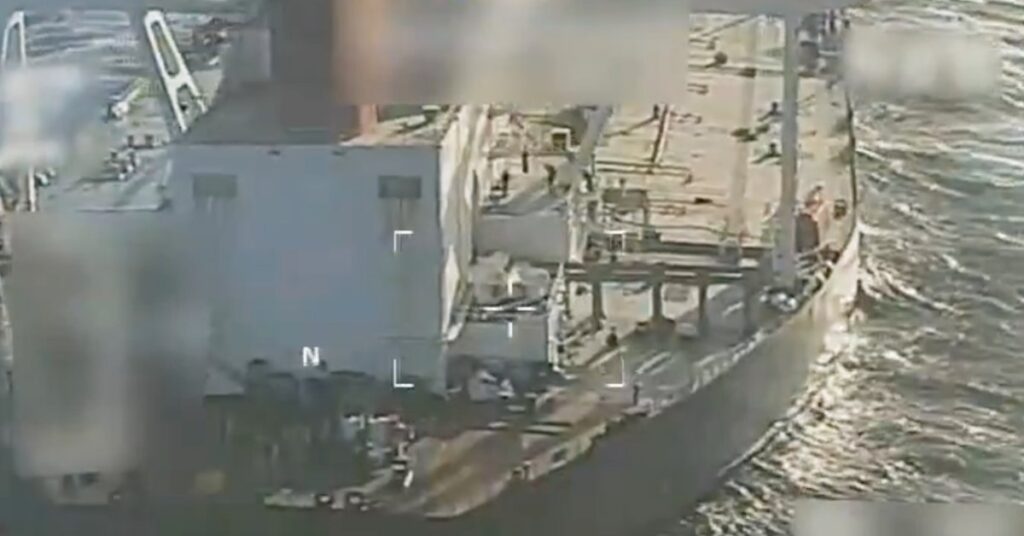
President Donald Trump confirmed that U.S. military forces seized the oil tanker on Wednesday, telling reporters, “We’ve just seized a tanker on the coast of Venezuela—large tanker, very large, largest one ever seized, actually,” and that it had been seized for a “very good reason.” (It is not certain whether it is the largest tanker ever seized by the U.S. military, but, at 1,092 feet in length, it was one of the largest tankers in the world when it was built two decades ago.) The mission involved two helicopters, 10 Coast Guard members, 10 Marines, and special forces. Attorney General Pam Bondi said in a post on X that forces had a seizure warrant for the tanker, which had been carrying U.S.-sanctioned oil from Venezuela and Iran.
[time-brightcove not-tgx=”true”]
“For multiple years, the oil tanker has been sanctioned by the United States due to its involvement in an illicit oil shipping network supporting foreign terrorist organizations,” Bondi said. “This seizure, completed off the coast of Venezuela, was conducted safely and securely—and our investigation alongside the Department of Homeland Security to prevent the transport of sanctioned oil continues.”
But the Venezuelan government claimed the seizure reveals “the true reasons” for the Trump Administration’s recent escalating military actions towards Venezuela.
“It is not migration. It is not drug trafficking. It is not democracy. It is not human rights,” the Venezuelan government said in the statement. “It has always been about our natural resources, our oil, our energy, the resources that belong exclusively to the Venezuelan people.”
Venezuela’s Interior Minister Diosdado Cabello called the U.S. “murderers, thieves, pirates … these guys are high seas criminals, buccaneers.”
Venezuelan President Nicolás Maduro had repeatedly called on his country’s citizens to resist U.S. aggression and to enlist in Venezuelan militias. At a rally in Caracas earlier on Wednesday, he said Venezuelans should be prepared “to smash the teeth of the North American empire if necessary.” Maduro has also characterized U.S. military actions as aimed at regime change in Venezuela.
Trump, to reporters, warned Colombian President Gustavo Petro, who has condemned the U.S. strikes in the Pacific and Caribbean: “He better wise up or he’ll be next. I hope he’s listening. He’s going to be next because we don’t like people when they kill people.”
The Trump Administration has deployed the largest number of navy vessels to the Caribbean Sea since the Cuban Missile Crisis in 1962, and Trump has suggested that the U.S. could strike mainland Venezuela. The Trump Administration has also ramped up attacks on Maduro specifically, including placing a $50 million bounty on him and declaring that his “days are numbered.”
But the U.S. government has insisted that its aims are to end drug trafficking to the U.S. It has used national security to justify its military pressure campaign on Venezuela, claiming that the more than 80 people killed in strikes on more than 20 vessels between Sept. 2 and Dec. 4 were “narco-terrorists.” The governments and families of several of those killed in the strikes have said they were just fishermen.
The Department of Homeland Security posted a video edit of armed forces descending onto the deck of a ship from a helicopter soundtracked to LL Cool J’s “Mama Said Knock You Out.”
“KNOCKOUT,” the DHS said in the post accompanying the video on Wednesday evening. “If you threaten our nation, or break the law, there is no place on land or sea where we won’t find you.”
The Trump Administration has faced backlash for using music without artists’ or labels’ permission for its social media videos. LL Cool J has not yet responded to the post.
British maritime risk company Vanguard Tech has identified the vessel as the Skipper, a large crude oil carrier that was formerly called the Adisa, according to Reuters. The U.S. previously imposed sanctions on the tanker for alleged involvement in trading Iranian oil. The ship departed Venezuela’s main oil port Jose between Dec. 4 and 5 with over a million barrels of Venezuelan heavy crude, Reuters reported based on satellite analysis by TankersTrackers.com and data from Venezuela’s state oil company Petroleos de Venezuela SA.
The U.S. government concluded that the vessel was bound for Cuba, sources told Bloomberg, although historically a vessel as large as the Skipper would not typically travel that route. U.S. officials have long alleged that Venezuela skirts sanctions by selling its crude oil illegally via Cuba.
The supertanker was seen sailing under the flag of Guyana, according to the BBC. Guyana’s Maritime Administration said in a statement that the vessel was falsely flying the Guyana Flag, and that it is not registered in Guyana.
While the U.S. has maintained that the seizure is a legitimate military action for a sanctioned vessel, some, including the Venezuelan government, may be concerned that the seizure could mark the start of a naval blockade.
The U.S. seizure could hurt Venezuela’s oil exports, which is the country’s biggest source of revenue (selling mainly to China). While both sanctions and mismanagement have affected Venezuela’s oil industry over the years, the possibility of future seizures on the over 30 U.S.-sanctioned ships in Venezuela may discourage them from setting sail from the country’s waters for some time.
That has already meant a climb in oil prices on Wednesday. U.S. company Chevron partners with PDVSA to drill in Venezuela, although Chevron is exempted from sanctions by the U.S. Treasury. Chevron told Bloomberg that its operations are continuing normally.
Former Biden Administration Latin America adviser Juan González told the Guardian, last week prior to the seizure, that the Trump Administration could force Maduro to accept a recall referendum with “real hardline consequences” if he did not respect the results.
“Imposing an oil blockade would shut down the entire economy,” González said. “He could take unilateral action by blocking oil tankers from leaving or entering the country, and that I think would precipitate Maduro’s departure.”
The seizure—the first since the U.S. began striking vessels off Venezuela—is certainly an escalation—and not just for Venezuela.
If it is the first step towards an oil blockade, retired U.S. Marine Corps Colonel and a senior adviser at think tank Center for Strategic and International Studies Mark Cancian told the BBC that, “Because Venezuela is so dependent on oil, they could not resist that very long.”
It would be “an act of war,” he said.
The post Venezuela Accuses Trump Administration of ‘Piracy’ After Oil Tanker Seizure appeared first on TIME.