The Trump administration sided with officials from Saudi Arabia, Russia and Iran in a successful effort to block part of a United Nations report about the dire state of the planet because it called for phasing out fossil fuels, switching to clean energy and reducing plastics, according to two participants.
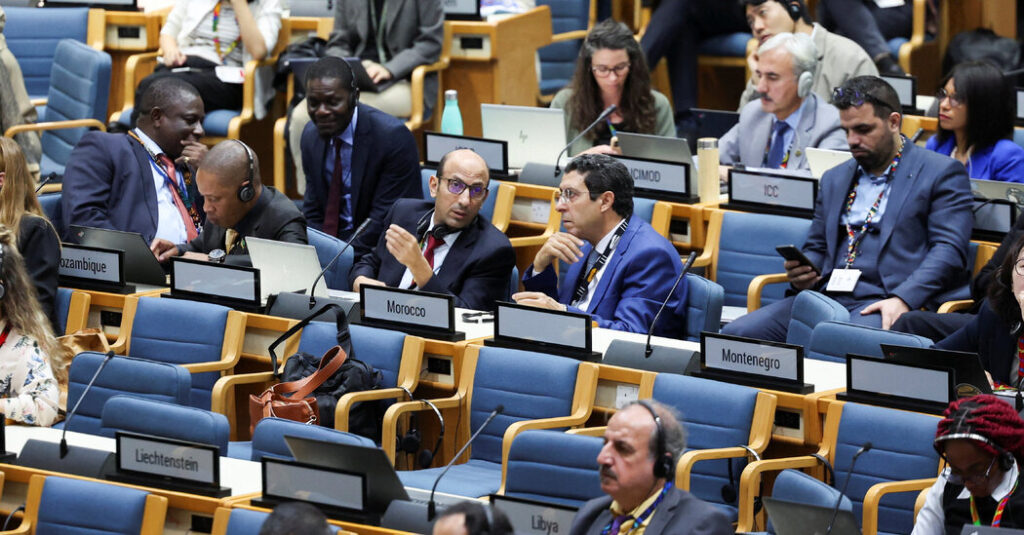
The section targeted was a summary of the Global Environment Outlook 7, a 1,210-page report that translates scientific evidence collected and reviewed by 300 experts into plain language that can be used by governments around the world. It was issued on Monday at the U.N. Environment Assembly in Nairobi.
It was the first time that countries failed to issue a “summary for policymakers” since the United Nations Environment Program began publishing outlook reports in 1997.
During negotiations over the document in October, the U.S. sided with Russia, Saudi Arabia and Iran to block the summary from being included, according to David Broadstock, a partner in the Lantau Group, an energy and environmental consulting firm with offices around the Asia-Pacific region, and Patrick Schröder, a senior research fellow at Chatham House, a research organization based in London.
The move was another indication of how sharply the Trump administration has reversed course on the environment. Under the Biden administration, the United States had made tackling climate change a top priority and frequently clashed with oil-producing countries like Saudi Arabia over their approaches to global warming.
Some authors of the study blame U.S. officials for undermining the process by coming in at the last minute to voice opposition. The Trump administration did not send a delegation to the October meeting in Nairobi where the report was assembled, but it did shape the final outcome, according to Dr. Broadstock, who was a coordinating author for two of the report’s 21 chapters and a negotiator in discussions of the summary for policymakers.
“Nonattendance does not mean a lack of influence,” he said. “It means exertion of influence in a certain manner.”
The U.S. State Department did not respond to a request for comment.
It’s the latest step by the Trump administration to undermine global climate policy. Shortly after re-entering office, President Trump signed an executive order to pull the United States out of the 2015 Paris Agreement, the 2015 pact in which nearly all countries agreed to cut greenhouse gas emissions to limit global warming. The administration was accused of using bullying tactics to block adoption of a landmark global measure in October that would have imposed a global pollution tax on the shipping industry. And the United States did not send a delegation to the COP30 climate summit in Brazil in November.
Governments use the summary for policymakers to help guide energy and environmental policies, Dr. Broadstock said. The U.N. report compiled existing science on the harmful effects of climate change, air and water pollution, land degradation, biodiversity and the growing threat from plastic waste.
In October, during final negotiations on the report, a U.S. State Department official called into a video conference with a roomful of negotiators in Nairobi, according to accounts from two participants.
The officer said that the U.S. opposed the final language on climate change, on the need to switch to clean energy, on biodiversity and the use of plastics, according to Dr. Schröder, who helped negotiate the report language and was present when the U.S. officer called.
“It felt a bit like a slap in the face, because the person who joined did not even turn on their camera,” Dr. Schröder said.
The U.N. report took three years of work and found that transitioning to clean energy and a cleaner environment would deliver global economic benefits that could reach $20 trillion per year by 2070.
“Fossil fuels must be out,” Edgar E. Gutiérrez-Espeleta, a co-chairman of the outlook report and former environment minister of Costa Rica, said in a call with reporters before the report was made public.
“We have to explore more renewable sources, and we need the scientific community to explore more in new materials that would help us replace those that we are using at this moment,” he said.
After the objections of the U.S. official, as well as some from Saudi Arabia, Iran, Russia and other oil and gas producing nations, the summary for policymakers language was dropped entirely rather than renegotiated.
Over the past two decades, the United States has acted as a referee of sorts on numerous global agreements. By refusing to participate in the negotiations, and then objecting to the final language, the Trump administration is undermining the entire process, which bodes poorly for future international environmental agreements, according to Dr. Schröder.
The United States and other oil-producing countries “took their political red lines and then marked text that they didn’t like,” he said. “Although it was scientifically correct, they just wanted to have it removed.”
The post U.S. Helped to Weaken Report at U.N. Environment Talks, Participants Say appeared first on New York Times.