By 1966, the artist Jay DeFeo had labored obsessively over “The Rose,” the monumental work for which she’s best known, for eight years. It was 2,000 pounds of encrusted oil paint when it was excised from her apartment via forklift, and likely would have been more were she not being evicted. Psychically depleted, she dropped out of the art world, producing no work for three years, then shifting to eerie, Surrealist-inflected photography and photocopy collages — images of her dental bridge and a tripod shot to look like disembodied legs. When she returned to oil paint, after 16 years, it was with a certain clarity — both reprisal and refinement.
An astonishing show at Paula Cooper Gallery focuses on this return, gathering 17 paintings made between 1982 and 1989, most of them, incredibly, not exhibited since they were made, and never outside San Francisco. DeFeo, who lived in the Bay Area since childhood, led a modest and bohemian life, running in a postwar circle of Beat poets and jazz musicians. She created far more work than she showed.
Seven large, murky abstractions ring the main gallery. Their forms were modeled on still lifes or ones that had wandered in from DeFeo’s photo work. They’re enigmatic and moody. “La Brea” (1984-85) is a primordial whorl of carmine and cobalt on an asphalt ground, suggesting DeFeo’s subject was nothing less than the generative muck of her own humanity.
That slippage, pulling from her chronology as if in a paleontological dig, occurs repeatedly. Central forms emerge from a liquid darkness, not unlike the darkroom process (DeFeo maintained a home setup). Shapes catch shadows or bleed radiant penumbrae, as if shot with a flashbulb. Passages of color develop — a slick of vermilion, a shaft of optic white — like a latent image submerged in a stop bath. “I maintain a kind of consciousness of everything I’ve ever done while I’m engaged on a current work,” DeFeo said in 1978.
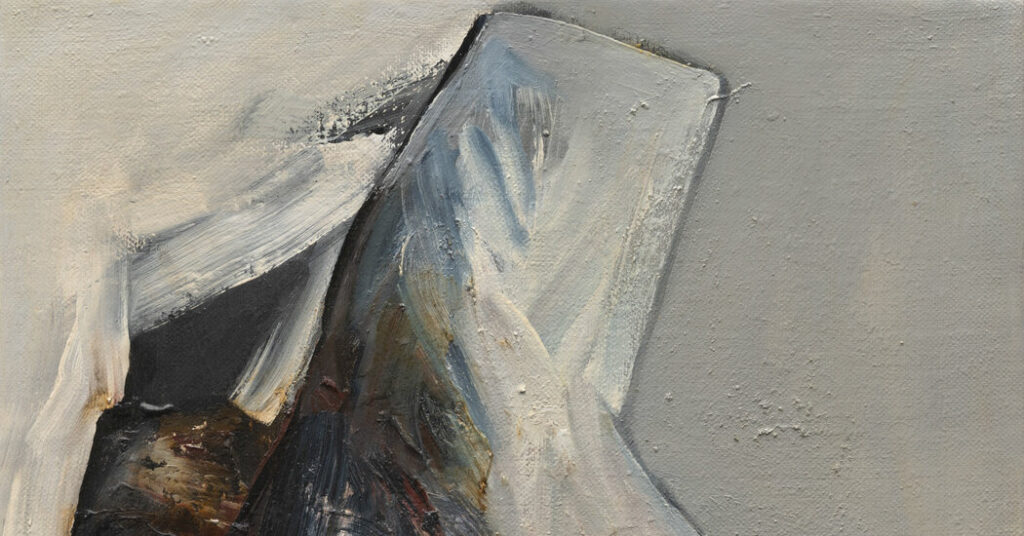
Even more affecting are the small canvases, some just 10 inches tall, from DeFeo’s Alabama Hills series, inspired by the eroded round rock formations along California’s Sierra Nevada seen during a 1986 road trip. Slathered on thickly with a knife in shades of ashen granite and flushes of iron oxide, they flatten masses of earth into soft profiles.
DeFeo had fixated on mountains before, in the mid-50s, after Sir Edmund Hillary’s summit of Mount Everest (there’s an early attempt buried in “The Rose”). They’re less observational than aspirational, evoking the mountain’s promise of self-actualization: “from objective reality toward an inner reality,” DeFeo said (she achieved this reality in 1987, when she scaled Mount Kenya). Like Mont Sainte-Victoire for Cézanne or Mount Tamalpais for Etel Adnan, the mountain for DeFeo existed as a spiritual reference point — the topography of the mind.
DeFeo was diagnosed with lung cancer in spring 1988, and the latest works in the show, “Smile and Lie” and “Garnets on the Boulder” (both from 1989), were made in the last year of her life. Stripped of color, there is the temptation to read them as funereal, a light dimming. Yet each emits an uncanny glow. “Garnets” in particular, an outcropping of white strokes slashed into a two-tone void, glints like pressure-formed gemstones catching the midday sun. Spare compositions in the grayscale DeFeo had favored her entire career, they look like how an ascent must feel, when everything else falls away. They look like clarity of thought.
Another locus of clarity can be found four blocks north in “Innocent Love,” Pace’s staggering assembly of late work by Agnes Martin: 13 canvases created in the last years of her life — between 1999 and 2002 (Martin died in 2004). They represent a late career shift as subtle as it is profound. Where Martin was content to restrain her palette to chalky grays, suddenly there was chromatic reverie. The horizontal lines remained, but now they were stripped in luminous translucent washes — rinsed bands of dusty brick and cornflower as if seen from behind a scrim. Perhaps most startling, where her output had gone largely untitled, now she gave them earnest, almost achingly sweet names: “Little Children Loving Love” (2001), “Little Children Playing With Love” (2001), “I Love Love” (1999).
The softness of a Martin painting relaxes the eye. A room of them douses it in psychic peace. This is as close as Pace’s halogen-lit ground-floor gallery will likely get to consecration. Martin was well read in myriad schools of spiritual thought, including Calvinism, American Transcendentalism and Zen Buddhism, which is where her invocation of childhood is rooted. Like a child’s, a beginner’s mind is empty, porous to inspiration, which Martin cherished above all else: “I gave up facts in order to have an empty mind. I’m convinced that with a soft attitude you receive more.”
Martin came to innocence the hard way. She struggled with schizophrenia, and the quietude of her work, rather than mystic evocations of the New Mexican mesa, as they were often misread, had more to do with internal silence. Martin liked to be left alone. She moved to the desert not on a spirit quest but because her Manhattan loft was being torn down; New York was becoming expensive for artists. She liked stillness but also speed, ripping through stop signs in the white Mercedes-Benz that Arne Glimcher, her dealer, gave her. Facts complicate legend.
In style, Martin’s paintings — smooth and flat, color a near whisper — could scarcely be more different from DeFeo’s craggy color like limpid sludge. And yet there are convergences: Artists who struggled with illness, financial precarity, against the fixing of mythology. Artists for whom accidents of real estate precipitated aesthetic breakthroughs; who kept an art world that both offers and demands too much at arm’s length. And above all, who spent a lifetime searching, convinced not only that a pure vision existed, but that it was reachable.
Jay DeFeo: Garnets on the Boulder
Through Dec. 13, Paula Cooper Gallery, 534 West 21st Street, Chelsea; 212-255-1105, paulacoopergallery.com.
Agnes Martin: Innocent Love
Through Dec. 20, Pace, 540 West 25th Street, Chelsea; 212-421-3292, pacegallery.com.
ᐧ
The post Two Women Who Kept the Art World at Arm’s Length appeared first on New York Times.