Two peace agreements that President Donald Trump took credit for brokering are under severe strain. Violent clashes have intensified on the Thailand-Cambodia border and between Democratic Republic of Congo and the Rwanda-backed M23 militia.
On Monday, less than two months after Trump signed a peace agreement to resolve a border dispute between Cambodia and Thailand, the Thai air force carried out airstrikes on its neighbor, renewing what has become the worst spate of violence between the two countries in decades. Both sides blamed the other for instigating the attack and for violating the terms of the peace deal. Both also claimed to be acting in self-defense.
Secretary of State Marco Rubio urged Thailand and Cambodia in a post on X on Tuesday to “immediately cease hostilities, protect civilians, and return to the de-escalatory measures outlined in the Kuala Lumpur Peace Accords.”
In the Democratic Republic of Congo, President Félix Tshisekedi on Monday accused Rwanda of violating the terms of a U.S.-brokered peace agreement, signed last week during a ceremony at the newly renamed Donald J. Trump Institute of Peace in Washington.
Thursday’s signing ceremony finalized a deal brokered in June that was supposed to end the decades-long conflict between the central African countries. But the fighting has continued, prompting roughly 200,000 people to flee their homes in eastern Congo, Reuters reported. By Wednesday, the M23 rebel group had entered Uvira, a town near Burundi, Congolese Information Minister Patrick Muyaya told The Washington Post. The U.N. says Rwanda backs the group, which the country denied.
The International Contact Group for the Great Lakes on Tuesday expressed “profound concern” for the renewed outbreak of violence in the area and the risk of greater regional instability. The group — which includes the United States, Belgium, Britain, Denmark, France, Germany, the Netherlands, Sweden, Switzerland and the European Union — urged all parties to uphold their commitments under the Dec. 4 peace agreement and de-escalate immediately.
In his quest to cement his reputation as a global peacemaker, Trump has waded into some of the most intractable conflicts. He claims to have “solved” eight conflicts since returning to office, brokering agreements between Congo and Rwanda, India and Pakistan, and Thailand and Cambodia, among others. In some instances, his role and/or the extent of the agreement remains contested, or he says he headed off conflict before it could begin. Trump has sought honors for his peacekeeping efforts, unsuccessfully campaigning for the Nobel Peace Prize. On Friday, Trump was awarded FIFA’s inaugural Peace Prize, created four weeks after he was passed over by the Nobel Committee.
Two of the accords now appear to be foundering.
“It’s commendable that Trump has tried to help resolve these conflicts. But the quick unraveling of these ceasefires suggests that the work is not done,” said Daniel B. Shapiro, a former U.S. ambassador to Israel and distinguished fellow at the Atlantic Council.
“Trump seems to think he can swoop in and resolve a deep, long-running conflict with a couple of phone calls or a minerals deal,” Shapiro said. “But conflict-resolving diplomacy usually involves much more sustained engagement.”
The White House defended Trump’s approach. “Peace is not a pretty process,” White House spokesperson Anna Kelly said Wednesday, saying that governments should follow their word. “The President expects all parties to fully honor the commitments they have made in signing these agreements, and he will hold anyone accountable as necessary to stop the killing and ensure durable peace.”
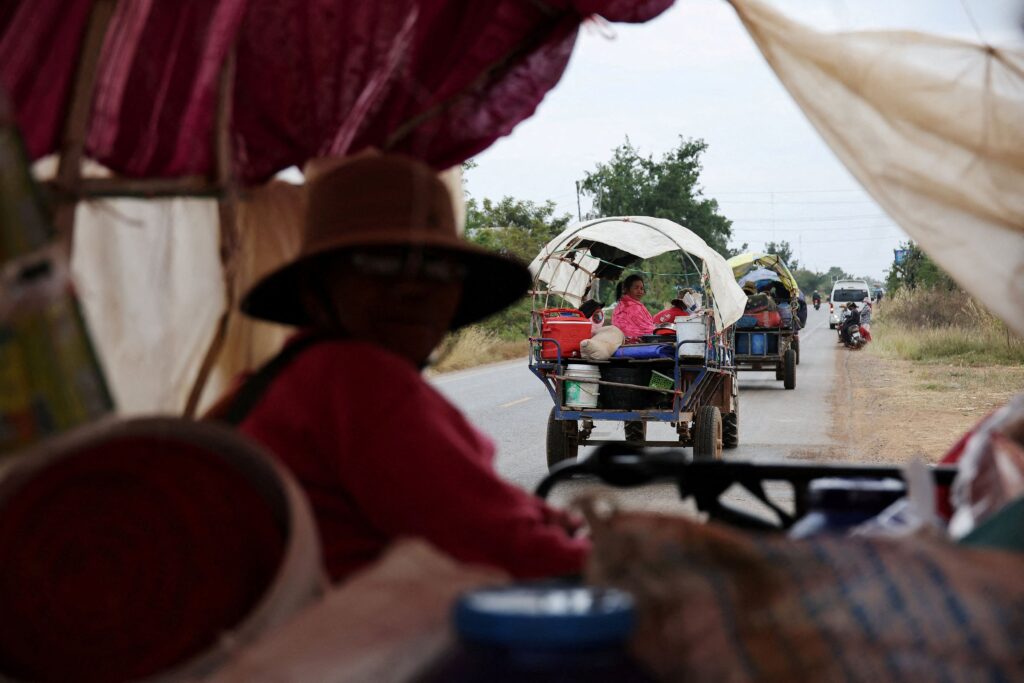
Long-simmering border tensions between Cambodia and Thailand erupted in July when a land mine maimed a Thai soldier on patrol. The two countries exchanged fire for five days, which left several dozen people dead and displaced tens of thousands. On the fourth day of fighting, Trump called the leaders of both countries and threatened to end tariff negotiations unless they agreed to a ceasefire. Fighting ended the next day.
Thai Prime Minister Anutin Charnvirakul, Cambodian Prime Minister Hun Manet and Trump signed the Kuala Lumpur Accord during a peace ceremony in Malaysia in late October, which formalized the ceasefire agreement. While Trump claimed credit for the deal, Malaysia — the current chair of the Association of Southeast Asian Nations (ASEAN) — was a central mediator, officials told The Post.
In November, Thailand halted its implementation of the peace agreement after four soldiers were injured in a land mine explosion. Thailand accused Cambodia of laying new land mines in violation of the truce. Cambodian officials denied the allegations, saying the mines are remnants of a civil war that ended in 1999.
Fighting renewed this week when Royal Thai Air Force fighter jets struck Cambodia along its shared border and deployed tanks in the province of Preah Vihear. “From now on, there will be no negotiations of any kind. If the fighting is to stop, Cambodia must follow the course of action set by Thailand,” Charnvirakul said after meeting with his national security council.
The Thai and Cambodian embassies in Washington did not respond to requests for comment.
The July and October deals were ineffective because they didn’t address the “the underlying disputes” between Thailand and Cambodia, said John Sifton, the Asia advocacy director at Human Rights Watch.
“This is not some kind of deep-seated state-to-state conflict,” Sifton said. “It’s a border dispute that spiraled out of control because of the domestic politics of two countries that are wracked by routine poor governance and corruption.”
“If you put zero effort into actually ensuring that the agreement is implemented and monitored, then is it any surprise when Thailand and Cambodia end up returning to their tit-for-tat?” he asked.
When Congolese and Rwandan officials gathered in the Oval Office in June to sign the Washington Peace Agreement, the foreign ministers acknowledged the difficulty of maintaining peace after decades of hostility. Still, the central African countries agreed to stop their aggression and end support for armed groups operating in each other’s territories.
But in mid-July, weeks after the Oval Office meeting, the M23 rebel group killed more than 140 largely ethnic Hutu civilians across at least 14 villages and small farming communities in eastern Congo, according to an August report from HRW. Congo’s Ministry of Information said that M23 fighters had killed more than 300 civilians in the region that month. M23 denied the accusations that it was responsible for the killings.
The violence continued even as African heads of state, including Tshisekedi and Rwandan President Paul Kagame, convened in Washington last week to finalize the June deal. Rwandan forces have been using expensive drones, antiaircraft weapons, and jamming equipment in Congolese territory, said Muyaya, the Congolese information minister, noting that M23 lacked the ability to use such weapons themselves. He added that recent operations by the rebel group were being led by Rwandan forces.
Congo’s embassy in Washington in a statement blamed Rwanda for violations.
Rwanda denied violating the agreement in a statement Wednesday, blaming Congolese armed forces and the Wazalendo, a loose array of local militias that have been helping Congo fight the insurgents.
The agreement includes economic partnerships and support for potential investment opportunities but lacked an accountability measure that guarantees the parties involved would cooperate, said Lewis Mudge, HRW’s Central Africa director.
“The beginning of peace for us means withdrawal of Rwandan troops and stop any kind of support to M23,” Muyaya said. “If there is any hope to save the deal, the Trump administration should act more effectively — not only by condemning — by taking sanctions against Rwandan officers and those who are perpetrating those crimes.”
Katharine Houreld and Rebecca Tan contributed to this report.
The post Two peace deals Trump took credit for appear to unravel at the same time appeared first on Washington Post.