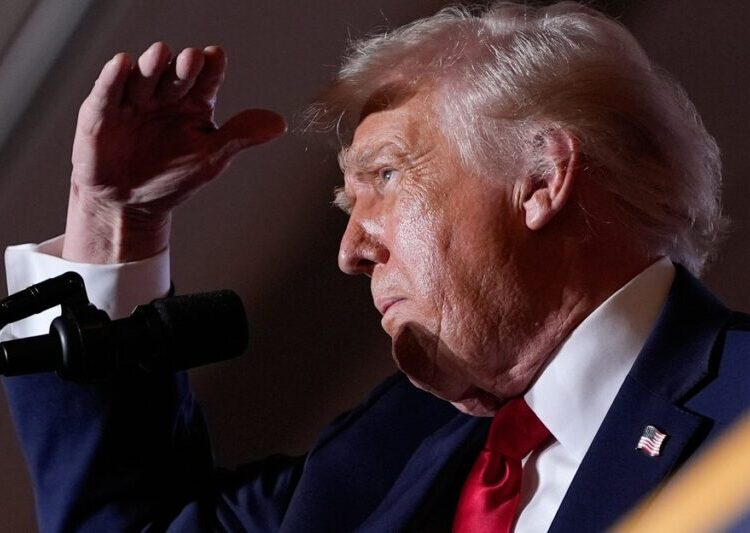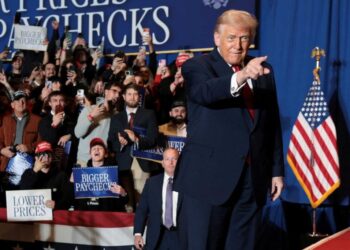
INDIANAPOLIS — Indiana Republicans rebuffed President Donald Trump’s months-long pressure campaign to redraw their state’s congressional map Thursday, dealing the White House its biggest blow yet in its nationwide effort to create safer GOP districts before the midterm elections.
Twenty-one Republicans in the state Senate joined all 10 Democrats in a 31-19 vote rejecting the map in one of the nation’s reddest states. The loss stymies Trump’s effort to backstop Republican control of a narrowly divided Congress as his poll numbers drop.
Since this summer, Republicans in four other states have rejiggered their maps at Trump’s urging to give their party as many as nine more seats — part of a larger plan aimed at retaining power in Congress after next year’s elections.
But in Indiana, a contingent of GOP state senators politely but persistently said no. And Trump’s relentless pressure appears to have backfired.
The GOP opponents told Trump and Gov. Mike Braun (R) they weren’t on board and last month 19 of them voted with Democrats to end a legislative session without acting on redistricting. Trump and his allies kept pressing, and the state House passed a plan last week that would likely give Republicans all nine of the state’s congressional districts, two more than they have now.
The leader of the state Senate, Rodric Bray, agreed to bring the senators back but it did not change the outcome. .
GOP opposition ran deep in the state Senate, a chamber Republicans control 40-10. The opponents included longtime lawmakers like Sen. Vaneta Becker (R) who got involved in politics 44 years ago, long before the rise of Trump and his Make America Great movement.
Becker was unmoved by an October conference call with Trump and other entreaties from his allies.
“Hoosiers are very independent,” said Becker, 76. “And they’re not used to Washington trying to tell us what to do.”
The state senators have been increasingly on edge in recent weeks as they endured intimidation — political and physical — and a stream of hoax police reports that seemed designed to draw large law enforcement responses to their homes.
States draw their congressional districts after the census, and lawmakers from both parties often try to maximize their advantage. Years of litigation sometimes follow, but state lawmakers typically don’t redraw their lines in the middle of the decade unless a court orders it. Trump has rejected the usual way of doing business, demanding Republican-led states make immediate changes.
So far, Republicans have not netted as many seats as they’d hoped because Democrats have counteracted them by adopting a new map in California and are trying to do the same in Virginia and other states. Opponents of a new GOP-friendly map in Missouri submitted more than 300,000 signatures to the state to try to block it from going into effect until a referendum on it can be held.
But the GOP resistance in Indiana stood apart, in large part because Republicans across the country have readily acquiesced to Trump’s demands and threats on a range of issues.
The rare instance of pushback here could offer warning signs to Trump that his grip on the party may be loosening amid slides in his public approval rating. The vote could have effects elsewhere and lead Trump to put more pressure on officials in other states.
Time is running short because election officials, candidates and voters need to know where the lines are well ahead of next year’s primaries. But the fight over maps will continue for months. Republicans in Florida are poised to draw a new map and GOP lawmakers in Utah are trying to reverse a court decision that is expected to give Democrats one of the state’s districts.
In Indiana, the map would have broken Marion County, the home to Indianapolis and the state’s largest African American population, into four districts, diluting Democratic votes. It likely would have doomed the reelection chances of Democratic Reps. Frank J. Mrvan and André Carson, the only Black member of Indiana’s congressional delegation.
Trump hosted Indiana officials at the White House. He dispatched Vice President JD Vance to the state twice. In October, he and his aides held their conference call with Indiana state senators to talk up redistricting. At the end of the call, the senators were told to press a number on their phone to indicate whether they supported redrawing the map, even though they were yet to see how the lines would change.
On Wednesday night, just ahead of the vote, Trump lashed out at the state Senate leader on Truth Social, calling Bray “the only person in the United States of America who is against Republicans picking up extra seats” and warning that lawmakers who oppose the changes were at risk of losing their seats.
Just after the state senators convened on Thursday, Vance criticized Bray in a social media post, accusing him of saying he wouldn’t fight redistricting while working to secure votes against it. “That level of dishonesty cannot be rewarded,” he wrote.
About 800 of Becker’s constituents in southwestern Indiana told her they were against the plan and about 100 told her they were for it, she said. Sitting in her wood-paneled cubicle Tuesday in the state capitol, she slid a constituent’s letter out of its envelope
“Mid-decade redistricting at the request of President Trump will unnecessarily intensify the already deep partisan divisions in our country,” the man wrote. “Even bringing this topic up in the Indiana legislature will ratchet up the antagonism.”
Voters knew the push was coming from Trump, and many were not afraid to criticize him for it, even if they otherwise support the president, she said. Becker declined to say whether she’d voted for Trump but said she’s “not crazy about him,” especially after the Jan. 6, 2021, attack on the U.S. Capitol.
Last month the president called out state Sen. Greg Goode (R) in a post on Truth Social, saying he was “very disappointed” that he opposed redistricting even though Goode had not taken a position. Later that day, Goode said, someone falsely told police he had murdered his wife and barricaded himself in his house. Police kicked in the door just after Goode got out of the shower, while his wife and son were getting Christmas decorations in the basement, and officers pointed their guns at Goode’s chest, he said.
Goode, who serves as the state director for U.S. Sen. Todd Young (R-Indiana), said he didn’t blame Trump for the incident. He got a call from Trump the next day, which he described as polite. Trump called Goode again on Monday, as the state senator was listening to the redistricting debate in committee.
“It was not a pressured call at all,” Goode said. “The overarching message really from day one is the importance for the Republican Party to maintain control of the United States House of Representatives.”
Goode voted against the map Thursday and told his colleagues they should focus on the cost of living, health care and cutting taxes. “We can’t allow ourselves to keep getting caught up in all of this noise,” he said. “We have to redirect our focus on what really matters, I believe, to Hoosiers.”
The conservative group Turning Point Action has claimed it will team up with other Trump-aligned organizations to spend $10 million or more on primaries in 2026 and 2028 against GOP state senators in Indiana who vote against the map. Several Republicans, including Becker, said they’re skeptical the groups would spend so much against members of their own party.
State Sen. Travis Holdman (R) got a call from the White House a couple of weeks ago asking if he would come to Washington to talk about redistricting, but he declined because he couldn’t miss work as a banking consultant. Adopting a new map now would be unfair, he said, and he doesn’t think the president’s team could have changed his mind.
As debate was about to begin Thursday, state Sen. Sue Glick (R) noted Indiana was celebrating an anniversary . “Two hundred and nine years ago, as of this date, Indiana joined the Union, and they didn’t have near as much trouble drawing the map,” said Glick, a redistricting opponent.
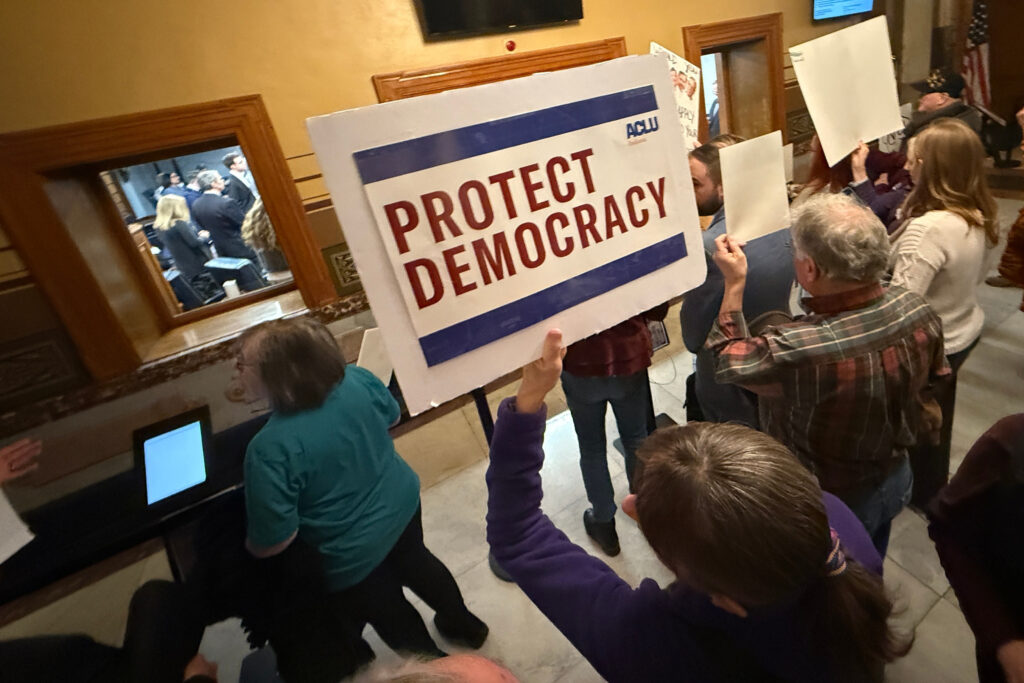
Watching from outside the state Senate chamber, dozens of opponents held signs with phrases such as “Hoosiers play fair” and “Losers cheat.” They reacted to the debate like a Greek chorus, whooping for speeches opposed to the new map and booing ones in favor of it.
Supporters in the state Senate said they wanted to ensure Republicans keep control of Congress and needed to respond to gerrymanders Democrats have controlled in other states over the years.
“I believe that there is an imbalance in the House of Representatives today,” said state Sen. Mike Gaskill (R), a sponsor of the new map. “And this is an attempt to try to, in small part, offset that balance, imbalance.”
State Sen. R. Michael Young (R) described grave stakes for a Congress that is narrowly divided. “I don’t want to wake up the morning after the election in November and find out we lost the House of Representatives by one vote,” he said.
Some made their opposition clear in recent weeks, saying they’re pushing back on what they call bullying. State Sen. Mike Bohacek (R) grew incensed last month when Trump called Minnesota Gov. Tim Walz (D) “seriously retarded” in a social media post. Bohacek, who has a daughter with Down syndrome, said in a social media post that Trump’s “choice of words have consequences.”
“Perhaps he can use the next 10 months to convince voters that his policies and behavior deserve a congressional majority,” Bohacek wrote in his post.
In the state House, Rep. Ed Clere was among 12 Republicans to vote against the map there. He believes Trump’s MAGA movement is starting to crack, but doesn’t think that’s what’s behind the GOP resistance to redistricting in Indiana. It stems from a sense of independence that is, he said, “part of Indiana’s DNA.”
Isaac Arnsdorf in Washington contributed to this report.
The post Trump’s redistricting effort fails in Indiana as GOP lawmakers deliver rare rebuke appeared first on Washington Post.