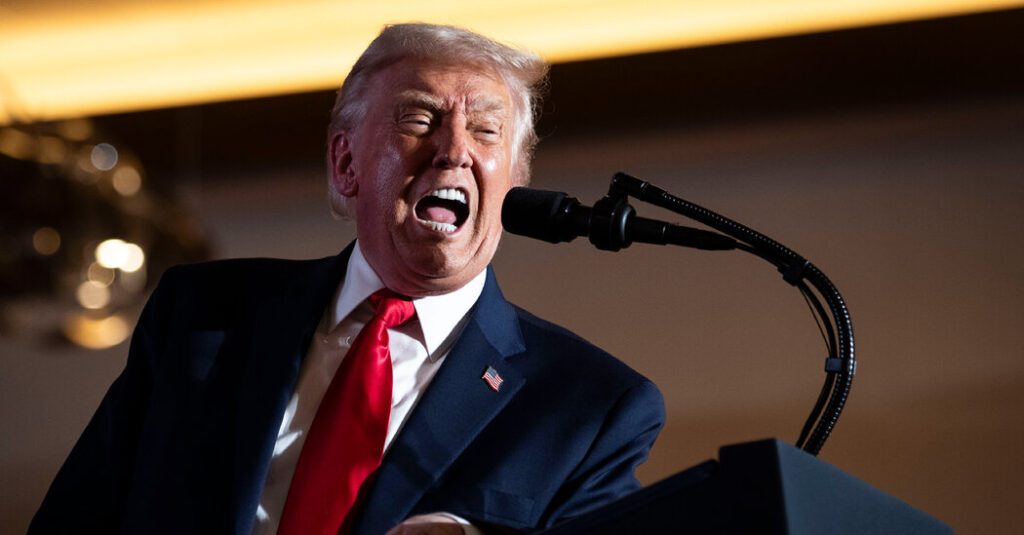
This was supposed to be the moment that President Trump put the country’s focus on his economic agenda. But as he embarked this week on a messaging campaign to assure the American public he is concerned about the cost of living, the president made one thing clear: He’d rather talk about anything else.
Mr. Trump didn’t mention the word “affordability” until 18 minutes into his often-meandering address Tuesday in rural Pennsylvania. He used the bulk of the 90 minutes to reprise his profane attacks on immigrants and his political foes and blame former President Joseph R. Biden Jr. for saddling him with rising inflation.
And when he did raise the cost of living, he waved away the idea that Americans were struggling.
“Our prices are coming down tremendously,” said Mr. Trump, even though government data shows that inflation in September was close to 3 percent, about the same as it was at the end of the Biden administration.
The president maintained the same defensive posture Wednesday, dismissing concerns about economic uncertainty and rising costs.
“It’s a hoax,” he said during a round-table discussion with business leaders at the White House.
Mr. Trump has given ammunition to his opponents in downplaying and sometimes outright denying the economic realities. Democrats are already strategizing on how to weaponize his defiant posture against Republicans heading into next year’s midterms. As Mr. Trump continues to brush off an issue that he said he would solve in his first months in office — one that is pulling down his poll numbers — Democrats believe one of his biggest strengths in his first term could become a major vulnerability in his second.
Bakari Sellers, a former South Carolina lawmaker and adviser to Democratic leaders, said that Mr. Trump is following a similar playbook Democrats used to their detriment in recent years when they tried to cite statistics to blunt worries about crime and immigration. Mr. Trump’s rejection of affordability concerns also comes as Republicans are struggling to contend with rising health care premiums set to take hold next year.
“It is a gift to Democrats, and I think this is the one time that the Democrats have been disciplined enough to home in on one message,” Mr. Sellers said. “And between this and health care, you have winning issues. And you’re seeing that throughout the country.”
The White House rejected the idea that Democrats were winning on the affordability message.
“Democrats spent four years creating a generational economic disaster and dismissing Americans’ concerns about inflation and affordability under Joe Biden,” Kush Desai, a White House spokesman, said in a statement. “They didn’t care that they were making American families worse off when they were in power, and they’re only pretending to care now — despite having no real solutions for the mess they created — to score cheap political points that no one is buying.”
But Republicans in Congress have increasingly acknowledged that they could face a serious hurdle next year, as polls show that Americans — including those who voted for Mr. Trump — are souring on the economy.
A New York Times analysis of Mr. Trump’s approval ratings found a decline in support for Mr. Trump’s handling of the economy from July to November. A recent poll conducted by Politico found that nearly half of the respondents, including a little more than one-third of Trump voters, said the cost of living was the worst they could remember, and more respondents said Mr. Trump was responsible than Mr. Biden.
“Republicans pay just as much for eggs and beef as the nonvegetarian Democrats,” said Barrett Marson, a Republican strategist based in Arizona. “You can spin your way out of a lot of things, but you cannot lie to the American public about their own economic experience.”
Mr. Marson said that Mr. Trump was falling into the same trap that former Mr. Biden did in failing to recognize the depth of the public’s anxiety about the economy.
“The more he denies that there is an affordability problem, the more out of touch he seems,” Mr. Marson said. “And if Donald Trump isn’t careful, Republicans will pay the same price that Democrats paid in 2024.”
Democrats have moved swiftly to seize on the moment.
Senator Chuck Schumer of New York, the minority leader, posted a video of the president contradicting himself on Tuesday, highlighting that Mr. Trump said he had “no higher priority than making America affordable again” and then moments later mocked the word “affordability.”
“So which is it? Your highest priority or a hoax?” Mr. Schumer wrote on social media.
On Wednesday, Mr. Schumer called Mr. Trump’s speech a “train wreck.”
“Last night’s speech in Pennsylvania was supposed to kick off a new messaging campaign on affordability, but all it did was expose how Donald Trump simply doesn’t get it,” Mr. Schumer said during remarks on the Senate floor.
Pennsylvania’s Democratic governor, Josh Shapiro, panned the speech as “BS.” “Donald Trump just finished an hours long rally telling Pennsylvanians not to believe what they can see with their own two eyes — the skyrocketing cost of living and rising prices at the grocery store,” he wrote on X.
While the White House billed Tuesday’s speech as a major economic address to address the rising concerns about the economy, Mr. Trump largely stuck to other talking points that mobilize his base.
The president acknowledged as much, saying that he was using “the weave,” an oratorical style of jumping around from topic to topic, which he prides himself on. “By the way, if I read what’s on the teleprompter, you’d all be falling asleep right now,” he told the crowd. He offered few policy solutions, riffing at one point that children didn’t need 37 dolls and pencils.
On Wednesday, Mr. Trump acknowledged that he would much rather be talking about his harsh immigration policies.
“Last night I said, ‘Let me talk about the border,’” Mr. Trump said. “My own people tell me, ‘Sir, nobody cares about the border anymore, you’ve fixed the problem.’ I said, ‘Do I get a little credit for fixing a disaster?’”
Throughout the event, he griped that the economy should be doing much better than it is, thanks to his policies, while also falsely claiming that he has brought prices down.
He also trumpeted his expedited visa “gold cards,” which would grant “U.S. residency in record time,” according to a government website, at a cost of $1 million for individuals and $2 million for corporations.
But unlike other issues that Mr. Trump has sought to sidestep, such as the fallout from the record-setting government shutdown earlier this year, economic policy experts say that Mr. Trump cannot shrug off a persistent political reality.
“Far and away, the No. 1 issue people want the president to focus on is the cost of living,” said Alex Jacquez, the chief of policy and advocacy at the Groundwork Collaborative, an economic policy group. “Far and away, they do not believe that the president is focused on the cost of living. They think that crime, that immigration, that tariffs and trade are much higher priorities for the president than addressing affordability issues.”
Mr. Jacquez, who previously served as an economic policy adviser under Mr. Biden, said the more that the president tried to deflect blame, the more frustrated Americans would become, something his boss learned the hard way, he acknowledged.
David Axelrod, a veteran Democratic strategist, said that Mr. Trump would be wise to heed the lesson from his predecessor.
“If there is one thing Joe Biden proved, it’s that you can’t jawbone people into feeling what they’re not experiencing in their lives,” Mr. Axelrod said. “The cost of living continues to be the most pressing issue Americans are facing and telling them that things are much better, as their burdens grow, is demonstrably a political mistake.”
Carl Hulse and Chris Cameron contributed reporting.
Erica L. Green is a White House correspondent for The Times, covering President Trump and his administration.
The post Trump Doesn’t Want to Talk About Affordability. Democrats Say That’s a Gift. appeared first on New York Times.