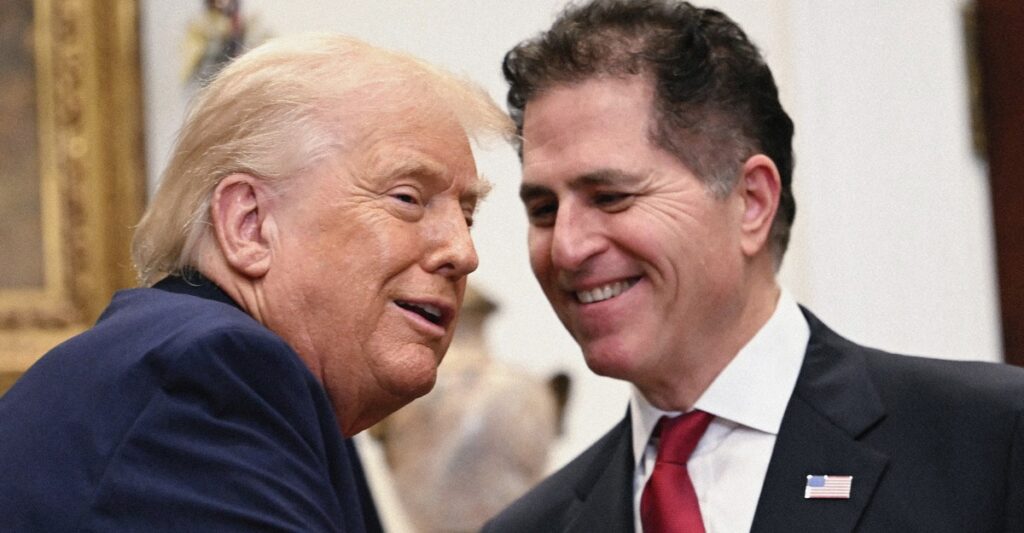
When Michael and Susan Dell announced last week that they would be donating $6.25 billion to put $250 per account into government-run savings accounts for millions of American children, it brought new attention to an initiative that was otherwise buried in the tax bill Republicans passed earlier this year: the Trump Account.
Trump Accounts—yes, that is the official name—function basically as individual retirement accounts for kids. Any parent or guardian can open one up for a child starting in 2026, and family, friends, and employers can contribute $5,000 total each year. These accounts will then be invested in index funds, and withdrawals are largely prohibited until the child turns 18. All American children born from January 1, 2025, to December 31, 2028, will be entitled to a onetime $1,000 contribution from the government. The Dells’ gift is meant to ensure that another 25 million American children who are 10 and under and in the poorest 75 percent of zip codes will get another $250 each.
President Donald Trump and his supporters are billing Trump Accounts as a vehicle to set the next generation “on a course for prosperity” and transform the lives of low-income and working-class people. In reality, the program is an interesting yet modest experiment in giving American children a stake in the stock market. Trump Accounts, in other words, are perfectly Trumpian down to the name, in that they deliver a lot of sizzle but not much steak.
The White House’s press release about the Dell gift hails these accounts as an initiative “to give every newborn child a head start toward lifelong financial security and the American Dream.” In a press conference last week with the Dells and Trump, Texas Senator Ted Cruz painted a glowing picture of how these accounts could help a little girl born next year to “a single mom waiting tables,” suggesting that by the time she is 18, she could have $170,000 in her account. By 35, if she keeps saving, she could have $700,000.
[Will Gottsegen: Trump campaigned on affordability. Now he’s calling the idea a ‘con job.’]
If Trump Accounts meant that the children of waitresses across America would be sitting on $200,000 by the time they turn 21, they would be a remarkable innovation in the history of U.S. capitalism. The problem is that Cruz’s claims are based on the unrealistic assumption that his hypothetical single-mom waitress will be able to contribute the maximum $5,000 a year in after-tax dollars to her daughter’s account—something few single-mom waitresses (or Americans, for that matter) can manage to do. Yes, setting aside a sizable chunk of money in an investment account for your kid every year will likely pay off by the time your child is 18. But this has little to do with the account, and almost everything to do with your contributions.
Trump hails these accounts as a way to “help millions of Americans harness the strength of our economy to lift up the next generation.” In reality, the impact of these accounts on the lives of most American kids will likely be trivial. There’s nothing wrong with the idea of Trump Accounts, which is presumably why Dell has admirably decided to contribute billions to expand them. But the way they’re being sold will end up leaving people disappointed.
The concept of giving all American kids an endowment is not new. It dates back to at least Thomas Paine, who in 1797 wrote a pamphlet proposing that every citizen be given 15 pounds upon turning 21. But the idea has gained steam over the past 30 years, thanks to anxiety over the future of Social Security, concern about the growing wealth gap in the United States, and a sense that too many Americans are being left on the sidelines of a booming stock market.
In the 1999 book The Stakeholder Society, Bruce Ackerman and Anne Alstott proposed that all kids who graduate high school and have no criminal record be given $80,000 upon entering college or reaching the age of 21, to be paid for with a 2 percent wealth tax. A couple of years later, the left-wing economics commentator Robert Kuttner suggested that the government fund a $5,000 endowment for every kid at birth, add $1,000 every year for low-income kids, and make contributions up to $1,000 a year tax-deductible for middle-class families. In 2018, Senator Cory Booker proposed something he called Baby Bonds, which, like Trump Accounts, would have seeded savings accounts for every American child with $1,000 at birth, then added up to $2,000 a year for low-income kids.
[Annie Lowrey: A cheap, race-neutral way to close the racial wealth gap]
The fact that people like Trump and Cruz have embraced a concept long associated with liberal wonks is interesting. The essential difference is that proposals like Ackerman’s, Kuttner’s, and Booker’s were relatively ambitious, with a far bigger commitment of public funds. Trump Accounts, by contrast, don’t really add up to much.
For starters, these accounts are not established automatically—parents or guardians will have to figure out how to opt in, which means that millions of children will likely be left out. The $1,000 for a child born in Trump’s second term is real money, but the government’s generosity ends there, and there are few incentives to make this a robust savings vehicle. For example, contributions to these accounts by individuals aren’t tax-deductible. And when beneficiaries turn 18 and can finally access the funds, withdrawals will be taxed as regular income.
This makes Trump Accounts less attractive, in many ways, than 529 accounts, which encourage saving for a child’s education. Withdrawals from 529s to pay for educational expenses are tax-free, and in some states, contributions can be deducted from state income taxes. This isn’t to say that it’s a bad idea to open a Trump Account. Americans should certainly do it for any child born in the next three years, if only for the $1,000. But aside from that, its advantages are limited.
The principle that the government should give low- and middle-income people a way of benefiting from the enormous returns on capital that American businesses make is a good one. But a more serious initiative would have involved rolling government contributions for low-income children, and would have made contributions to the accounts of low- and middle-income kids tax-deductible. That might have helped kids who need a nest egg actually build one. But the president does not, in fact, seem all that interested in narrowing the wealth gap. For Trump, a product just needs to look the part for him to give it his name.
The post Trump Accounts: Don’t Believe the Hype appeared first on The Atlantic.