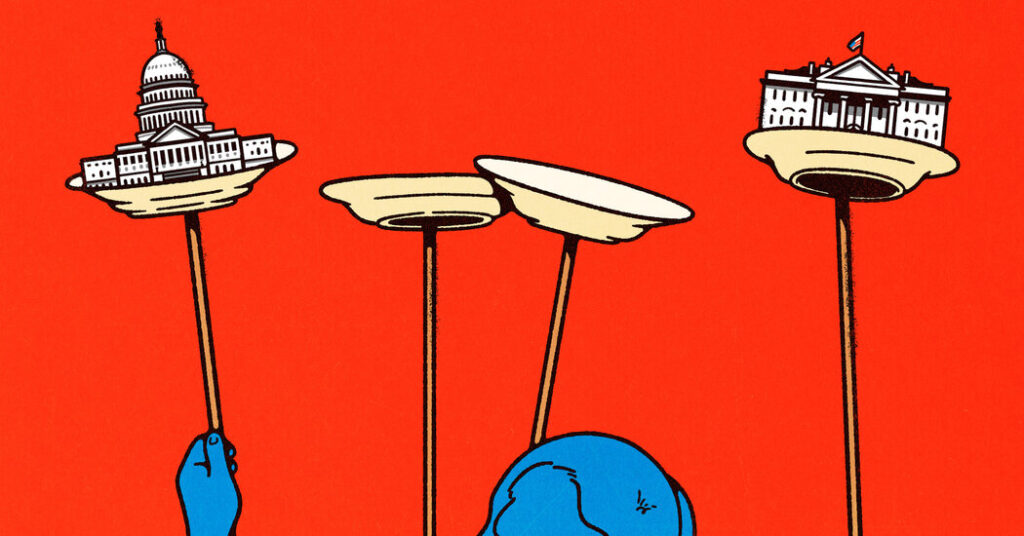
To the Editor:
Re “Actually, the Supreme Court Has a Plan,” by Sarah Isgur (Opinion guest essay, Dec. 8):
Ms. Isgur praises the Supreme Court’s efforts to curb the administrative state, suggesting that its conservative justices “have been trying to revive congressional power.” But the court’s record under Chief Justice John Roberts points in the opposite direction.
In case after case, the court’s conservatives have curtailed Congress’s ability to legislate when doing so conflicts with conservative preferences. It has gutted federal campaign finance laws and the Voting Rights Act, blocked Congress from enforcing federal rights through private lawsuits and stymied Congress from investigating President Trump.
It has also made it more difficult for Congress to legislate in key areas, weaponizing the First and Second Amendments in ways that sharply restrict the legislative bailiwick to respond to contemporary crises of economic inequality and gun violence.
Defenders of the court cast its assault on the administrative state as a return to constitutional first principles. In reality, it reflects a modern project to weaken government’s capacity to meet the complex demands of today’s society — an agenda grounded less in constitutional fidelity than in libertarian ideology.
Undermining the state, whether by diminishing Congress or disabling the administrative agencies it relies upon, serves that cause.
Duncan Hosie Palo Alto, Calif. The writer is a constitutional scholar at Stanford Law School.
To the Editor:
Sarah Isgur brilliantly explains how the growth of independent federal agencies over the past century undermines our constitutional democracy by obscuring political accountability, and why the Supreme Court would be justified in reining in such power during its current term.
But her hope that Congress will begin playing a more mature and nonpartisan role in oversight of executive branch agencies — rather than simply granting ever more powers to the president — is not likely to occur. Fortunately, it is not necessary in order for Congress to begin reasserting its authority over independent agencies.
Partisan loyalty — rather than institutional abdication — is what most afflicts Congress. If the Supreme Court allows for greater oversight of administrative agencies, we are likely to see Congress assume a more active role, albeit mostly during periods of divided government.
While that might be an imperfect and unsteady outcome, it would boost the separation of powers, and add electoral accountability back into the mix.
Stuart Gottlieb New York The writer, a former Senate policy adviser and speechwriter, teaches public policy at Columbia University.
To the Editor:
Unitary executive theory is a creation of the Republican Party, now being reinforced by this Supreme Court, and it is a blueprint for a monarchy.
Yes, the executive powers reside with the president. But according to the Constitution the power of the purse, the power to make laws and even the power to declare war are vested in Congress alone.
It is a function of the executive branch to see that the laws — made by Congress — are faithfully executed. Congress can make a law that creates a commission and stipulate that it be bipartisan. The president cannot change that stipulation, nor can the Supreme Court. He can, and must, go to Congress if he wants the stipulation changed.
Yes, the president was elected — along with his agenda — but so were the members of Congress.
Dorothy Brooks Punta Gorda, Fla.
Imperiled by Kennedy
To the Editor:
Re “Kennedy Is Upending Science-Based Policies on Vaccinating the U.S.: Methodical Quest to Sideline Scientists and Lift Allies” (front page, Dec. 6):
Health Secretary Robert F. Kennedy Jr.’s attack on science and medicine is yet another example of the perils our nation faces under Donald Trump’s presidency. What makes this more unforgivable is that Mr. Kennedy’s blatant ignorance and blitzkrieg on scientific evidence are now putting our children’s lives in danger.
Your article demonstrates what’s at risk. In a nation where the world’s most pre-eminent minds gather to produce cutting-edge scientific discoveries, it seems inconceivable that one unscrupulous man can undo decades of medical progress.
Far from hyperbole, Mr. Kennedy’s systematic campaign to wage war on science and health makes him the most dangerous secretary of health and human services in our nation’s history.
Amy M. Ferguson Dunmore, Pa.
The post The Supreme Court and Executive Power appeared first on New York Times.