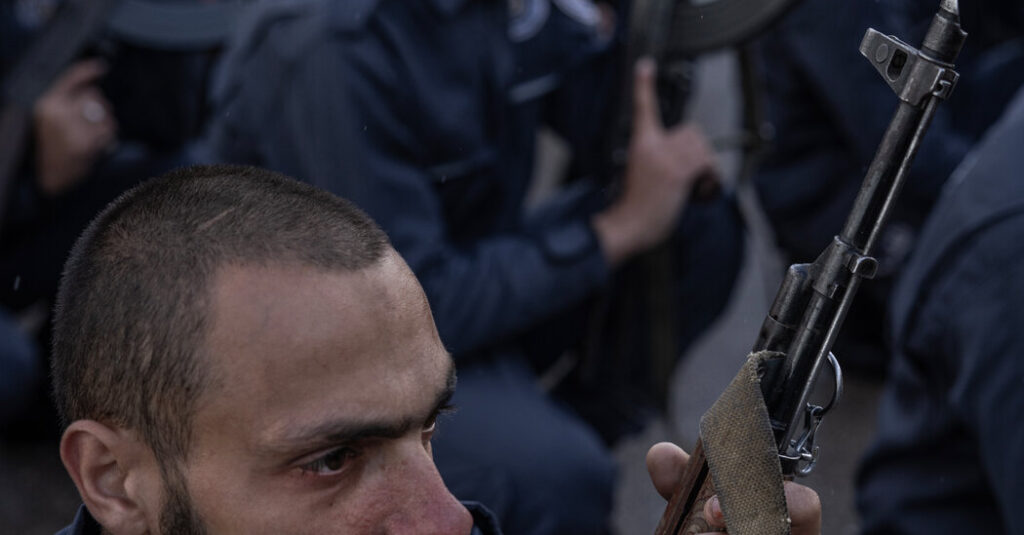
When rebels in Syria came to power a year ago, one of their first acts was to dismiss all of the country’s military forces, which had been used as tools of repression and brutality for five decades under the rule of Bashar al-Assad and his family.
Now, one of the biggest challenges facing the nascent government is rebuilding those forces, an effort that will be critical in uniting this still-fractured country.
But to do so, Syria’s new leaders are following a playbook that is similar to the one they used to set up their government, in which President Ahmed al-Sharaa has relied on a tightknit circle of loyalists.
The military’s new command structure favors former fighters from Mr. al-Sharaa’s former rebel group — even over those who may have more expertise, according to many soldiers, commanders and analysts. And religious minorities have not yet been included in the military, although Syria is a religiously and ethnically diverse country that has already witnessed waves of sectarian violence.
The Syrian Defense Ministry is instituting some of the same training methods, including religious instruction, that Mr. al-Sharaa’s former rebel group used to become the most powerful of all the factions that fought the Assad regime during Syria’s civil war.
The New York Times interviewed nearly two dozen soldiers, commanders and new recruits in Syria who discussed the military training and shared their concerns. Nearly all spoke on the condition of anonymity because the Defense Ministry bars soldiers from speaking to the media.
Several soldiers and commanders, as well as analysts, said that some of the government’s rules had nothing to do with military preparedness.
The new leadership was fastidious about certain points, like banning smoking for on-duty soldiers. But on other aspects, soldiers said, the training felt disconnected from the needs of a modern military force.
Last spring, when a 30-year-old former rebel arrived for military training in Syria’s northern province of Aleppo, instructors informed roughly 1,400 new recruits that smoking was not permitted. The former rebel said one of the instructors searched him and confiscated several cigarette packs hidden in his jacket.
The ban pushed dozens of recruits to quit immediately, and many more were kicked out for ignoring it, according to the former rebel, a slender man who chain-smoked as he spoke in Marea, a town in Aleppo Province. After three weeks, only 600 recruits had made it through the training, he said.
He stuck with it.
He said he was taken aback by other aspects of the training. The first week was devoted entirely to Islamic instruction, including a two-and-a-half-hour lecture on the birth of the Prophet Muhammad, he said.
Soldiers and commanders said the religious training reflected the conservative Sunni Muslim ideology that by Mr. al-Sharaa’s former rebel group, Hayat Tahrir al-Sham, or H.T.S., espoused when it was in power in Idlib, a province in northwestern Syria. That raises questions about whether religious and ethnic minorities will be welcome in such a military, and how representative of Syria’s diversity it will be.
A Syrian defense official, who spoke on the condition of anonymity because he was not authorized to speak publicly, said the government had not decided whether minorities would be allowed to enlist. Excluding them risks amplifying Syria’s sectarian tensions, which have already erupted in several waves of deadly violence over the past year.
Instead of turning to those with the most expertise, including thousands of officers who defected under the Assad regime, Syria’s leaders are relying on a small circle of trusted comrades from H.T.S. to lead and shape the new military, several soldiers, commanders and recruits said.
The Syrian Defense Ministry did not respond to a detailed list of questions or repeated requests for comment.
After abolishing conscription, much hated under the Assad regime, the new military recruited volunteers and set qualifications like a ninth-grade education, physical fitness and the ability to read.
But soldiers who had fought with the rebels in the civil war were grandfathered into the ranks, even if they did not fulfill all the criteria, according to several soldiers and commanders.
“They are bringing in a commander of Hayat Tahrir al-Sham who doesn’t even have a ninth-grade education and are putting him in charge of a battalion,” said Issam al-Reis, a senior military adviser with Etana, a Syrian research group, who has spoken to many former rebels currently serving in the military. “And his only qualification is that he was loyal to Ahmed al-Sharaa.”
Mr. al-Reis said such appointees lacked formal military education and discipline.
Former H.T.S. rebels, like fighters from many other rebel factions, have years of guerrilla-fighting experience from the war to oust the Assad dictatorship. But most have not served as officers in a formal military with different branches such as the navy, air force and infantry and with rigid command structures, knowledge that is considered beneficial when rebuilding an army.
“The strength of an army is in its discipline,” he added. “Memorizing Quran isn’t going to help you. You need to be able to fight.”
Most soldiers and commanders now start with three weeks of basic training — except those who previously fought alongside Mr. al-Sharaa’s rebel group. That training provides nearly no military skills, Mr. al-Reis said.
Instead, he said, “they are trying to teach them their way of thinking.”
The government has signed an initial agreement with Turkey to train and develop the military, said Qutaiba Idlbi, director of American affairs at the Syrian Foreign Ministry. But the agreement does not include deliveries of weapons or military equipment, he said, because of American sanctions remaining on Syria.
Already, the military’s lack of control over its forces and low discipline among soldiers have contributed to outbreaks of sectarian violence, undermining the government’s relations with minority groups. Human rights groups say forces affiliated with or supporting the government have been involved in some of the killings.
Col. Ali Abdul Baqi, staff commander of the 70th Battalion in Damascus, is among the few high-level commanders who was not a member of H.T.S. Speaking from his office in Damascus, Colonel Abdul Baqi said that had he been in Mr. al-Sharaa’s place, he would have built the new military in the same way.
“They aren’t going to take a risk on people they don’t know,” said the colonel, who commanded another rebel group during the civil war.
One officer who defected from Mr. Assad’s air force and has now joined the new army said the key criterion for promotion was loyalty. As a result, those close to Mr. al-Sharaa and his former rebel group often outrank experienced former military officers, the officer said.
Many of those who led Syria’s new air force battalion did not understand the hierarchy of military ranks, he said. A more qualified commander was appointed after he and other officers complained, but that happened only because of the specialized nature of the air force, he added.
Some senior commanders said the religious instruction was an attempt to build cohesion through shared faith, not a way of forcing a specific ideology on new recruits.
Syria is predominantly Sunni Muslim, as are the rebels who ousted the Assad regime. The Assad family belongs to the Alawite religious minority, which practices an offshoot of Shiite Islam and previously dominated the military’s highest ranks.
Two other commanders warned that allowing minorities, especially Alawites and Shiites, into the military after a brutal civil war with sectarian overtones would be like lighting a powder keg.
A few others countered that creating an army that reflected Syria’s diversity would build trust among minority communities and help prevent sectarian violence.
Putting those loyal to Mr. al-Sharaa in command also makes it challenging to integrate the Kurdish-led Syrian Democratic Forces, which control much of Syria’s northeast and have a strong internal hierarchy. The group, which is backed by the United States, has been in negotiations for months with the government over integrating the military, with little progress.
Some soldiers also warned that their training lacked any focus on the laws of war, beyond telling recruits to avoid conflating all minority groups with the crimes of a few individuals.
“In our army, there should be a division focused on political awareness and preventing crimes against humanity and war crimes,” said Omar al-Khateeb, a law graduate, former rebel and current military commander in Aleppo Province. “This is more important than training us in religious doctrine we already know.”
Muhammad Haj Kadour contributed reporting.
Raja Abdulrahim reports on the Middle East and is based in Jerusalem.
The post Syria, Rebuilding its Military, Relies on Loyalists and Religious Teaching appeared first on New York Times.