When she was 12 years old, Sarvy van Maris fled revolution in Iran for the safety of Canada. When, as an adult, she learned that fellow Iranians were in peril, she sought them out to help.
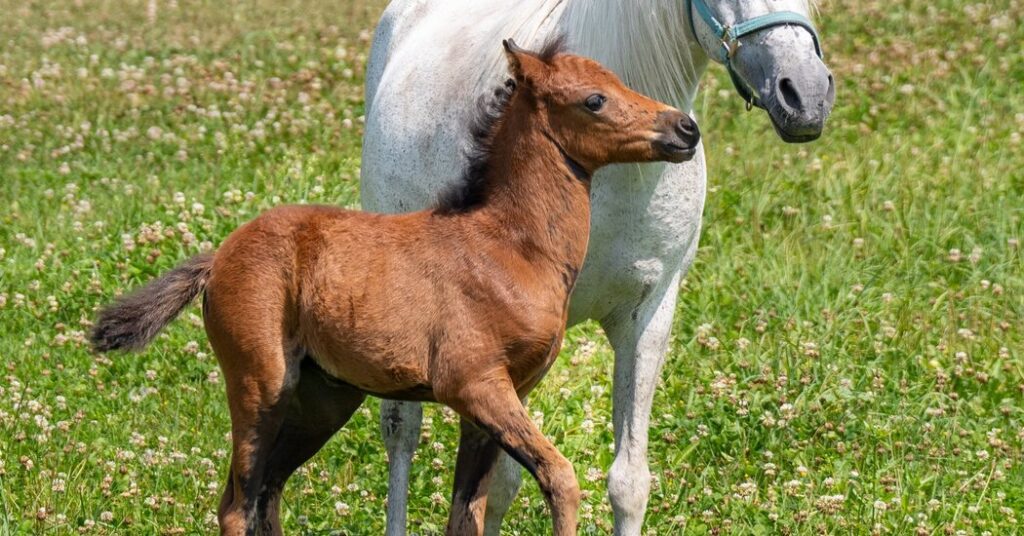
Today, van Maris has made it her mission to save those compatriots, who are not humans but critically endangered Caspian horses, an ancient Iranian breed of which there are just an estimated 1,500 on earth. Thirteen of the diminutive equines are on her farm in Rockwood, Ontario.
“Being the new kid in school, my English wasn’t good, I was always made fun of; I was always the underdog, and I feel maybe these little horses are somewhat of the underdog,” van Maris, secretary of the Caspian Horse Society of the Americas, a preservationist group, said. “I feel a tie to them as something that should be saved — they are the national treasure of Iran.”
There are a handful of breeds — like the chunky American Cream Draft and the Choctaw horse — whose ranks have dwindled to just a few thousand. According to Livestock Conservancy, a preservationist group, about two dozen breeds are considered critically endangered (a term various groups define differently). Several others are close.
Some are already extinct, like the Narragansett Pacer. Once owned by George Washington, that breed disappeared by the late 19th century.
Today, a small number of breeders are battling against extinction, researching breeding and pouring resources into championing their esoteric breeds. The Kentucky Horse Park, an equine education center in Lexington, showcases 18 rare horses in its Breeds Barn. Visitors are often surprised learning that some breeds are threatened, said Mindy Welch of the horse park. “You lose them, you lose history,” she said.
Some breeders, like van Maris, are drawn by personal connections, others by a family legacy and others because they could not sit by and watch a horse vanish.
“As a child I wanted to be Jane Goodall,” said Victoria Tollman, the executive director of the Equus Survival Trust, a consortium of rare-horse preservationists, who was a breeder of rare Fell ponies, a type of equine once championed by Queen Elizabeth II.
When Tollman discovered the breed in the 1990s, she said estimates put them at about 2,500 worldwide; today, she said, those numbers have nearly tripled.
Unlike the dodo or the passenger pigeon, rare horses were not hunted into extinction. Often they are victims of obsolescence. Mechanization of farm work caused the number of plow horses, like the heavy-duty Suffolk Punch, to plummet, and the car took away the Hackney carriage horse’s job.
Scrupulous attention must be paid to bloodlines to avoid too much inbreeding, though with populations so small — like for example the wild Przewalski’s (pronounced che-VAL-ski’s) horse, which once dwindled to just a dozen animals and has since rebounded to the thousands because of zoo-led conservation efforts — it often cannot be avoided.
Competition horses are bred for desired traits like the ability to jump high or gallop fast. Tollman said that, for some rare horse breeders, when ensuring a species’ continued existence was the goal, “you have to breed everything, which sounds insane. But,” she explained, “you are doing your very best job at retaining the genes you can.”
The genes of the Mountain Pleasure Horse, a Kentucky breed with a distinctive gait with about 1,500 animals remaining, have been stewarded by seven generations of the Little family. Of the 60 head at their Rockin’ R Farm in Kentucky, more than three-quarters have bloodlines that trace back to the animals Robert Thomas Little cultivated in the 1800s, according to his great-great-great-granddaughter, Robin Little-Basil. “This is my family’s legacy,” she said.
Breeders like Little-Basil said they faced an uphill battle to not just produce healthy horses, but also promote interest to others to ensure their efforts last.
“Any time you are dealing with somebody with critically endangered horses, they have no doubt that this breed will probably go extinct,” she said. “I can just say — it will not go extinct in my lifetime.”
Sarah Maslin Nir is a Times reporter covering anything and everything New York … and sometimes beyond.
The post Some Horse Breeds Are Near Extinction. These People Are Trying to Save Them. appeared first on New York Times.