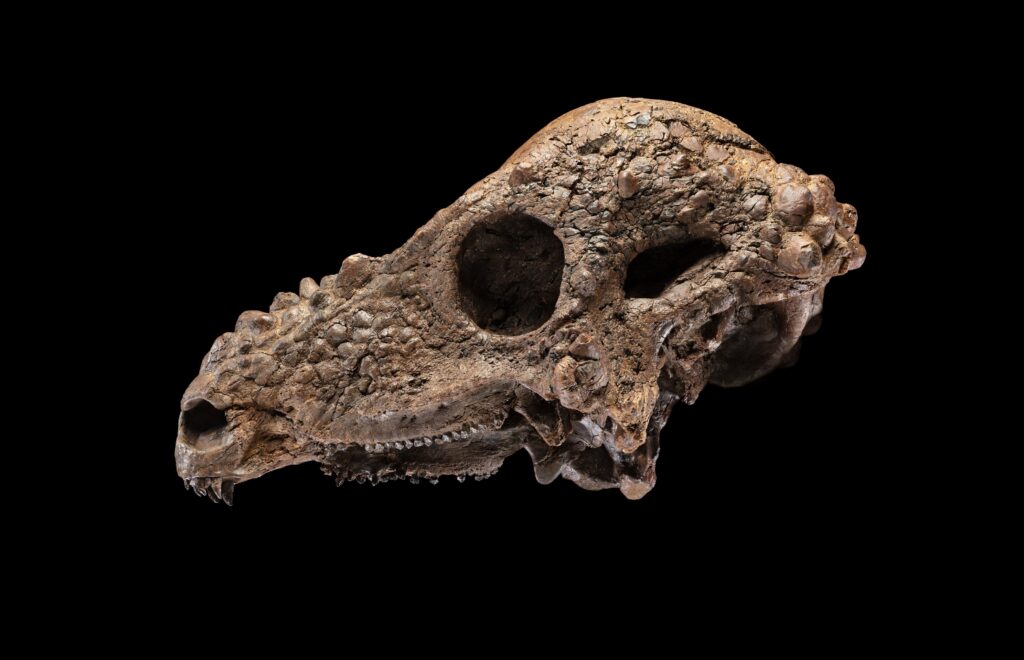
Matthew Carrano gently ran his finger along the toothy upper jaw of the Smithsonian Institution’s newest arrival, which was still sitting in its padded shipping crate.
The dinosaur curator looked down in awe at the hulking 67-million-year-old fossil with jumbo eye sockets and knobby protrusions that he hopes will change humanity’s understanding of a baffling, lost creature.
Over the summer, scientists at the National Museum of Natural History acquired the rare and remarkably preserved Pachycephalosaurus skull. On Thursday, researchers announced they are getting ready for the public to view it, at least for a few days.
Pachycephalosaurus means “thickheaded lizard,” which is something of an understatement. Researchers speak lovingly of the bowling ball-esque dome topping its head, and hope to help figure out how that bit of anatomy relates to its behavior. Was that thick head for ramming and settling rivalries? Or was it a tool for gentler knock-arounds?
“They’re really weird, odd, wonderful, mysterious animals,” said Kirk Johnson, a paleontologist and the museum’s director.
The skull will be on display at the museum for one week, starting Dec. 22, before researchers remove it to put it through a battery of intricate and high-tech tests to learn more about the dinosaur’s story, habits and biology. After scientists tease out all the secrets they can, which they expect will take at least a year or two, the skull will join skeletons belonging to the T. rex and other contemporaries in the museum’s Hall of Fossils, ready for millions of yearly visitors. They also plan to post a downloadable 3D model of the skull in the Smithsonian’s digital collection, so someone with a 3D printer can churn out their own plastic copy.
A private dinosaur hunter discovered the skull in South Dakota and it was excavated last year.
For paleontologists, the “dream is to walk along the Badlands and see a skull staring out of the ground at you. And it hardly ever happens,” Johnson said. “It happened this time.” An eye socket was sticking out of the ground.
Johnson saw a couple snapshots after bumping into the dinosaur hunter at a gem and fossil show in February and he recalled thinking, “Oh my goodness!” There was no doubt. Usually fossilized Pachycephalosaurus heads become so heavy over eons that they act as their own wrecking balls, helping to destroy other intriguing but more fragile bits of the animals’ faces and physical history, Johnson said. This one had a few imperfections but was still so pristine Johnson knew he needed it for the museum.
Philanthropist Wendy Schmidt and her husband, Eric Schmidt, the former Google CEO, purchased it this summer at a Sotheby’s auction, then donated it to the Smithsonian.
Opening the box when it arrived in Washington in September, and again in one of the vast museum complex’s behind-the-scenes workspaces this week, Carrano spoke with reverence about everything the new scientific specimen will make possible, about what is known and unknown about it and its world, and about the joys and tinges of wistfulness that come from probing and trying to reanimate things that have been long gone.
“This animal has eyes that blink and makes snarfling noises with its nose,” Carrano said. It pokes around for food.
Before him was the remnant of something real, not quite an old friend but certainly no stranger either.
He felt his way along the Pachycephalosaurus’s two rows of top teeth — dozens in all — including a sharp, delicate one that was just emerging when the creature’s life ended. From evidence of wear, they hope to learn about how it chewed and how tough the materials were in its diet.
Carrano also pointed to tiny pinholes in the bone just above the teeth, where blood vessels would have emerged.
“That gives us an idea of the softer material that’s now rotted away. In this case, probably skin, but not a muscle, would have come from this spot down,” Carrano said.
The skull is largely complete, with some missing areas restored before the Smithsonian received it.
Beyond the snout and further back is a delicate neck bone Carrano believes was once attached to the herbivore’s tongue. He’s not aware of that particular bone being found on any other Pachycephalosaurus fossils.
Using techniques developed in recently published research on other dinosaurs, he hopes to use that bone to figure out exactly how many years he or she roamed the Earth. (Carrano doesn’t think they’ll be able to determine a sex.)
Deep under its thick noggin would have been a brain, development-wise, “somewhere between an alligator and an emu,” Carrano said. That would have bestowed it with some personality — not something on a parrot’s level, but still something to work with, he said.
Among his paleontological pet peeves is the notion, which took hold about a century ago, that dinosaurs are dumb. That idea grew from the vast discrepancy, in the most extreme cases, between the size of their bodies and brains. But dinosaur brains are not that different, in terms of their anatomy, from a lot of modern animals, he said.
“They’re certainly no dumber than an alligator. And some of them were quite a bit smarter,” Carrano said, such as a Velociraptor.
There’s no evidence suggesting the Pachycephalosaurus’s hefty skull “is protecting some bit of genius,” he said, though “it’s a total mystery.”
The post Smithsonian to display a rare dinosaur skull that was a ‘dream’ discovery appeared first on Washington Post.