The confluence of two seemingly unrelated news events in recent days — the first one roiling Hollywood and media from coast to coast, the other playing out before the Supreme Court — was nothing short of uncanny.
And disturbing.
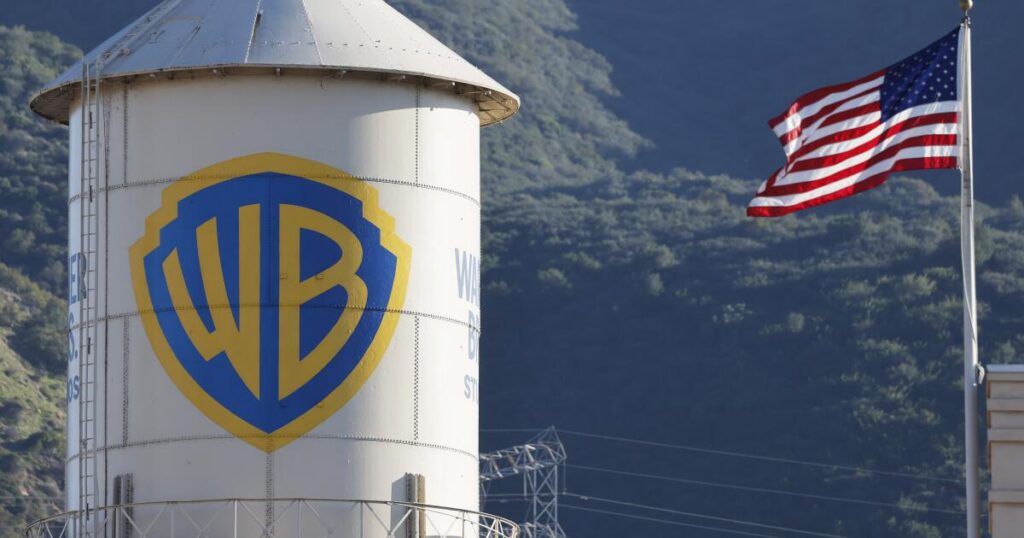
The first news was the one-two punch of Friday’s bombshell that Netflix planned to swallow up Warner Bros. Discovery’s studio and streaming business to create an entertainment industry behemoth, and then Monday’s competing hostile bid from jilted suitor Paramount Skydance for all of Warner. And in between, on Sunday, President Trump — tuxedoed and speaking on a red carpet, appropriately enough — proclaimed matter-of-factly “I’ll be involved” in deciding the winner. (Just as he’d decided who won that night’s annual Kennedy Center Honors, after firing the center’s bipartisan board and making himself chairman and host.)
As if anyone doubted that Trump would be the de facto decider here. Certainly Netflix co-Chief Executive Ted Sarandos and Paramount CEO David Ellison didn’t doubt. The warring rivals each have been courting Trump’s favor, just as he likes — and as other corporate chieftains have learned to do in the suck-up, pay-to-play world Trump has built from his gilded White House. Ellison even sat in the Kennedy Center’s presidential box with Trump, hours before announcing Paramount’s flex (with Trump son-in-law Jared Kushner as an investor), and Trump confirmed from the red carpet that he and Sarandos recently met in the White House as Sarandos weighed Netflix’s surprise bid.
Playing with the supposed titans like a cat with mice, Trump coupled praise of Sarandos with concern about Netflix’s already huge market share, and tempered his Sunday coziness with Ellison by lambasting Ellison’s Paramount in an unhinged social media post on Monday because one of its properties, CBS, put Trump disciple-turned-detractor Rep. Marjorie Taylor Greene of Georgia on “60 Minutes.” (Separately, Ellison reportedly assured Trump that should Paramount win, it would make changes at CNN, a Warner property that’s a frequent Trump punching bag.)
“None of them are particularly great friends of mine,” Trump teased to reporters on Monday. As if that should matter.
The president likes to keep people guessing, keep ’em courting. He also likes to build a little reality show suspense: Everyone is competing to be his apprentice.
“In Warner Fight, a Hollywood Plot That Makes Trump the Star” was the headline in the Wall Street Journal on Tuesday.
Such overt displays of presidential power-grabbing and corporate supplication would have been mini-scandals, at the least, in past times. Presidents of both parties knew that, by law and tradition, judgments about such mega-mergers should be left to the antitrust lawyers, economists and regulators within the Justice Department and at the appropriate independent federal agency. That was precisely to shield against politics and presidential whims polluting the process of making complex, consequential, market-moving decisions.
Yet even as Trump was busting more norms in the war over Warners, in the other news of past days, the right-wing supermajority on the Supreme Court signaled loud and clear that it’s about to further empower presidents to interfere politically in American enterprises, and to undermine Congress and the rest of government.
The conservative justices’ comments came in oral arguments on Monday in a case challenging Trump’s firing of a Democratic appointee on the Federal Trade Commission — one of many such illegal firings since he retook power — for violating the statutory independence of federal agencies. The justices took Trump’s side. Their hostility to regulatory agencies, and their zeal to strike down the unanimous 90-year-old court precedent that protects the agencies’ independence, has been well known.
For years it’s been a fever dream on the right to neuter the so-called administrative state (the deep state, in MAGA-speak). In fact, during Trump’s first term, what recommended Brett M. Kavanaugh, Neil M. Gorsuch and Amy Coney Barrett to White House vetters (and the Senate’s Republican majority) was less their antiabortion cred than their proven animus toward the administrative state and the 1935 ruling, Humphrey’s Executor, that gave rise to it.
The conservatives’ support for allowing presidents to fire independent government officials without cause could affect not only what TV shows and films Americans see, but also the safety of the food, water and medicines they consume, the financial products they buy, the news they get and much more.
The court would essentially bless what Trump is already doing: picking winners and losers in business, science, media and other private sectors — exactly what Republicans have long railed against. Until now.
What an unfortunate coincidence of history that we’re saddled with a Supreme Court dedicated to expanding presidential power at a time when we have a president who fancies himself an all-powerful king (and a Republican-controlled Congress that also won’t check him).
The Warner fight, and the spectacle of Trump openly taking ownership of the outcome, is a preview of the government to come, assuming the court rules as expected by summer. All but gone will be the system built over a century, in which Congress created independent, bipartisan and expert agencies to fill in complex details for the bills legislators passed and to see to it that those laws were followed. Agency administrators by law include both Democrats and Republicans serving fixed terms, to insulate against one-sided politics.
“Having a president come in and fire all the scientists and the doctors and the economists and the PhDs, and replacing them with loyalists and people who don’t know anything, is actually not in the best interest of the citizens of the United States,” liberal Justice Sonia Sotomayor said during Monday’s arguments.
An independent, bipartisan Congress could try to take back its powers, including by new laws. But we don’t have that. What we have is a clownish president with too much power, who wears a hat emblazoned “Trump was right about everything” and actually believes it. And that guy gets even more power? If only it were just a bad movie.
Bluesky: @jackiecalmes Threads: @jkcalmes X: @jackiekcalmes
The post Signs of the regulatory apocalypse appeared first on Los Angeles Times.